Lesson 08 — Building a Movement Plan That Lasts
Learners turn the training principles into a personal, sustainable movement plan — built on what they enjoy, starting small, resting, and checking in — so it lasts rather than being abandoned. The plan is theirs, fits their body and life, and is held as a tool of joy and care.
Objectives
Objectives
- D03.S2.10.01 Apply principles of training, such as progressive effort and recovery, to build a safe and sustainable movement plan.
Essential question
How do I turn the principles of training into a movement plan I can actually keep — safely and joyfully?
Key vocabulary
Materials
Standard materials
- Movement plan template · 1 per learner A one-page plan — goal, chosen activities, weekly rhythm, small first steps, rest days, and a way to check in
- Writing journal · 1 per learner
Low-tech / no-cost
- Paper plan drawn by hand, or a plan spoken and remembered No printing needed — the plan lives in words or on a single page
- Body and space Try one planned activity in place to check it fits the body and the setting
Enriched / lab & device
- Digital planner or spreadsheet · 1 per learner A simple weekly grid to track the plan over a few weeks
- Community resource list (optional) · 1 per class Free or low-cost local places to move — parks, trails, community centers, groups
Works in different contexts
- large-group Model one complete plan, then learners build their own; peer-review in pairs
- multi-age Younger learners plan one activity and one rest; older learners build a full weekly plan with a check-in
- self-directed A learner builds the full plan alone and writes one paragraph on why it will last
- level-grouped Learners ready to extend add a progress check-in and a plan for adapting when life interrupts
- outdoor-only Build the plan around what the outdoors offers — walking, cycling, carrying, gardening, games
Lesson 8 — Building a Movement Plan That Lasts
Summary
Learners turn the training principles into a personal, sustainable movement plan — built on what they enjoy, starting small, resting, and checking in — so it lasts rather than being abandoned. The plan is theirs, fits their body and their life, and is held as a tool of joy and care, never punishment.
Objectives
- Apply principles of training, such as progressive effort and recovery, to build a safe and sustainable movement plan. (D03.S2.10.01)
Connection
Most plans fail not because people are lazy but because the plan was never built to fit a real life. A plan that fits you is one you can actually keep — it uses what you already enjoy, starts small enough to survive a busy week, rests without guilt, and can bend when life bends. Think of it like planting: you do not plant a seed and pull it up to check; you plant it, water it a little, and let it grow at its own pace. A movement plan that lasts is planted the same way — chosen for your soil, your season, your light.
Materials
- Movement plan template (goal, activities, rhythm, first steps, rest, check-in)
- Writing journal
Preparation
- Copy or draw the movement plan template.
- Retrieval: from Lesson 7, recall the two principles — progressive effort (small increases) and recovery (rest is half of progress). Today we build them into a plan that will last.
- Prepare one complete worked example of a plan so learners can see the skill modeled.
Facilitator note
This lesson is written to the learner (“you”). The idea to land: a movement plan that lasts is built on enjoyment, small starts, rest, and honest check-ins — and it belongs to the learner. The plan operationalizes the training principles from Lesson 7 (progressive effort and recovery) and the balanced-routine picture from Lesson 3 (aerobic plus muscle-strengthening; S-341). It is also framed by the UNESCO charter’s commitment that movement is a fundamental right for all, inclusive of every ability (S-342): the plan is not a ladder for the already-fit but a welcome for every body, in adapted, seated, or everyday forms.
Model once, then let learners build (S-011). The ethics lens: a plan is a tool of care, never a contract to punish oneself for missing; missing a day is information, not failure. The egalitarian lens: plans must fit real constraints — money, time, safe space, ability, family duties — so the lesson insists on sustainability over heroics, and treats free, everyday movement (walking, carrying, gardening, play, chores, dance) as every bit as valid as a gym. The global lens: movement traditions and settings differ everywhere — a plan might center a dance, a walk to a field, a swim, a game, or a seated practice; no one form is “the” way. The critical-thinking lens: a plan that asks for too much too soon is a plan designed to fail; learners are taught to design against their own enthusiasm. The social-emotional lens: enjoyment is the glue — the plan that feels good is the one that survives; invite learners to choose what they love. The technology & environment lens: the environment shapes the plan (safe paths, green space, weather), and Lesson 9 will ask how apps and trackers fit — for now, the plan stands on its own. Preview: this plan returns as a portfolio artifact and in the unit’s final reflection.
Procedure
- Recall (5 min). From Lesson 7, name the two principles: progressive effort and recovery. Ask: how do I turn these into something I will actually keep doing?
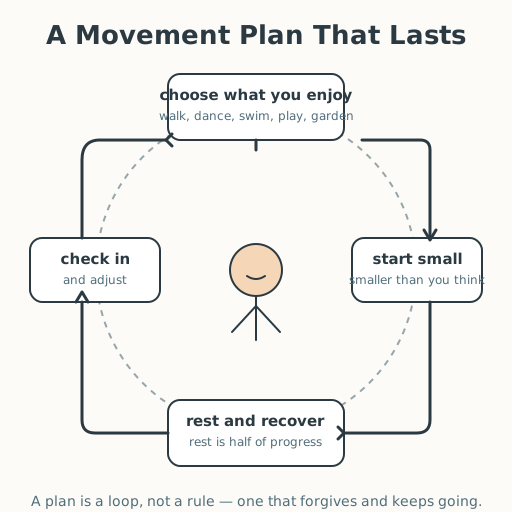
- Meet the cycle (10 min). Look at the plan cycle: choose what you enjoy → start small → rest and recover → check in and adjust → repeat. Watch a worked example: goal “more energy and steadier mood”; activity “brisk walking and dancing at home”; start “15 minutes, three times a week”; rest “two full rest days”; check-in “every Sunday, adjust by one small step.”
- Choose what you enjoy (8 min). List two or three ways of moving you genuinely like — or used to like. Include everyday movement: walking, cycling, swimming, dancing, gardening, carrying, a game, a seated or adapted practice. Pick one to build around.
- Build your plan (15 min). Fill the template. Write your goal (energy? mood? strength? joy?), your chosen activity, your small first step (a realistic amount for one week), your rest days, and one check-in moment when you will look back and adjust. Keep the first step smaller than you think you can do — the plan is built to survive.
- Test it in place (5 min). Do a tiny version of your chosen activity right now — two minutes of it — to check it fits your body and your setting. Adjust anything that does not.
- Peer-check (optional, 5 min). If you have a partner, swap plans and ask: is the first step small enough to survive a hard week? Is there a real rest day? Does it feel like joy, not duty? Offer one kind suggestion each.
- Close (4 min). Remember: a plan that lasts is a plan that forgives. Start small, rest well, check in, and let it grow.
Differentiation
- Support: Offer a three-line plan (activity, first step, one rest day) with a worked example to copy and adjust.
- Extension: Add a written plan for when life interrupts — what you will do when a week falls apart, and how you will return without guilt.
Assessment
- Formative (self): Can the learner produce a plan with a goal, a chosen activity, a realistic first step, a rest day, and a check-in — and explain why it will last?
- Portfolio artifact (summative for the unit): The completed movement plan, added to the unit portfolio as the “building a movement plan that lasts” artifact.
Home connection
Share your plan with an adult or friend you trust and ask them to be your “check-in person” — someone to notice, once a week, how it is going, without pressure.
Resources
- On balanced physical activity (aerobic + muscle-strengthening): WHO, “Physical activity” fact sheet, https://www.who.int/news-room/fact-sheets/detail/physical-activity (S-341).
- On physical activity and sport as a fundamental right for all, inclusive of every ability: UNESCO, International Charter of Physical Education, Physical Activity and Sport (2015), https://www.unesco.org/en/sport-and-anti-doping/international-charter-sport (S-342).
- On modeling + guided practice: Kirschner, Sweller & Clark (2006), https://doi.org/10.1207/s15326985ep4102_1 (S-011).