Lesson 01 — Communication, Remixed by Screens
Learners evaluate how digital communication reshapes the act of talking and listening: which cues it keeps, which it hides, and what it adds. They close by naming one thing gained and one thing to watch for in their own messages.
Objectives
Objectives
- D02.S1.10.01 Evaluate how technology and social media shape communication and use digital tools respectfully.
Essential question
How does technology and social media change the way we communicate — what is gained, and what is lost or reshaped?
Key vocabulary
Materials
Standard materials
- Face-to-face vs. screen two-column sheet · 1 per learner Two columns — "cues I can see/hear in person" vs. "cues the screen hides" — plus a third band for "what the screen adds"
- Writing journal · 1 per learner
Low-tech / no-cost
- Paper folded into three columns, or lines drawn in the ground Columns labeled "in person," "on a screen," and "what screens add"
- Voice and body Act out a sentence said three ways (warm, joking, angry) to feel how tone carries meaning the text drops
Enriched / lab & device
- A shared device with one messaging or social app open (optional) · 1 per group To examine a real message thread and notice which cues are present and absent
- Short clip on the online disinhibition effect (optional) · 1 per class An age-appropriate explainer on why people type things they would not say to a face
Works in different contexts
- large-group Model one worked example whole-class, then learners fill their own columns and share only in small circles of three to four
- multi-age Younger learners name one cue a screen hides and one thing it adds; older learners trace the full affordance/persistence/disinhibition picture
- self-directed A learner fills the columns alone and writes one paragraph on a message they sent that was misread, and why
- level-grouped Learners ready to extend connect reduced cues to the online disinhibition effect and preview the respect skills of Lesson 2
- outdoor-only Pass a message two ways — spoken face-to-face across a circle, then written and passed hand-to-hand — and notice what changes
Lesson 1 — Communication, Remixed by Screens
Summary
Learners evaluate how technology and social media change communication: which cues they keep, which they hide, and what they add. Using the reduced-cues picture of online communication (S-343), they distinguish what is gained — reach across distance, speed, a permanent record — from what is lost or reshaped — tone, face, body, and the instant chance to repair a misread. They close by naming one gain and one thing to watch for in their own messages.
Objectives
- Evaluate how technology and social media shape communication — beginning with how the medium changes the message itself. (D02.S1.10.01)
Connection
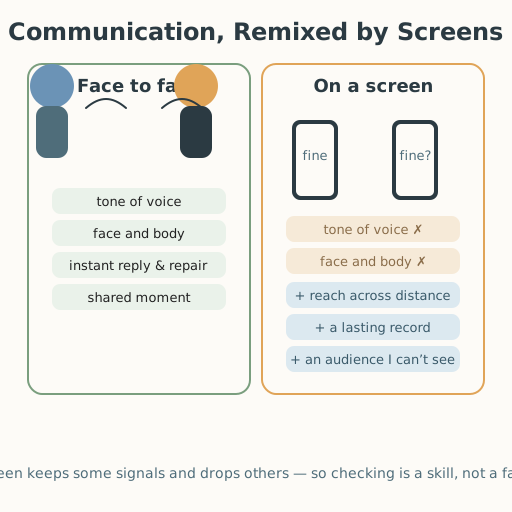
Say the sentence “I’ll be there soon” three ways: warm, joking, and angry. In person, the words carry the whole meaning — your face, your voice, your hands say as much as the sentence. Now type the same sentence into a message. The screen keeps only the words and strips the rest: the warmth, the joke, the edge all vanish, and the reader has to guess. Whether you live in a crowded city or a quiet village, and whether your screen is a phone in your pocket or a shared one at a shop, the same quiet trade happens every time you send a message: the screen remixes your communication, keeping some signals and dropping others. Learning to read that trade is a skill you will use for the rest of your life.
Materials
- Face-to-face vs. screen two-column sheet
- Writing journal
Preparation
- Copy or draw the two-column sheet (with a third band for “what screens add”).
- Retrieval: from Grade 9, recall that communication carries meaning through tone, body language, and context (D02.S1.09.01). Today we ask what happens when a screen strips some of those carriers away — and adds a few of its own.
- Prepare one worked example of a message that got misread because the tone was missing.
Facilitator note
This lesson is written to the learner (“you”). The idea to land: every medium shapes what a message can carry — screens keep words and speed but drop tone, face, and body, and add reach, permanence, and an invisible audience — so misreading is ordinary, not a personal failure, and checking is a skill. The reduced-cues account is well documented: online communication removes or delays the social cues that carry meaning (tone, facial expression, gesture, immediate reaction) and can loosen self-restraint — the “online disinhibition effect” (S-343). The gains are real too: messages cross distance instantly, persist for later, and reach audiences we choose or never see (S-481 documents what social media platforms are and how their feeds work). Present both sides as description, not as a verdict that “screens are bad” — the same affordances that connect also mislead.
Model the skill once, then let learners practice (worked example → guided practice → independent work; S-011). The technology lens is the spine: read the medium as a designed thing — persistence, public-by-default audiences, and disappearing stories are all choices someone built, and each shapes what we dare to say. The critical-thinking lens: ask which cues survive and which are dropped, and how does that change the meaning? The social-emotional lens: misreads and hurtful replies are real and common; invite, never force, and let learners share only what they choose. The ethics lens: a screen that hides the other person’s face can make cruelty feel costless — noticing that is the first guard against it. The egalitarian lens: access to these tools is not equal — cost, connectivity, disability, and language shape who can reach whom (S-281) — and the “norms” of one platform are not universal truths. The global lens: people everywhere weave screens into daily talk differently; no single way of being online is the right one. Preview: Lesson 2 turns from what screens change to how to use them respectfully.
Procedure
- Recall (5 min). Think back to Grade 9: how do you know what a friend really means? Not just their words — their tone, their face, their body, how fast they reply. Today we ask: what happens to all of that when the message travels through a screen?
- Meet the two sides (10 min). Look at the two-column sheet. Watch a worked example: a text that says “fine.” In person, “fine” plus a sigh plus crossed arms means one thing; the same word alone on a screen means something the reader must guess. List, in the first column, the cues you get in person (tone, face, gesture, instant reaction); in the second, the cues the screen hides; and in the third band, what the screen adds (reach across distance, speed, a lasting record, an audience you cannot see).
- Feel it in a real message (10 min). Recall a message you sent or received that got misread. Which cue went missing? (The joke without the laugh? The concern without the warm voice?) Write one sentence about it.
- Name the disinhibition (10 min). Learn the term: because the other person’s face is not in front of us, people sometimes type things they would never say aloud — the “online disinhibition effect” (S-343). Think of one example you have seen, and one reason it happens (no face, no immediate reaction, sometimes no name).
- Draft your trade (12 min). In your journal, write: here is one thing screens let me do that I value (reach, speed, record), and here is one thing they cost me (lost tone, misread words, a cruel word made easy).
- Close (5 min). Remember: a screen is a remix, not a mirror. It keeps some of your meaning and drops the rest — so the person reading it deserves your care and your patience. Preview: next time, we learn the respectful moves.
Differentiation
- Support: Offer a short list of cues to sort into “kept” and “dropped,” and a sentence starter (“A screen keeps ___ but drops ___, so I should ___.”).
- Extension: Analyze a specific platform’s design (disappearing messages, permanent feed, public comments) and argue how that one design choice changes what people say.
Assessment
- Formative (self): Can the learner name one cue a screen hides and one thing it adds, and give a real example of a misread?
- Portfolio artifact (summative for the unit): The “remix trade” journal entry, added to the unit portfolio as the “how screens shape communication” reflection.
Home connection
Ask an adult you trust: have you ever had a message misread because the tone was missing — what happened? Compare your two stories, then decide together on one way to send clearer messages.
Resources
- On the reduced-cues account and the online disinhibition effect: Suler (2004), “The Online Disinhibition Effect,” CyberPsychology & Behavior 7(3), 321–326, https://doi.org/10.1089/1094931041291295 (S-343).
- On what social media platforms are and how their feeds work: Encyclopaedia Britannica, “Social media,” https://www.britannica.com/topic/social-media (S-481).
- On unequal access to digital tools (the digital divide): World Bank, World Development Report 2016: Digital Dividends (S-281).
- On modeling + guided practice before independent work: Kirschner, Sweller & Clark (2006), https://doi.org/10.1207/s15326985ep4102_1 (S-011).