Lesson 09 — Building Belonging with Technology
Learners evaluate how technology and media create and transform communities and belonging: digital tools build new kinds of community — online spaces, diaspora connection, communities of shared need or interest — and transform offline belonging, while also deciding who is welcomed and who is left out. They close by mapping their own belonging and naming one inclusion and one exclusion they see.
Objectives
Objectives
- D02.S3.10.01 Evaluate how technology and media create and transform communities and belonging.
Essential question
How does technology create and transform communities and belonging — who does it welcome, and who does it leave out?
Key vocabulary
Materials
Standard materials
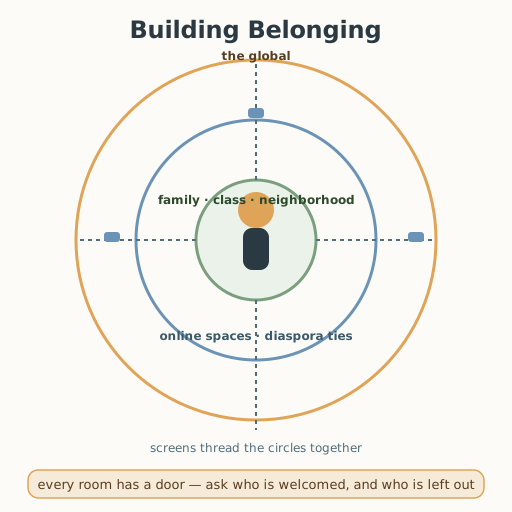
- Belonging circles diagram · 1 per learner or projected Concentric circles of community — family, class, neighborhood, then online/diaspora/global — with connective threads (screens), and a note on who is inside vs. outside the circle
- Writing journal · 1 per learner
Low-tech / no-cost
- Concentric circles drawn in the ground Stand in your offline circle, then step to a wider circle and name what connects you to people far away
- Voice and discussion Name a community you belong to that exists mostly online — what holds it together, and who is left out
Enriched / lab & device
- A shared device to visit one online community (optional) · 1 per group A forum, fan space, or support group to examine how belonging is built and who is included or excluded
- A short documentary or article on a diaspora community staying connected online (optional) · 1 per class A first-person account of a community transformed by digital connection
Works in different contexts
- large-group Model the circles whole-class, then learners map their own belonging in small groups and share one insight
- multi-age Younger learners name one offline and one online community they belong to; older learners analyze inclusion, exclusion, moderation, and the digital divide
- self-directed A learner maps their own belonging circles and writes when technology built belonging and when it gated it
- level-grouped Learners ready to extend analyze how platform design and moderation decide who is welcomed and who is driven out
- outdoor-only Draw your own belonging circles in the ground and walk from the innermost to the widest, naming what holds each circle together
Lesson 9 — Building Belonging with Technology
Summary
Learners evaluate how technology and media create and transform communities and belonging. Digital tools build new kinds of community — online spaces, diaspora connection, communities of shared need or interest — and transform offline belonging, even as they decide who is welcomed and who is left out. They close by mapping their own belonging and naming one inclusion and one exclusion they see.
Objectives
- Evaluate how technology and media create and transform communities and belonging. (D02.S3.10.01)
Connection
Think of a group that matters to you that could not exist without a screen: the faraway family kept close by daily calls, the friends who share a rare interest no one in your town has, the people who understand a struggle you thought was only yours. Technology does not just move messages — it builds rooms. It lets a diaspora stay one people across oceans, lets a person with a rare identity find others like them, lets a neighborhood organize a cleanup in an afternoon. But the same rooms have doors, and doors keep some people out: those without a device or a connection, those who do not speak the platform’s language, those who are shouted down or driven out. Whether your community is a village or a global network, asking who is welcomed, and who is left out is how you read belonging itself — and it is a question you can ask of every room you ever stand in.
Materials
- Belonging circles diagram
- Writing journal
Preparation
- Copy or draw the concentric belonging circles.
- Retrieval: from Grade 7, recall that online and offline communities differ and that people belong in each (D02.S3.07.01); from Grade 8, recall analyzing how power and resources are shared and who is left out (D02.S3.08.01). Today we put those together at Grade 10 depth.
- Prepare a worked example: one community built by technology and one transformed by it.
Facilitator note
This lesson is written to the learner (“you”). The idea to land: technology both creates new communities — online spaces, diaspora ties, communities of shared need — and transforms offline belonging, while its design and its divides decide who is welcomed and who is left out. The balance is the honest center: online community is a real, ordinary part of adolescent social life, not inherently harmful (S-226, S-311), yet access is unequal — cost, connectivity, disability, and geography change who can join (S-281) — and the design of a room (who moderates, who is amplified, who is banned) shapes belonging as much as the people in it. Putnam’s account of declining shared life is one lens on how connection can thin (S-157); Anderson’s “imagined communities” show how shared media can bind people who will never meet (S-415). Present these as lenses to evaluate with, not verdicts.
Model one example once, then let learners work (worked example → guided practice → independent work; S-011). The technology lens is the spine: read the room as a built thing — its rules, moderation, and ranking decide belonging. The community lens: ask what holds a community together and what sustains it over time. The egalitarian lens is essential: belonging is not distributed fairly — the digital divide, platform power, and harassment gate some people out, and that is a justice question, not a personal one. The ethics lens: a welcoming room is one a person has shaped to be fair; an exclusive room is one that has shaped the person to be cruel. The critical-thinking lens: ask who is missing from this room, and why? The social-emotional lens: belonging is deeply felt — being welcomed or shut out can shape a whole year; invite, never force, and let learners share only what they choose. The global lens: the same tools build different rooms in different places, each shaped by its culture and its history. Preview: Lesson 10 zooms out — how a local community connects to the regional, national, and global.
Procedure
- Recall (5 min). From Grade 7: how do online and offline communities differ? From Grade 8: who gets left out when power and resources are shared unevenly? Today we ask what technology does to belonging.
- Meet the circles (10 min). Look at the diagram. Your belonging is nested: family, class, neighborhood — then, threaded by screens, the online spaces, the diaspora ties, the global networks. Learn the two things technology does: it creates communities that could not exist before, and it transforms the ones that already do.
- Read two examples (10 min). Watch a worked example. Created: a group of people with the same rare condition, or the same far-flung heritage, find each other online and become a community. Transformed: a neighborhood that used to meet at the market now also organizes on a group chat — faster, but with some neighbors left off it.
- Ask the belonging question (12 min). For each room, ask: who is welcomed, and who is left out? Learn the gates: the digital divide (who has a device, a connection, the language), moderation (whose voice is protected, whose is silenced), and harassment (who is driven out). Name one gate you have seen.
- Map your own belonging (12 min). Draw your own circles — offline and online. For each, write one thing that holds it together. Then mark one inclusion (who is welcomed) and one exclusion (who is left out) you can see.
- Close (5 min). Remember: a community is not just the people in it — it is the door. You get to help decide, in every room you stand in, who the door lets in.
Differentiation
- Support: Offer two circles to map and a sentence starter (“This community welcomes ___, but it leaves out ___ because ___.”).
- Extension: Analyze one online community’s design and moderation and argue what change would make it more welcoming without losing what holds it together.
Assessment
- Formative (self): Can the learner name one community technology created and one it transformed, identify one gate to belonging, and map one inclusion and one exclusion?
- Portfolio artifact (summative for the unit): The belonging-circles map, added to the unit portfolio as the “technology and belonging” analysis.
Home connection
Ask an adult you trust: what community do you belong to that a screen helps hold together — and who gets left out of it? Compare your maps.
Resources
- On unequal access to digital tools (the digital divide): World Bank, World Development Report 2016: Digital Dividends (S-281).
- On online community as a real part of adolescent social life, and on shared life and connection: Common Sense Media Research Program, https://www.commonsensemedia.org/research (S-226); Putnam (2000), Bowling Alone, Simon & Schuster (S-157); Anderson (1983), Imagined Communities, Verso (S-415).
- On adolescence as a formative time whose digital habits can shape wellbeing: WHO, “Mental health of adolescents,” https://www.who.int/news-room/fact-sheets/detail/adolescent-mental-health (S-311).
- On modeling + guided practice before independent work: Kirschner, Sweller & Clark (2006), https://doi.org/10.1207/s15326985ep4102_1 (S-011).