Lesson 08 — Echo Chambers: Who's Talking to Me?
Learners evaluate echo chambers and filter bubbles: how recommendation systems and our own choices (homophily) narrow what we see, and how that narrowing shapes empathy — it is easy to feel with people who already agree with us, and hard across difference. They close by auditing their own feed and naming one step to widen it.
Objectives
Objectives
- D02.S2.10.02 Evaluate how digital platforms shape empathy, compassion fatigue, and echo chambers.
Essential question
How do recommendation systems and my own choices narrow what I see — and how does that narrowing shape my empathy?
Key vocabulary
Materials
Standard materials
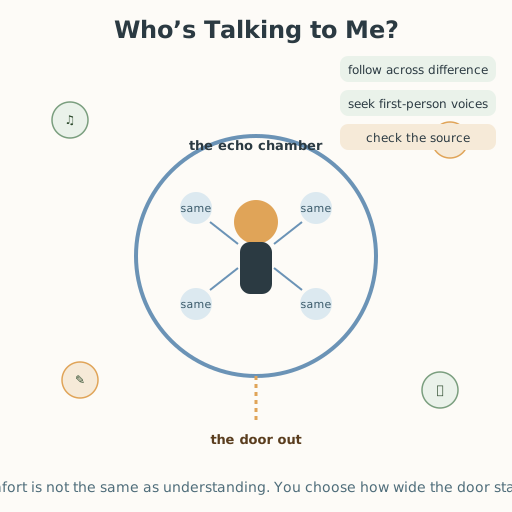
- Echo chamber diagram · 1 per learner or projected A person inside a circle of same-opinion voices, with arrows repeating one note inward, and a door opening to diverse first-person voices outside
- Writing journal · 1 per learner
Low-tech / no-cost
- A circle drawn in the ground with inward arrows Stand inside and notice how every voice repeats the same note; then step through the "door" to a wider circle
- Voice and discussion Choose a topic you care about and list the voices you hear — then list the voices you never hear, and why
Enriched / lab & device
- A shared device to examine a recommendation feed (optional) · 1 per group To notice what the feed shows again and again, and what it never shows
- A pair of articles from two different perspectives on one topic (optional) · 1 pair per group To practice reading across difference and checking each against its source
Works in different contexts
- large-group Model the echo chamber whole-class, then learners audit their own feed in pairs and share one counter-move
- multi-age Younger learners name one voice they always hear and one they never hear; older learners trace the algorithm/homophily mechanism and its effect on empathy
- self-directed A learner audits their own feed, lists the missing voices, and writes one step to widen it
- level-grouped Learners ready to extend weigh the filter-bubble hypothesis (and its scholarly debate) and argue whether the effect is real or overstated
- outdoor-only Stand in a tight circle and pass one repeated phrase, then open the circle wide and let new voices in — feel the difference in a body
Lesson 8 — Echo Chambers: Who’s Talking to Me?
Summary
Learners evaluate echo chambers and filter bubbles: how recommendation systems and our own choices (homophily — liking to be with people who think like us) narrow what we see, and how that narrowing shapes empathy — it is easy to feel with people who already agree with us, and hard across difference. They close by auditing their own feed and naming one step to widen it.
Objectives
- Evaluate how digital platforms shape empathy, compassion fatigue, and echo chambers — the echo-chamber half of the standard. (D02.S2.10.02)
Connection
Scroll your feed for a minute and notice who is talking to you. Often it is a chorus of voices saying versions of what you already think — liking what you like, angry at what angers you, agreeing with you back. It feels comfortable, like a room full of friends. But a room where everyone agrees is also a room where you never have to stretch: it is easy to feel with people who already sound like you, and far harder to feel with someone whose life and views are different. Some of that room is your own doing — we all drift toward the familiar — and some of it is built by the feed itself, which learns what keeps you scrolling and shows you more of it. Whether your feed is in your pocket or on a shared screen, learning to notice who is missing from the room — and to open the door — is a skill for keeping your mind, and your empathy, wide.
Materials
- Echo chamber diagram
- Writing journal
Preparation
- Copy or draw the echo chamber diagram.
- Retrieval: from Lesson 7, recall that empathy runs narrow and can be worn thin. Today we ask the other question: what narrows the room itself — and how does that shrink our empathy?
- Prepare a worked example: a topic where the learner’s feed repeats one view.
Facilitator note
This lesson is written to the learner (“you”). The idea to land: an echo chamber is what happens when recommendation systems and our own homophily narrow the voices we hear — and narrowing the room narrows empathy, because it is easy to feel with the similar and hard across difference; the counter-move is to notice who is missing and deliberately widen the circle. The mechanism is real: recommendation and ranking algorithms prioritize content that engages, and personalization can surround a person with confirming information — the “filter bubble” (S-482) and the echo-chamber dynamic that Britannica documents (S-481). Be honest about the debate: scholars disagree about how strong the filter-bubble effect is — some find it weaker than popular accounts claim — so present it as a tendency to examine, not a law (S-482). The counter-moves are practical: follow across difference, seek first-person voices, and check claims against independent sources — “lateral reading” (S-063, S-217).
Model the mechanism once, then let learners work (worked example → guided practice → independent work; S-011). The technology lens is the spine: read the feed as a designed object whose ranking is a choice made by someone, for engagement or profit. The critical-thinking lens: ask who is missing, and whose account am I not hearing? — and check each claim against its source. The ethics lens: living only among the like-minded is a quiet ethical risk, because it lets our judgments go untested; widening the circle is an act of intellectual honesty. The egalitarian lens: whose voices get amplified and whose get crowded out is a question of power — the same feed that comforts the majority can silence the minority. The social-emotional lens: this topic can feel exposing (our feeds reveal our habits); invite, never force, and let learners share only what they choose. The global lens: the same mechanism works in every language and region, but its effects differ with who holds platform power. Preview: with empathy examined, Lessons 9–10 turn to belonging and community.
Procedure
- Recall (5 min). From Lesson 7: empathy runs narrow and can be worn thin. Today we ask what narrows the room itself — and what that does to our empathy.
- Meet the echo chamber (10 min). Look at the diagram. Inside the circle, every voice repeats one note; you feel agreed with, and comfortable. Learn the two forces that built the room: homophily — we drift toward people who think like us — and the recommendation feed — which learns what keeps us scrolling and shows more of it (S-481, S-482).
- Notice the empathy cost (10 min). It is easy to feel with someone who already sounds like you. It is hard to feel with someone whose life is different — and the narrower your room, the less practice you get. Write one sentence: the more my feed agrees with me, the ___ my empathy becomes across difference.
- Audit your feed (12 min). Take one topic you care about. List the voices you always hear on it. Then list the voices you never hear — the people most affected, the dissenters, the first-person voices from inside another community. Be honest: why are they missing?
- Open the door (12 min). Learn the counter-moves: follow across difference (one voice unlike yours), seek first-person voices (from Lessons 5–6), and check claims against independent sources — lateral reading (S-063, S-217). Write one concrete step you will take this week to widen your circle.
- Close (5 min). Remember: a room full of agreement is comfortable, but comfort is not the same as understanding. You get to choose how wide your door stands.
Differentiation
- Support: Offer a two-column “voices I hear / voices I never hear” sheet and a sentence starter (“To widen my circle, I will ___.”).
- Extension: Weigh the filter-bubble debate — why some researchers find the effect weaker than popular accounts claim — and argue what evidence would settle it.
Assessment
- Formative (self): Can the learner name the two forces that build an echo chamber, explain its effect on empathy, and state one concrete step to widen their circle?
- Portfolio artifact (summative for the unit): The feed-audit and widen-the-circle entry, added to the unit portfolio as the echo-chamber reflection.
Home connection
Ask an adult you trust: whose voices do you hear most — and whose are you missing? Then each of you names one voice you could seek out this week.
Resources
- On the “filter bubble” idea and its scholarly debate: Pariser (2011), The Filter Bubble: What the Internet Is Hiding from You, Penguin Press (S-482).
- On algorithms, feeds, and echo chambers: Encyclopaedia Britannica, “Social media,” https://www.britannica.com/topic/social-media (S-481).
- On lateral reading and checking claims against sources: Common Sense Education, “News & Media Literacy” (S-063); UNESCO, “Media and Information Literacy” (S-217).
- On modeling + guided practice before independent work: Kirschner, Sweller & Clark (2006), https://doi.org/10.1207/s15326985ep4102_1 (S-011).