Lesson 11 — Technology: Cooperation's Tool or Undoer?
Learners analyze how technology can enable or undermine cooperation and mutual aid globally: it coordinates help across distance, moves money to people without banks, and maps crises in real time — yet the same systems can surveil, misinform, and extract. They close by evaluating one tool and arguing that design is a choice.
Objectives
Objectives
- D02.S4.10.01 Analyze how technology can enable or undermine cooperation and mutual aid globally.
Essential question
How can technology enable cooperation and mutual aid — and how can it undermine them?
Key vocabulary
Materials
Standard materials
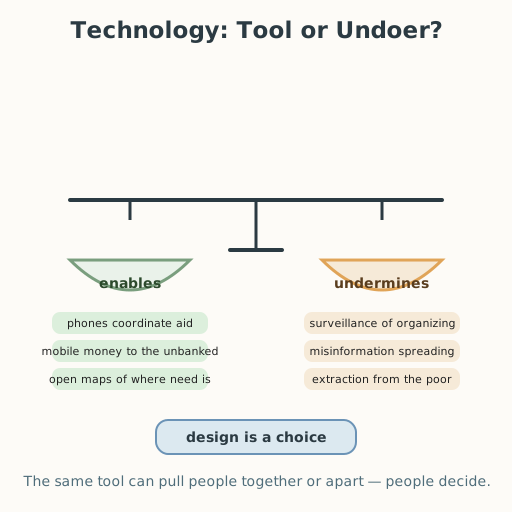
- Enables vs. undermines two-column sheet · 1 per learner Two columns — "how technology enables cooperation and mutual aid" and "how it undermines them" — with a center note "design is a choice"
- Writing journal · 1 per learner
Low-tech / no-cost
- Paper folded into two columns, or lines drawn in the ground One side "enables," the other "undermines," with concrete examples named aloud
- Voice and discussion Debate one tool — a phone, a map, a network — as both an enabler and an undoer of cooperation
Enriched / lab & device
- A shared device to examine one cooperative or aid tool (optional) · 1 per group A crisis-mapping, crowdfunding, or mutual-aid platform to evaluate directly
- A short case study of mobile money or disaster response (optional) · 1 per class A concrete example of technology coordinating aid across distance
Works in different contexts
- large-group Model one enable and one undermine whole-class, then learners fill their own columns and share in small circles
- multi-age Younger learners name one way a phone helps people help each other and one way it hurts; older learners weigh surveillance, misinformation, and platform power
- self-directed A learner evaluates one tool for how it enables and undermines cooperation and writes a short verdict with reasons
- level-grouped Learners ready to extend analyze a specific case (mobile money, crisis mapping, gig platforms) and weigh who gains and who loses
- outdoor-only Choose a real shared problem outdoors (clearing a path, moving water) and name which tools would help people cooperate and which would get in the way
Lesson 11 — Technology: Cooperation’s Tool or Undoer?
Summary
Learners analyze how technology can enable or undermine cooperation and mutual aid globally. It can coordinate help across distance, move money to people without banks, and map crises in real time — yet the same systems can surveil, misinform, and extract. They close by evaluating one tool and arguing that design is a choice, not destiny.
Objectives
- Analyze how technology can enable or undermine cooperation and mutual aid globally. (D02.S4.10.01)
Connection
When a flood hits a town, the same pocket device can do two opposite things. It can be the thing that saves people: a neighbor posts where help is needed, strangers send money in minutes, a shared map shows which road is open — people who have never met coordinate like one body. Or it can be the thing that fails them: rumors spread faster than water, a company profits from the chaos, and a government watches who is organizing. A tool is never just a tool — it is a choice someone made about who it serves. Whether your community faces a flood, a drought, a crisis, or just a hard winter, the question is the same: is this technology helping us pull together, or is it pulling us apart — and who decided? That question is the whole lesson, and you will ask it of every new tool for the rest of your life.
Materials
- Enables vs. undermines two-column sheet
- Writing journal
Preparation
- Copy or draw the two-column sheet.
- Retrieval: from Grade 8, recall the difference between charity and mutual aid and solidarity (D02.S4.08.02). Today we ask what technology does to cooperation and mutual aid — for better and for worse.
- Prepare a worked example: one tool that enables and one that undermines.
Facilitator note
This lesson is written to the learner (“you”). The idea to land: technology is neither cooperation’s savior nor its ruin — it can enable mutual aid (coordination, mobile money, open maps, crowdfunding) and undermine it (surveillance, misinformation, extractive platforms, algorithmic division), and which way it tips is a design and power choice, not an accident. The enabling cases are well documented: mobile money grew where bank branches were scarce, letting people send, save, and pay by phone — M-Pesa, launched 2007 in Kenya, is the canonical example (S-210, S-211); open maps and crisis coordination let strangers organize aid in real time. The undermining cases are equally documented: surveillance chills organizing, misinformation spreads faster than correction, and platform power can extract from the very people it claims to serve (S-481, S-281). Present both sides as facts to weigh, not a balanced “both sides” that dodges the question — some tools, in some hands, do more of one than the other.
Model one enable and one undermine, then let learners work (worked example → guided practice → independent work; S-011). The technology lens is the spine: read the tool as a designed object — every feature was chosen by someone, for some purpose. The ethics lens: ask who does this serve, and who does it watch or extract from? The egalitarian lens is essential: cooperation tools are not equally available — the digital divide means the people who most need mutual aid may be the least connected (S-281), and the same platform that helps a diaspora send money home can charge the poorest the most. The global lens: the same app means different things in a rich city and a rural village, and in a democracy and under surveillance. The critical-thinking lens: for each claim about a tool’s good, ask for whom, and at what cost? Preview: Lesson 12 grounds this in concrete examples of cooperative economies and mutual-aid networks across the world.
Procedure
- Recall (5 min). From Grade 8: what is the difference between charity and mutual aid? (Charity keeps power with the giver; mutual aid meets needs together, as equals.) Today we ask what technology does to mutual aid.
- Meet the two columns (10 min). Look at the sheet. Watch a worked example. Enables: a phone coordinates neighbors after a flood; mobile money lets a worker without a bank send help home in minutes (S-210, S-211); an open map shows where the need is. Undermines: surveillance watches who organizes; misinformation spreads faster than the truth; a platform profits from people’s desperation. Notice: the same tool can do both.
- Evaluate one tool (15 min). Choose a tool you know — a messaging app, a money app, a map, a crowdfunding site, a social network. Fill the two columns: how does it enable cooperation and mutual aid, and how does it undermine them? Be specific about who gains and who loses.
- Ask the sharp questions (10 min). For each side, ask: who designed this, and for whom? who is left out (the unconnected, the watched, the poor)? what would a caring design change? Write one sentence answering each.
- Draft your verdict (10 min). In your journal: on balance, this tool ___ cooperation and mutual aid because ___. But design is a choice — here is one change that would tip it toward cooperation: ___.
- Close (5 min). Remember: no tool is neutral. Whether it pulls us together or pulls us apart is decided by people — including, one day, you.
Differentiation
- Support: Offer a short feature list to sort into “enables” and “undermines” and a sentence starter (“This tool helps people help each other by ___, but it also ___.”).
- Extension: Compare mobile money’s promise for people without banks against its fees and surveillance risks, and argue how to keep the good while checking the harm.
Assessment
- Formative (self): Can the learner name one way technology enables and one way it undermines cooperation and mutual aid, evaluate one tool, and argue that design is a choice?
- Portfolio artifact (summative for the unit): The enable-vs-undermine evaluation, added to the unit portfolio as the “technology and mutual aid” analysis.
Home connection
Ask an adult you trust: has a phone or app ever helped people in our community help each other — and has one ever gotten in the way? Compare your two columns.
Resources
- On mobile money growing where bank branches were scarce: CGAP, “Financial Inclusion” (S-210); World Bank, “Financial Inclusion,” https://www.worldbank.org/en/topic/financialinclusion (S-211).
- On unequal access and platform power (the digital divide): World Bank, World Development Report 2016: Digital Dividends (S-281).
- On how platforms operate and are governed: Encyclopaedia Britannica, “Social media,” https://www.britannica.com/topic/social-media (S-481).
- On modeling + guided practice before independent work: Kirschner, Sweller & Clark (2006), https://doi.org/10.1207/s15326985ep4102_1 (S-011).