Lesson 12 — Co-ops and Mutual Aid Around the World
Learners examine cooperative economies and mutual-aid networks across the world: they distinguish charity (a one-way gift with power kept) from mutual aid (equals deciding together) and cooperative ownership (shared ownership, shared benefit), and meet real examples — communal-work traditions, credit unions, and worker co-ops. They close by naming one cooperative or mutual-aid effort they would join or build.
Objectives
Objectives
- D02.S4.10.02 Examine examples of cooperative economies and mutual-aid networks across the world.
Essential question
What are cooperative economies and mutual-aid networks, and how do people run them across the world?
Key vocabulary
Materials
Standard materials
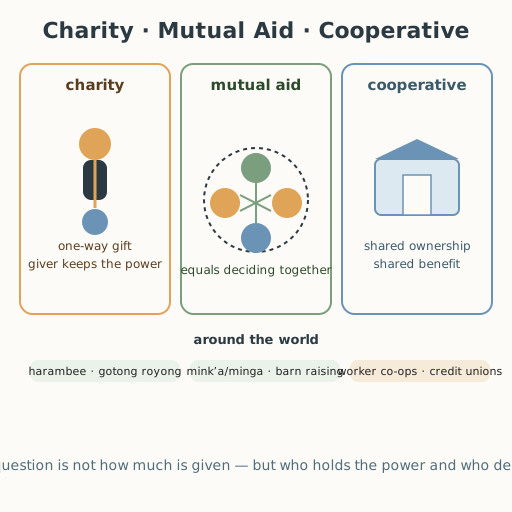
- Charity vs. mutual aid vs. cooperative diagram · 1 per learner or projected A spectrum — charity (one-way gift, power kept) → mutual aid (equals deciding together) → cooperative economy (shared ownership and shared benefit)
- Writing journal · 1 per learner
Low-tech / no-cost
- Paper folded into three panels, or three circles drawn in the ground One panel each for charity, mutual aid, and cooperative — with arrows showing who decides and who benefits
- Voice and discussion Name a real example of each from your own community — a gift, a shared task, a shared shop or fund
Enriched / lab & device
- A short profile of a cooperative or mutual-aid network (optional) · 1 per class A first-person account of a worker co-op, credit union, or mutual-aid group in action
- A directory of local cooperatives or mutual-aid groups (optional) · 1 per class To connect the global examples to something near the learner
Works in different contexts
- large-group Model the spectrum whole-class, then learners match examples to each panel in small groups and share one they would join or build
- multi-age Younger learners name one example of each; older learners weigh the charity/mutual-aid/solidarity distinction and analyze shared ownership
- self-directed A learner studies one cooperative or mutual-aid example and writes what it shares, who decides, and who benefits
- level-grouped Learners ready to extend compare a worker co-op with a conventional firm and argue how ownership changes who decides and who gains
- outdoor-only Do one small shared task together (clearing, carrying, planting) and name which of the three forms your teamwork most resembled — and why
Lesson 12 — Co-ops and Mutual Aid Around the World
Summary
Learners examine cooperative economies and mutual-aid networks across the world. They distinguish charity (a one-way gift, power kept by the giver) from mutual aid (equals deciding together) and cooperative ownership (shared ownership, shared benefit), and meet real examples — communal-work traditions, credit unions, and worker cooperatives. They close by naming one cooperative or mutual-aid effort they would join or build.
Objectives
- Examine examples of cooperative economies and mutual-aid networks across the world. (D02.S4.10.02)
Connection
A community can meet a need in three very different ways. It can give: a wealthy person hands food down, the giver keeping the power and the receiver staying passive — that is charity. It can share: neighbors pool what they have and decide together who needs what, no one above anyone — that is mutual aid. Or it can own together: workers run their own workshop, families share a savings fund, a village runs its own water system — that is a cooperative economy, where the people who use or make a thing also own and decide it. The difference is not in how much is given, but in who holds the power and who decides. Whether your community is a village, a city block, or a network across continents, these three ways of caring are everywhere — and learning to tell them apart, and to see them working, is how you come to see that the economy is not a force of nature but something people build, together.
Materials
- Charity vs. mutual aid vs. cooperative diagram
- Writing journal
Preparation
- Copy or draw the three-panel spectrum.
- Retrieval: from Grade 8, recall the charity-vs-mutual-aid distinction (D02.S4.08.02); from Grade 5, recall examples of mutual aid from different cultures and times (D02.S4.05.01). Today we go deeper: naming cooperative ownership as a third way, with world examples.
- Prepare a worked example of each panel.
Facilitator note
This lesson is written to the learner (“you”). The idea to land: cooperation and mutual aid are not marginal — they are widespread, documented ways people meet needs together, and the key distinction is power: charity keeps it with the giver, mutual aid shares it among equals, and cooperative ownership ties it to shared ownership and benefit. The anchors are sound. Mutual aid — cooperation and reciprocity born of belonging, not pay — is a widespread human practice, named and documented in Kropotkin’s classic (S-163). Communal self-help traditions are real and named: harambee (“all pull together”) in Kenya, gotong royong in Indonesia, mink’a/minga in the Andes, and barn raising in North America (S-164). The charity-vs-solidarity distinction — charity as a one-way gift in which the giver keeps power, mutual aid as people meeting needs together as equals — is the standard framing (S-345). Worker cooperatives (such as the Mondragón federation in the Basque Country) and credit unions are well-known cooperative forms; describe them as widely documented examples and invite learners to check first-party detail (the International Cooperative Alliance and Mondragón are the primary references — see Resources). Hold “sharing power is better” as a value, distinct from the descriptive claim that these forms exist and work.
Model each panel once, then let learners work (worked example → guided practice → independent work; S-011). The egalitarian lens is the spine: the whole point of mutual aid and cooperation is that no one is above and no one is left out — and asking who decides is how you tell the forms apart. The ethics lens: charity is not “bad” — it can save lives — but it keeps the receiver dependent, while mutual aid and cooperation build dignity and power. The global lens: these forms appear across cultures and times, each shaped by its own place — hold them side by side, never ranked. The community lens: ask what each form builds — dependency, solidarity, or ownership. The critical-thinking lens: not every group that calls itself a “co-op” shares power fairly — check who actually decides and who actually benefits. Note: this is the unit’s closing lesson — invite learners to gather the thread back to Lesson 1, where respectful communication began the whole arc.
Procedure
- Recall (5 min). From Grade 8: what is the difference between charity and mutual aid? (Charity keeps power with the giver; mutual aid meets needs together, as equals.) Today we add a third way and meet real examples.
- Meet the three ways (12 min). Look at the diagram. Charity: a one-way gift — the giver keeps the power, the receiver stays passive. Mutual aid: equals decide together who needs what — no one above anyone (S-345). Cooperative economy: the people who use or make a thing own it and decide it together — shared ownership, shared benefit. Watch a worked example of each.
- Meet world examples (12 min). Learn real, named forms. Communal work: harambee in Kenya, gotong royong in Indonesia, mink’a/minga in the Andes, barn raising in North America (S-164). Cooperative ownership: worker cooperatives such as the Mondragón federation in the Basque Country, and credit unions — savings and lending owned by their members. These are not rare — cooperation is a widespread human practice (S-163).
- Match and check (10 min). Take three needs — food, money, work — and for each, name how charity, mutual aid, and a cooperative would meet it, and who would decide. Notice where the power sits in each.
- Choose yours (10 min). In your journal: one cooperative or mutual-aid effort I would join — or help build — is ___, because it would meet ___ while keeping power with ___.
- Close (5 min). Remember: the economy is not weather — it is something people build. Every cooperative and every mutual-aid network began when ordinary people decided to share the deciding. That option is yours too.
Differentiation
- Support: Offer a three-row table (need → charity / mutual aid / cooperative) with a sentence starter (“A ___ would meet ___ while keeping power with ___.”).
- Extension: Compare a worker cooperative with a conventional firm and argue how ownership changes who decides and who gains — then name one real cooperative and check your account against its own description.
Assessment
- Formative (self): Can the learner distinguish charity, mutual aid, and cooperative ownership, name at least two real world examples, and state one effort they would join or build?
- Portfolio artifact (summative for the unit): The “one I would join or build” entry, added to the unit portfolio as the cooperative-economies-and-mutual-aid analysis — and the closing artifact of the unit’s portfolio.
Home connection
Ask an adult you trust: have you ever been part of something where people shared the work and the deciding — a fund, a farm, a building project, a neighborhood group? Write down their story.
Resources
- On mutual aid as a widespread human practice: Kropotkin (1902), Mutual Aid: A Factor of Evolution (S-163).
- On named communal-work traditions — harambee, gotong royong, mink’a/minga, barn raising: documented in the source registry’s communal-traditions entry (S-164).
- On the charity-vs-mutual-aid/solidarity distinction: Spade (2020), Mutual Aid: Building Solidarity During This Crisis (and the Next), Verso (S-345).
- On worker cooperatives and credit unions (first-party detail): International Cooperative Alliance, https://www.ica.coop/; Mondragón Corporation, https://www.mondragon-corporation.com/.
- On modeling + guided practice before independent work: Kirschner, Sweller & Clark (2006), https://doi.org/10.1207/s15326985ep4102_1 (S-011).