Lesson 03 — Critiquing a Public Speech
Learners critique a whole public speech using a five-part scaffold — claim, evidence, appeal, what is asked of them, and a fair counter-point — practiced first on a worked example and then on a speech of their own choosing. They close by writing a fair critique that names both strengths and gaps.
Objectives
Objectives
- D04.S1.10.01 Critique rhetoric in public speech and media, distinguishing emotional appeal from reasoned argument.
Essential question
How do I critique a whole public speech — its claims, its evidence, and its appeals — and judge how well it reasons?
Key vocabulary
Materials
Standard materials
- Speech-critique scaffold · 1 per learner Five rows — claim, evidence, appeal (ethos/pathos/logos), what is asked of me, and a fair counter-point — for one speech
- A short printed or projected public speech (worked example) · 1 per class A real, age-appropriate speech with clear claims, e.g., Wangari Maathai's 2004 Nobel lecture (S-059) or a community leader's address
- Reading journal · 1 per learner
Low-tech / no-cost
- Paper scaffold drawn by hand, or a five-row frame in the ground Claim / Evidence / Appeal / Asked of me / Fair counter-point
- Voice and body Read the worked speech aloud twice — once to hear the feeling, once to catch the claims — before filling the rows
Enriched / lab & device
- Audio or video recording of the worked speech (optional) · 1 per class To hear delivery — pace, pause, emphasis — as part of the rhetoric
- Shared device to find a second speech for independent critique · 1 per group Learners choose a speech from their own region or language tradition to critique
Works in different contexts
- large-group Fill the scaffold whole-class for the worked speech, then learners critique a second short speech in pairs
- multi-age Younger learners complete the first three rows (claim, evidence, appeal); older learners add the fair counter-point and rebuttal
- self-directed A learner fills the full scaffold alone for one speech and writes a short, fair critique that names both strengths and gaps
- level-grouped Learners ready to extend add Toulmin's warrant and rebuttal to the scaffold and weigh whether the evidence actually supports the claim
- outdoor-only Critique a speech remembered from a ceremony, rally, or community meeting, filling the rows aloud together
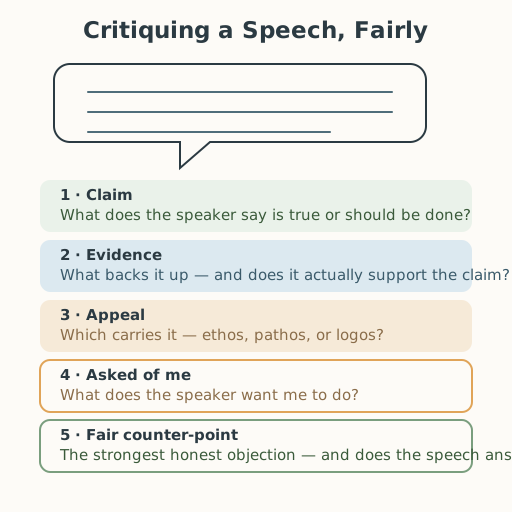
Lesson 3 — Critiquing a Public Speech
Summary
Learners put Lessons 1 and 2 together into a full critique of one public speech. Using a five-part scaffold — claim, evidence, appeal, what is asked of them, and a fair counter-point — they practice on a worked example and then critique a speech of their own choosing, writing a fair assessment that names both strengths and gaps.
Objectives
- Critique rhetoric in public speech, distinguishing emotional appeal from reasoned argument, by working through a complete speech with a claim–evidence–appeal scaffold. (D04.S1.10.01)
Connection
Every time a leader, a campaign, a preacher, or a protester stands up to persuade you, they are building a case in front of you — and you are allowed to ask questions of it. Does this claim hold up? Where is the evidence? What am I being asked to do, and for whom? Being able to answer those questions is the difference between being spoken to and being reasoned with. It is a skill you will use at a town meeting, at a ballot box, at a market, and in front of any screen.
Materials
- Speech-critique scaffold (five rows)
- A short printed or projected public speech (worked example)
- Reading journal
Preparation
- Copy the scaffold and the worked speech (Wangari Maathai’s 2004 Nobel lecture excerpts, or a community leader’s address — keep it short and real; S-059).
- Retrieval: from Lessons 1–2, recall the three appeals and the feeling-vs-reason sort. Today we run the whole critique on one speech.
- Read the worked speech once yourself and mark its claims and evidence so you can model the first rows.
Facilitator note
This lesson is written to the learner (“you”). The idea to land: a critique is a fair reading that names what a speech claims, what evidence it offers, which appeal it leans on, and what it asks — then weighs strengths and gaps without mocking the speaker. A reasoned argument is a claim backed by evidence, open to checking (S-236); a critique asks whether the evidence actually supports the claim and whether a counter-point is fairly handled. Wangari Maathai’s 2004 Nobel Peace Prize lecture is a strong worked example: it makes real claims (the Green Belt Movement planted over thirty million trees; started in 1977; spread to other African countries) that can be checked (S-059), and it also reaches the audience’s feeling about land, dignity, and future. It lets learners see a speaker use both appeals well — which is the honest, non-cynical conclusion this lesson should reach.
Model the first two rows, then let learners work (worked example → guided practice → independent work; S-011). The critical-thinking lens is the spine: hold the speech to the question “does the evidence support the claim?” The ethics lens: critique the argument, never the person; the goal is truth and fairness, not humiliation. The egalitarian lens: critique is a power — it treats every speaker, however powerful, as accountable to reason; and it belongs to everyone, not just experts. The global lens: choose speeches from many traditions, and let learners critique a speaker from their own community or language — the skill transfers across every art of speaking. The technology lens: the same scaffold reads a viral video, a campaign ad, or a politician’s clip — media are speeches too. Preview: Lesson 4 shifts from reading a speaker to being one, beginning with register.
Procedure
- Recall (5 min). What did you sort in Lesson 2? (Feeling-moves vs. reason-moves.) Today you run the whole critique on one speech — fairly, from start to finish.
- Meet the scaffold (10 min). Look at the five rows: claim (what the speaker says is true or should be done), evidence (what backs it up), appeal (which of ethos/pathos/logos carries it), asked of me (what the speaker wants me to do), and fair counter-point (a strong objection the speaker must answer).
- Worked example, rows 1–2 (15 min). Read the worked speech aloud twice — once to hear the feeling, once to catch the claims. Together, write the main claim and the evidence offered for it. Check: does the evidence actually support the claim, or only sit beside it?
- Worked example, rows 3–5 (10 min). Which appeal carries the speech? What is the audience asked to do? Then write one fair counter-point — the strongest honest objection — and whether the speech answers it.
- Critique your own (15 min). Choose a short speech — from your region, your language tradition, or a speaker you admire — and fill all five rows yourself.
- Write a fair critique (5 min). In your journal, write two or three sentences: this speech argues that ___, supports it with ___, and asks me to ___; its strength is ___, and its open question is ___.
- Close. Remember: to critique is to take a speaker seriously enough to ask for their reasons. That is respect, not rudeness.
Differentiation
- Support: Provide the claim and evidence pre-written for the worked speech; ask only for the appeal and the “asked of me” rows.
- Extension: Add Toulmin’s warrant and rebuttal: name the unstated rule connecting evidence to claim, and write the rebuttal the speaker should give to the counter-point (S-236).
Assessment
- Formative (peer): Learners exchange scaffolds and check one another’s “fair counter-point” for fairness — does it steelman the speaker or mock them?
- Summative artifact (unit): The completed five-row critique of a chosen speech, added to the portfolio as the “rhetoric critique” the unit’s assessment plan calls for.
Home connection
Watch or listen to a short speech with an adult you trust, then fill in one row each: you find the claim, they find the evidence — and decide together whether the two match.
Resources
- On Wangari Maathai and the Green Belt Movement (worked-example facts): Nobel Prize, “Wangari Maathai — Facts,” https://www.nobelprize.org/prizes/peace/2004/maathai/facts/ (S-059).
- On the claim/evidence/warrant structure: Toulmin, The Uses of Argument (1958) (S-236).
- On modeling + guided practice before independent work: Kirschner, Sweller & Clark (2006), https://doi.org/10.1207/s15326985ep4102_1 (S-011).