Lesson 04 — Register: Matching Your Voice to the Room
Learners meet register — the way we adapt language's formality, address, and tone to the setting — build a spectrum from close to formal, and re-write one message five ways. They see register as a skill of respect, practiced in every language and culture, never a single "correct" style.
Objectives
Objectives
- D04.S1.10.02 Speak to a public or unfamiliar audience with confidence, adapting register and formality to the setting.
Essential question
How do I adapt my language — its formality, its forms of address, its tone — to the setting and the people I am speaking to?
Key vocabulary
Materials
Standard materials
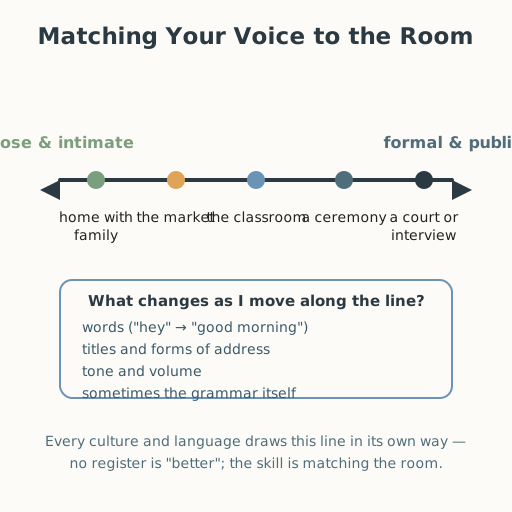
- Register spectrum strip · 1 per learner A line from close/intimate to formal/public, with slots to place settings — home, market, classroom, ceremony, court, interview
- One message, five ways sheet · 1 per learner The same request re-written for five different settings, to compare word choice
- Reading journal · 1 per learner
Low-tech / no-cost
- A line drawn in the ground or on paper Close at one end, formal at the other; learners stand where each setting belongs
- Voice and body Say the same greeting to a baby, a friend, an elder, and an official, and feel how the voice changes
Enriched / lab & device
- Short clips of one speaker in two registers (optional) · 2 per class E.g., an athlete in an interview vs. an award speech — to compare the same person shifting register
- Shared device to look up forms of address in another language · 1 per group To compare how different languages mark respect (honorifics, titles, verb forms)
Works in different contexts
- large-group Build the register spectrum as a whole class by placing settings on a line, then learners re-write one message individually
- multi-age Younger learners place two settings and re-write one sentence; older learners map a full spectrum and explain the *why* of each shift
- self-directed A learner builds the spectrum alone, re-writes one message five ways, and records themselves saying it in two registers
- level-grouped Learners ready to extend connect register to code-switching and to honorific systems in languages they know
- outdoor-only Walk the spectrum physically, standing closer to formal or close as each setting is named, then say one sentence from that spot
Lesson 4 — Register: Matching Your Voice to the Room
Summary
Learners meet register — adapting language’s formality, forms of address, and tone to the setting — and practice it as a skill of respect and clarity. They build a spectrum from close to formal, place real settings along it, and re-write one message five ways, seeing that every language and culture draws this line in its own way.
Objectives
- Speak to a public or unfamiliar audience with confidence, adapting register and formality to the setting — beginning by mapping the registers we already move between. (D04.S1.10.02)
Connection
You already do this every day without thinking: the way you greet a close friend is not the way you greet a grandparent, and neither is the way you would speak to a doctor, a shopkeeper, or a stranger asking directions. The words, the titles, the tone — even how loud or soft you speak — shift with the room. This is not putting on a fake self; it is fitting your voice to the listener, which is what being understood and showing respect both require. In a city apartment, a village gathering, or a formal interview, the skill is the same: read the room, then match it.
Materials
- Register spectrum strip
- “One message, five ways” sheet
- Reading journal
Preparation
- Copy the spectrum strip and the “one message, five ways” sheet.
- Retrieval: from Grade 9, recall how a speaker adapts a presentation to audience and purpose (D04.S1.07.02). Today we name the axis they adapt along: register.
- Prepare one worked example: one request (e.g., “please help me”) said five ways.
Facilitator note
This lesson is written to the learner (“you”). The idea to land: register is the dimension of language — formality, address, tone — that we vary to fit a setting; it is a skill of respect and clarity, and every culture marks it differently. The Common European Framework and its companion volume treat adapting register (formal/informal) and forms of address as a core of communicative competence, alongside knowing more than one language (S-237). Many languages mark respect inside the grammar itself — honorifics, polite verb endings, titles — so “register” is not just word choice but sometimes grammar. Hold this as description and appreciation: no register is “better”; the skilled speaker matches the room. Frame code-switching (moving between languages or registers) as a resource, not a deficit — a speaker who shifts between home language and formal language is doing something harder, not something lesser.
Model the skill once, then let learners practice (worked example → guided practice → independent work; S-011). The global lens is the spine: compare how different cultures mark respect in language, and let learners teach the class a form of address from their own language. The egalitarian lens: the “formal” register of a society is often the register of its powerful — and demanding respect for every way of speaking is a small act of justice. The social-emotional lens: anxiety about “getting the register right” is real, especially for learners speaking a second language or an unfamiliar dialect; normalize the wobble. The ethics lens: matching register is a way of honoring the other person; misjudging it is usually awkwardness, not insult, and can be repaired. The critical-thinking lens: ask why a setting calls for this register — who set the rule, and whom does it include or exclude? Preview: Lesson 5 turns register into delivery — speaking with confidence to an unfamiliar audience.
Procedure
- Recall (5 min). Think of the last time you spoke to three very different people in one day. How did your voice change for each? That change has a name today: register.
- Meet the spectrum (15 min). Look at the register strip — a line from “close and intimate” on one end to “formal and public” on the other. Place these settings on the line: home with family, the market, the classroom, a wedding or ceremony, a doctor’s office, a court or a job interview. Watch one worked example: the request “please help me” said five ways — a whisper to a sibling, a call to a friend, a polite ask to a neighbor, a careful request to an official, a formal plea at a hearing. Notice what changes: words, titles, tone, volume, even the grammar.
- Find the moves (10 min). On the “one message, five ways” sheet, circle the words that shift between registers. Underline any form of address — a name, a title, a polite word. Ask: what does each choice tell the listener about how I see them?
- Write five ways (15 min). Choose your own message — asking for help, saying thank you, or disagreeing politely — and write it for five different settings. Try at least one in your home language and one in a second language you know.
- Reflect (7 min). In your journal: the register I find hardest is ___, because ___; one form of address my culture or family uses is ___, and it shows respect by ___.
- Close (3 min). Remember: matching your voice to the room is respect made audible. Next time, you’ll deliver that voice to a real, unfamiliar audience.
Differentiation
- Support: Provide three pre-written versions of one message and ask the learner only to place them on the spectrum and explain one difference.
- Extension: Research an honorific system (e.g., titles, polite verb forms, or kinship address) in a language you know or are learning, and show how grammar itself marks respect.
Assessment
- Formative (self): Can the learner place five settings on the register spectrum and re-write one message for two of them, naming what changed?
- Portfolio artifact (unit): The “one message, five ways” sheet, added to the portfolio as the register entry for the public-speaking thread.
Home connection
Ask an adult you trust: how do you change the way you speak between home, work, and a formal occasion? Listen for one word or title they switch — and ask who taught them.
Resources
- On register, formality, and plurilingual competence: Council of Europe, CEFR Companion Volume, https://www.coe.int/en/web/common-european-framework-reference-languages/companion-volume (S-237).
- On modeling + guided practice before independent work: Kirschner, Sweller & Clark (2006), https://doi.org/10.1207/s15326985ep4102_1 (S-011).