Lesson 05 — Speaking to an Unfamiliar Audience
Learners plan and deliver a short address to a public or unfamiliar audience, using a two-minute planner and a delivery checklist, then self- and peer-assess. They see confidence as a practiced skill — breath, pace, posture, preparation — not a fixed trait, and adapt register to the audience they actually face.
Objectives
Objectives
- D04.S1.10.02 Speak to a public or unfamiliar audience with confidence, adapting register and formality to the setting.
Essential question
How do I speak to a public or unfamiliar audience with confidence — planning my words, my body, and my breath?
Key vocabulary
Materials
Standard materials
- Two-minute address planner · 1 per learner Slots for purpose, audience, one main point, one piece of evidence, an opening, and a closing
- Delivery checklist · 1 per learner Pace, volume or sign clarity, breath, posture (seated or standing), eye line where culturally and personally comfortable — to self-check and peer-check
- Reading journal · 1 per learner
Low-tech / no-cost
- Paper planner drawn by hand The same slots as a simple five-line frame
- Voice and body Practice to a real listener — a peer, a family member, or even a tree or a wall — with no device needed
Enriched / lab & device
- A recording device or phone (optional) · 1 per pair To record a practice run, then play it back and self-assess delivery
- A mirror or a video call to a distant listener (optional) · 1 per pair To see one's own posture and practice for an audience that is not in the room
Works in different contexts
- large-group Pair-share the two-minute address so every learner speaks in a low-stakes setting before a few volunteers present to the whole group
- multi-age Younger learners deliver a one-minute version to one listener; older learners deliver the full two minutes and handle a question
- self-directed A learner plans, records, and self-assesses a two-minute address using the checklist, then shares the recording with one trusted listener
- level-grouped Learners ready to extend add a fair counter-point and a one-sentence rebuttal, then field one audience question
- outdoor-only Deliver the address standing, to a small circle in the open, using the natural space to practice projection across a real distance
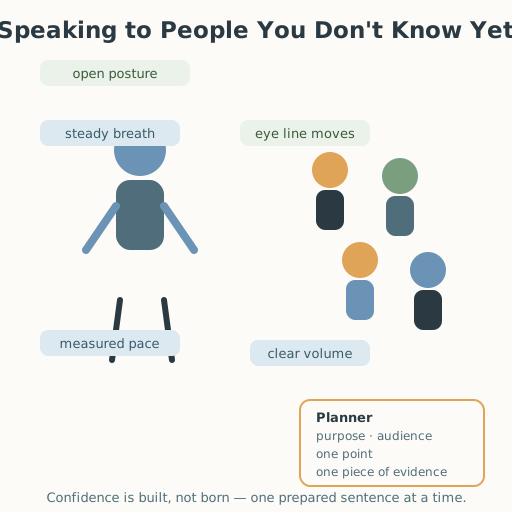
Lesson 5 — Speaking to an Unfamiliar Audience
Summary
Learners plan and deliver a short address to a public or unfamiliar audience, combining the register work of Lesson 4 with the craft of delivery — breath, pace, posture, and projection. They use a two-minute planner and a delivery checklist, then self- and peer-assess, learning that confidence is built, not born.
Objectives
- Speak to a public or unfamiliar audience with confidence, adapting register and formality to the setting. (D04.S1.10.02)
Connection
The knot in your stomach before you speak to people you do not know is not a sign that something is wrong with you — it is your body preparing for something that matters. The speakers you admire were not born calm; they planned their words, practiced their breath, and learned to let the nervousness ride along. Whether the audience is a classroom, a community meeting, a ceremony, or a camera that reaches strangers, the same truth holds: confidence is a skill you practice, one breath and one prepared sentence at a time.
Materials
- Two-minute address planner
- Delivery checklist
- Reading journal
Preparation
- Copy the planner and checklist.
- Retrieval: from Lesson 4, recall register — today you choose a register for a real audience, then deliver it. From Lesson 3, recall the parts of an argument (claim + evidence) to keep your address reasoned, not just felt.
- Prepare one worked example: a short, strong opening and closing you can model aloud.
Facilitator note
This lesson is written to the learner (“you”). The idea to land: public speaking is a practiced skill with visible parts — preparation (purpose, audience, one point, one piece of evidence), and delivery (breath, pace, volume, posture, eye line) — and nervousness is normal and manageable, not a verdict. The register work of Lesson 4 (S-237) now becomes a choice made for a real listener: the same message is said differently to peers than to a formal body, and the skilled speaker reads the audience and adapts. Confidence, in the developmental picture for ages 14–18, is partly a matter of practice and feedback — the more a learner speaks and hears themselves improve, the more the fear recedes.
Model the skill once, then let learners practice (worked example → guided practice → independent work; S-011). Keep stakes low: everyone speaks to a partner before anyone speaks to the whole room, and a recording can replace a live audience where that is safer. Delivery may be oral, signed, or through a communication device (AAC) — the craft being assessed is purpose, audience, one point, one piece of evidence, and a register matched to the audience, not the voice or the standing posture. The social-emotional lens is the spine: name the physical signs of nervousness (racing heart, shallow breath, shaking hands) as the body’s preparation, not a failure; teach a slow breath as a real tool. The egalitarian lens: the “right” accent or register is a gate — every voice, every dialect, every first language is welcome on this stage, and confidence should not require a learner to erase their own way of speaking. The global lens: every culture has its own arts of public address — formal oratory, call-and-response, story — and a learner may draw on their own tradition’s strengths. The ethics lens: with an audience comes responsibility — say what is true, own your sources, and do not use the platform to harm. The critical-thinking lens: keep the address reasoned — one claim, one piece of evidence — so confidence is built on substance, not just polish. Preview: Lesson 6 turns from speaking to reading — evaluating media for bias and omission.
Procedure
- Recall (5 min). From Lesson 4: what is register? Today you pick a register for a real audience — and you deliver it out loud.
- Plan the address (15 min). Fill the two-minute planner: your purpose (to inform, to persuade, to honor?), your audience (who, and how formal?), one main point, one piece of evidence, an opening that gets attention, and a closing that lands. Watch a worked example of a strong opening and closing, then write your own.
- Learn the delivery moves (10 min). Read the delivery checklist: slow your pace (nerves speed you up), take one breath before you begin, and project your voice so the back of the room hears you (speak from your chest, or sign clearly, or let your device carry the words). Sit or stand open and grounded. If it is comfortable for you and your culture, let your eyes move across the audience; eye contact is optional, not required — some cultures and some learners find it easier to look at a spot just above the listeners’ heads, or not at all. Practice the breath together: in for four, out for six.
- Deliver to a partner (15 min). Stand and deliver your two-minute address to one or two listeners. They listen for one strength and one thing to try next, using the checklist.
- Self-assess and revise (10 min). Hear the feedback. What worked? What will you change? Mark one revision on your planner and say the changed line aloud once more.
- Close (5 min). In your journal: before I spoke I felt ___; after I spoke I felt ___; the next time I speak to strangers I will remember ___. Remember: the nervous feeling is energy you can use.
Differentiation
- Support: Reduce the address to one minute and one sentence each for opening, point, and closing; allow speaking seated if standing is a barrier.
- Alternative delivery: A learner who is nonverbal, has a speech or voice impairment, or whose first language is signed may deliver the address in sign, through a communication device or AAC, or as a written script shared with the listener. Only the channel differs — the assessed craft (purpose, audience, one point, one piece of evidence, and a register matched to the audience) is identical, and the planner and checklist still apply. A learner who cannot manage a live audience may instead record, sign, or write the address.
- Extension: Deliver to a larger or mixed-age audience, field one question, and add a fair counter-point with a one-sentence rebuttal.
Assessment
- Formative (performance + peer): Can the learner deliver a two-minute address with a clear point, one piece of evidence, and a register matched to the audience, and name one thing to improve?
- Portfolio artifact (unit): The filled planner (and, where possible, a recording), added to the portfolio as the “public address” the unit’s assessment plan calls for.
Home connection
Give your two-minute address to an adult you trust — or a voice note to a relative far away — and ask them to tell you one thing they remember. That single remembered thing is your message working.
Resources
- On adapting register and formality to audience and setting: Council of Europe, CEFR Companion Volume, https://www.coe.int/en/web/common-european-framework-reference-languages/companion-volume (S-237).
- On modeling + guided practice before independent work: Kirschner, Sweller & Clark (2006), https://doi.org/10.1207/s15326985ep4102_1 (S-011).