Lesson 06 — Bias and Omission: What the Story Leaves Out
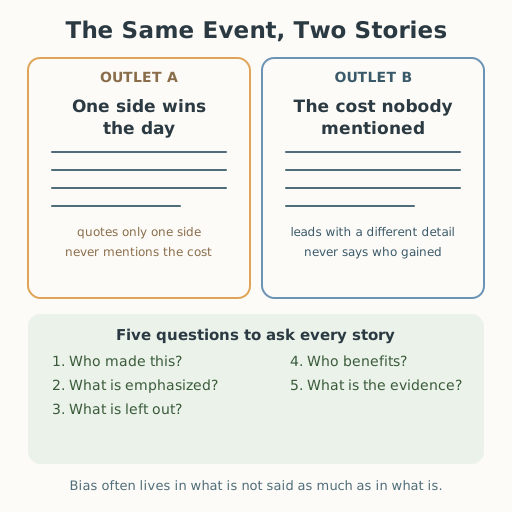
Learners evaluate digital and print media for bias and omission using five core questions — who made it, what is emphasized, what is left out, who benefits, and what is the evidence. They apply the questions to two accounts of one event, then to one real item of their own choosing.
Objectives
Objectives
- D04.S2.10.01 Critically evaluate digital and print media for bias, omission, and the difference between evidence and belief.
Essential question
How do I read a news story or post for what it emphasizes — and for what it quietly leaves out?
Key vocabulary
Materials
Standard materials
- Media-evaluation sheet · 1 per learner Five questions — who made this, what is emphasized, what is left out, who benefits, and what is the evidence — with room to write
- Two short news items on the same event (print or projected) · 1 set per pair Two different outlets' accounts of one event, to compare framing and omission
- Reading journal · 1 per learner
Low-tech / no-cost
- Paper sheet with the five questions written by hand The same five questions on any scrap of paper
- Voice and body Tell the same small event two ways aloud — once emphasizing one person's side, once the other's — and notice what changes
Enriched / lab & device
- Two digital news pages or posts on the same event (optional) · 1 set per pair Real current items chosen by the facilitator, to apply the five questions to live media
- Shared device to look up who owns a given outlet (optional) · 1 per group To begin the who-made-this-and-who-benefits question at the ownership level
Works in different contexts
- large-group Model the five questions whole-class on one item, then pairs apply them to a second item and report one omission they found
- multi-age Younger learners answer who made this and what is left out; older learners add who benefits and trace ownership
- self-directed A learner applies the five questions to one real news item of their own choosing and writes a short evaluation
- level-grouped Learners ready to extend compare bias to outright falsehood and preview Lesson 7's evidence-vs-belief distinction
- outdoor-only Use a printed news item or a remembered story from the community; discuss the five questions aloud in a circle
Lesson 6 — Bias and Omission: What the Story Leaves Out
Summary
Learners evaluate media for bias and omission using five core questions — who made this, what is emphasized, what is left out, who benefits, and what is the evidence. They apply the questions to two accounts of one event, then to one real item of their own choosing, learning that bias often lives in what is not said as much as in what is.
Objectives
- Critically evaluate digital and print media for bias, omission, and the difference between evidence and belief — beginning with framing and omission. (D04.S2.10.01)
Connection
Two people can tell you about the same market-day argument and leave you with two different truths — not because either lied, but because each chose what to emphasize and what to skip. The same happens with the news and the feed: every headline, photo, and clip is a selection, made by someone, for someone. A story that is “true” in its facts can still mislead by what it leads with, who it quotes, and what it never mentions. Learning to ask “what is left out?” is a superpower you carry from the market stall to the newsroom to your own phone.
Materials
- Media-evaluation sheet (five questions)
- Two short news items on the same event
- Reading journal
Preparation
- Copy the sheet and select two short, age-appropriate accounts of one event (same facts, different framing — e.g., a local dispute, a sporting decision, a policy change).
- Retrieval: from Lessons 1–3, recall reading for appeal and claim vs. evidence. Today we read for selection — what the maker chose to show and hide.
- Prepare one worked example: mark the first account’s emphasis and one omission.
Facilitator note
This lesson is written to the learner (“you”). The idea to land: every media message is a selection made by someone for an audience; bias shows up as emphasis, framing, and especially omission — so the reader’s job is to ask the five questions, not to hunt for a perfectly neutral outlet. The five questions follow established media-literacy frameworks: the Center for Media Literacy’s five core concepts (all media are constructed; media use creative language; different people experience the same message differently; media embed values and points of view; most media seek profit and/or power) (S-442); NAMLE’s key questions (who created this, why, what techniques are used, how might others read it, what is omitted, who benefits) (S-151); and UNESCO’s media and information literacy framing of access, evaluate, and engage (S-217). Omission is the subtle one: a report can be factually accurate and still mislead by what it never says. Note that even bias can be automatic rather than deliberate — people (and outlets) absorb the angles of their surroundings (S-344) — so the lesson asks learners to catch bias, not to assume bad faith.
Model the five questions once, then let learners work (worked example → guided practice → independent work; S-011). The critical-thinking lens is the spine: ask the five questions of every item, habitually. The technology lens: the feed is a designed selection — algorithms choose what to show, and concentrated ownership shapes what is reported at all (S-481; S-281) — so “what is left out” is partly engineered. The egalitarian lens: whose voices get quoted, and whose are omitted, is a question of power — omission is often how the less powerful are kept out of the story. The ethics lens: fair reporting means checking facts, naming sources, and representing sides fairly — an ideal to hold, not a claim that any outlet is perfect. The global lens: media differ across countries and languages, and no single outlet speaks for the world; read across borders when you can. Preview: Lesson 7 sharpens the last question — evidence versus belief.
Procedure
- Recall (5 min). From Lesson 3: what makes a critique fair? Today you turn that fairness on the news itself — asking what a story shows, and what it hides.
- Meet the five questions (10 min). Look at the media-evaluation sheet. The five questions: who made this? what is emphasized? what is left out? who benefits? what is the evidence? Watch a worked example: mark the first news item’s headline, its first sentence, who it quotes, and one thing it never mentions.
- Compare two accounts (15 min). Read the second account of the same event. Fill the sheet for both. Ask: where do they differ? What did each leave out? Which details lead, and why might that be?
- Find the omission (10 min). The hardest question is “what is left out.” For each account, write one thing a person would not know if they read only that one.
- Evaluate your own (10 min). Choose one real news item or post you saw this week. Run the five questions on it. Write one sentence naming its angle — and one sentence naming its omission.
- Close (5 min). Remember: no story is complete; the reader’s job is to notice the seams. Next time, we separate the last question — evidence from belief — on its own.
Differentiation
- Support: Provide the two accounts with the leading detail already underlined; ask only “what did each leave out?”
- Extension: Look up who owns or funds the outlet behind one item, and argue how that ownership might shape what it covers or omits (S-281).
Assessment
- Formative (self): Can the learner name what one account emphasizes and one thing it omits, and state who might benefit from that framing?
- Portfolio artifact (unit): The media-evaluation sheet for one real item, added to the portfolio as the “bias and omission” entry.
Home connection
Watch or read one news item with an adult you trust, then each of you write down one thing the story left out. Compare — did you notice the same gap?
Resources
- On the five core concepts of media literacy: Center for Media Literacy, “Five Core Concepts and Key Questions” (S-442).
- On the key questions for analyzing media messages: NAMLE, “Key Questions,” https://namle.org/resources/key-questions/ (S-151).
- On media and information literacy: UNESCO, Media and Information Literacy programme (S-217).
- On automatic (implicit) bias: Banaji & Greenwald, Blindspot (2013) (S-344).
- On concentrated media ownership and the digital divide: World Bank, World Development Report 2016: Digital Dividends (S-281); Encyclopaedia Britannica, “Social media,” https://www.britannica.com/topic/social-media (S-481).
- On modeling + guided practice before independent work: Kirschner, Sweller & Clark (2006), https://doi.org/10.1207/s15326985ep4102_1 (S-011).