Lesson 07 — Evidence and Belief: Telling Them Apart
Learners distinguish evidence from belief: a claim about the world that can be tested and corroborated, versus a value or conviction that is held rather than proven. They sort a mixed set of statements, fact-check one claim, and reflect on what each is allowed to do in their thinking — holding both with honesty.
Objectives
Objectives
- D04.S2.10.01 Critically evaluate digital and print media for bias, omission, and the difference between evidence and belief.
Essential question
How do I tell a claim backed by evidence from a belief I hold — and what should each be allowed to do in my thinking?
Key vocabulary
Materials
Standard materials
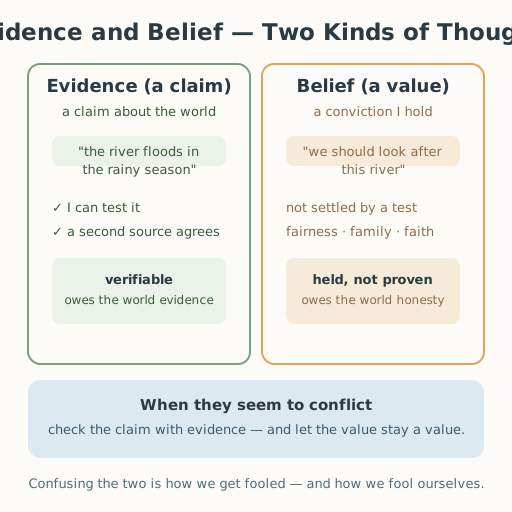
- Evidence vs. belief sheet · 1 per learner Two columns — claim I can test/verify and belief/value I hold — plus a middle band for what happens when they conflict
- A short set of mixed statements (print or projected) · 1 set per pair A mix of checkable factual claims and held beliefs/values, to sort
- Reading journal · 1 per learner
Low-tech / no-cost
- Paper folded into two columns, or two lines drawn in the ground Testable and Belief/value
- Voice and body Say each statement aloud and vote by standing on one side of the room — then defend the placement
Enriched / lab & device
- Shared device to fact-check two of the statements (optional) · 1 per group To trace one claim to a source and see whether it is corroborated by a second independent source
- A fact-checking site or method card (optional) · 1 per group A short trace-the-claim method to apply in real time
Works in different contexts
- large-group Sort the statements whole-class by voting, then small groups defend the trickiest placements and reach agreement
- multi-age Younger learners sort the clearest statements; older learners handle the conflict band and write about how to hold both
- self-directed A learner sorts the set alone, fact-checks one claim, and writes a short reflection on one belief they hold that is not a claim
- level-grouped Learners ready to extend trace corroboration — two independent sources for one claim — and mark where confidence should rise or fall
- outdoor-only Sort the statements aloud by stepping to one side of a line, then discuss the borderline cases together
Lesson 7 — Evidence and Belief: Telling Them Apart
Summary
Learners distinguish evidence from belief. A claim about the world can be tested and corroborated; a belief or value is held rather than proven. They sort a mixed set of statements, fact-check one claim, and reflect on what each is allowed to do in their thinking — learning to hold both with honesty, and to let evidence discipline their factual claims without demanding that every belief submit to a test it was never meant to pass.
Objectives
- Critically evaluate media for the difference between evidence and belief, by sorting claims that can be tested from values and convictions that are held. (D04.S2.10.01)
Connection
“I saw the shop open at seven” is a claim about the world — you could check it. “The shopkeeper is a good person” is a judgment you hold — no single fact settles it. Life is full of both, tangled together, and a great deal of confusion (and more than a little manipulation) comes from treating one as if it were the other: dressing a value up as a fact, or dismissing a fact as “just your opinion.” The skill is not to abandon your beliefs — it is to know which of your thoughts are claims (and therefore owe the world evidence) and which are values (and therefore owe the world honesty, but not proof).
Materials
- Evidence vs. belief sheet
- A short set of mixed statements (checkable claims + held beliefs/values)
- Reading journal
Preparation
- Copy the sheet and the statement set (keep statements age-appropriate, uncontroversial enough to discuss safely, and drawn from daily life — e.g., “this river floods in the rainy season” vs. “we should look after this river”).
- Retrieval: from Lesson 6, recall the five questions, especially “what is the evidence?” Today we split evidence from belief on its own.
- Prepare one worked example: sort two statements and say why each belongs where it does.
Facilitator note
This lesson is written to the learner (“you”). The idea to land: evidence and belief are different kinds of thought, and each is legitimate in its own place — a claim about the world owes evidence and can be checked, while a value or conviction is held rather than proven, and we mislead ourselves when we swap them. This distinction is a core of media and information literacy: UNESCO frames the ability to distinguish information from persuasion, and evidence from belief, as central to evaluating media (S-217); the media-literacy question-sets of NAMLE and the Center for Media Literacy build the same habit (S-151; S-442). The lesson’s deeper commitment (philosophy §5) is that the curriculum itself distinguishes evidence from values and models the difference.
Hold the line gently and without ranking anyone’s beliefs: the point is clarity about the kind of claim, not a verdict that beliefs are lesser. A belief can be deeply true for a person, a family, or a tradition without being a testable claim — and that is fine. Model the sort once, then let learners work (worked example → guided practice → independent work; S-011). The critical-thinking lens is the spine: sort every statement by “could I test this?” The ethics lens: it is dishonest to pass a value off as a fact, and it is also dishonest to sneer at a belief simply because it cannot be tested — respect the kind of claim being made. The egalitarian lens: the powerful often dress their values as facts (“it has always been this way”) to close off challenge; asking “is that a claim or a belief?” reopens the door. The global lens: different cultures draw the evidence/belief line in different places, and both hold wisdom — describe, don’t rank. The social-emotional lens: discovering a cherished belief is “not a claim” can feel like a loss; name that feeling and let it sit. Preview: Lesson 8 begins the extended reading — tracking themes across a full work.
Procedure
- Recall (5 min). From Lesson 6, the five questions end with “what is the evidence?” Today that question gets its own day.
- Meet the two columns (15 min). Look at the evidence-vs-belief sheet. Left column: evidence — a claim about the world that can be tested and corroborated by a second source. Right column: belief or value — a conviction I hold (fairness, family, faith, taste) that is not settled by a test. Watch a worked example: sort two statements and say why each goes where it does.
- Sort the set (15 min). In pairs, sort the mixed statements. For each “evidence” claim, say how you would test it; for each belief, say what makes it a value rather than a claim. Note the tricky ones — where the line is genuinely blurry.
- Check one claim (10 min). Take one “evidence” claim and actually check it: trace it to a source, and ask whether a second, independent source agrees. If the set has no claim to check, invent a safe one (“the nearest river rises in the rainy season”) and check it together.
- Write the honest mix (7 min). In your journal: one thing I believe that is not a claim is ___, and it matters to me because ___; one thing I treat as fact that I should actually check is ___.
- Close (3 min). Remember: beliefs deserve honesty, claims deserve evidence, and confusing the two is how we get fooled — and how we fool ourselves.
Differentiation
- Support: Offer a shorter statement set with clear-cut examples, and a starter (“This is a claim because I could check it by ___.”).
- Extension: Take a real public statement and separate its factual claims from its value claims, then fact-check one factual claim against two independent sources.
Assessment
- Formative (self): Can the learner sort a new statement as evidence or belief and explain the test that decides, or why no test applies?
- Portfolio artifact (unit): The “honest mix” journal entry, added to the portfolio as the evidence-vs-belief reflection.
Home connection
Ask an adult you trust about one thing your family believes strongly. Together, decide: is it a claim about the world (something to check), or a value (something to hold)? Talk about how your family treats each kind.
Resources
- On distinguishing information from persuasion and evaluating media: UNESCO, Media and Information Literacy programme (S-217); NAMLE, “Key Questions,” https://namle.org/resources/key-questions/ (S-151); Center for Media Literacy, “Five Core Concepts and Key Questions” (S-442).
- On modeling + guided practice before independent work: Kirschner, Sweller & Clark (2006), https://doi.org/10.1207/s15326985ep4102_1 (S-011).