Lesson 11 — Crafting Prose: Sentences and Word Choice
Learners craft prose with deliberate style, starting with the sentence: they map a paragraph's rhythm (short, medium, long), vary it on purpose, and sharpen word choice for precision and connotation. They revise a draft twice and explain each change.
Objectives
Objectives
- D04.S3.10.01 Craft prose with deliberate style, varying sentence structure, word choice, and tone to suit purpose and audience.
Essential question
How do I shape a sentence — its length, its rhythm, its words — so it does exactly what I want it to do?
Key vocabulary
Materials
Standard materials
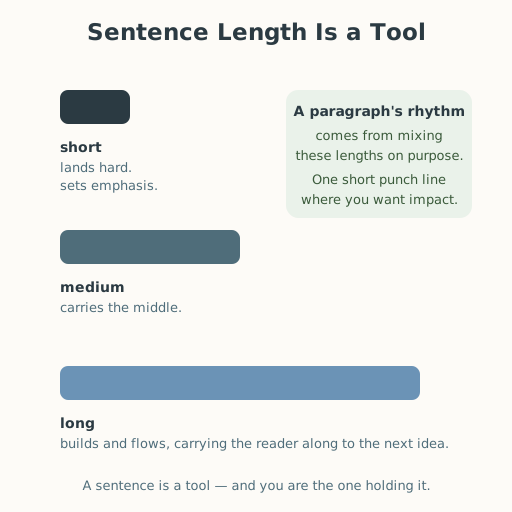
- Sentence-rhythm strip · 1 per learner A line for mapping a paragraph's sentence lengths — short, medium, long — to see the rhythm
- Word-choice ladder · 1 per learner A small set of near-synonyms to arrange from plain to precise to vivid, with notes on connotation
- Writing journal · 1 per learner
Low-tech / no-cost
- Paper strip with dashes for sentence lengths, or claps to mark rhythm Clap once per word to feel a sentence's length and beat
- Voice and body Read a paragraph aloud twice — once flat, once with the rhythm — and feel how sentence length steers the reader
Enriched / lab & device
- A word processor or editing view (optional) · 1 per learner To see sentence lengths as a column and revise with copy-paste
- A thesaurus or dictionary, print or digital (optional) · 1 per pair To test near-synonyms and their exact meanings and connotations
Works in different contexts
- large-group Model one revision whole-class, then learners revise their own paragraph and read the before and after aloud in pairs
- multi-age Younger writers vary sentence length in a three-sentence draft; older writers revise word choice for precision and connotation
- self-directed A learner maps their own paragraph's rhythm, revises it twice (once for length, once for word choice), and explains each change
- level-grouped Learners grouped by readiness practice different moves — rhythm for some, connotation and tone for others — then compare
- outdoor-only Write a paragraph about what is around you, then clap its rhythm and rewrite it with one short punch sentence and one long flowing one
Lesson 11 — Crafting Prose: Sentences and Word Choice
Summary
Learners craft prose with deliberate style, beginning with the sentence. They map a paragraph’s rhythm — short, medium, and long sentences — vary it on purpose, and sharpen word choice for precision and connotation. They revise a draft twice and explain each change, treating style as a set of choices rather than a fixed talent.
Objectives
- Craft prose with deliberate style, varying sentence structure and word choice to suit purpose and audience — beginning with the sentence itself. (D04.S3.10.01)
Connection
Read these two lines aloud: “The fire was out. The house was cold. We waited.” Now: “The fire had long since gone out, and the house had settled into the kind of cold that seeps into your bones, so we waited.” Same facts, two rhythms — the first short and hard, the second long and sinking. Writers do this on purpose: sentence length is a tool, like a drummer’s beat, and word choice is a tool, like a cook’s spice. Whether you are writing a letter, a post, a story, or an argument you want someone to actually read, the same question stands: what should this sentence do, and how can I make it do it?
Materials
- Sentence-rhythm strip
- Word-choice ladder
- Writing journal
Preparation
- Copy the rhythm strip and word-choice ladder.
- Retrieval: from Grade 9, recall writing with precise language and well-chosen details (D04.S3.07.01). Today we make the sentence the unit of craft.
- Prepare one worked example: a flat paragraph to revise aloud, once for rhythm and once for word choice.
Facilitator note
This lesson is written to the learner (“you”). The idea to land: style is choice, not talent — sentence length creates rhythm and emphasis (short sentences land hard; long ones carry and build), and word choice controls precision and connotation (what a word means, and what it makes a reader feel). This is the unit’s writing-craft thread (Lessons 11–12). Effective adolescent writing is taught with explicit strategies — models, sentence-level practice, and revision — not left to intuition (S-102; the writing process and explicit strategy instruction are the evidence-backed core). A worked example of revision is the key move: show a flat sentence become a crafted one, and name why each change works.
Model the skill once, then let learners practice (worked example → guided practice → independent work; S-011). The intellectual lens is the spine: revision is where thinking happens — each change is a decision with a reason. The critical-thinking lens: ask of every sentence “what is it doing, and is that what I want?” The ethics lens: precise, honest words serve truth; inflated or evasive words can be used to deceive — craft carries responsibility. The egalitarian lens: every learner’s home-language way of putting things is a resource, not an error — style may vary across languages and dialects, and none is “broken.” The global lens: sentence craft and word-choice art exist in every written and oral tradition — from a Bashō haiku’s compression (S-351) to a griot’s performance — and learners may draw on any of them. Preview: Lesson 12 turns from the sentence to tone — matching word and sentence to purpose and audience.
Procedure
- Recall (5 min). From Grade 9, what did you learn about choosing precise words? Today you make the sentence itself the thing you craft.
- Hear the rhythm (15 min). Look at the sentence-rhythm strip. A paragraph’s rhythm comes from sentence length: short sentences land hard and set emphasis; medium ones carry the middle; long ones build and flow. Watch a worked example: read a flat paragraph, then a revised one that mixes lengths on purpose. Clap the beats — one clap per word — to feel the difference.
- Map and vary your own (15 min). Take a paragraph you have already written. Map its sentence lengths on the strip. Then revise it: add one short punch sentence where you want emphasis, and one long flowing sentence where you want the reader to feel carried. Read both aloud.
- Climb the word ladder (12 min). Look at the word-choice ladder: a plain word, a more precise one, a vivid one — and note each word’s connotation (what it makes a reader feel). Replace three words in your paragraph with sharper choices, and write why each new word earns its place.
- Explain your craft (5 min). In your journal: I changed ___ to ___ because ___; the short sentence I added lands on the idea of ___.
- Close (3 min). Remember: a sentence is a tool, and you are the one holding it. Next time, you match that tool to a purpose and an audience.
Differentiation
- Support: Provide a pre-written paragraph and ask for one rhythm change and one word swap, with sentence starters for the “why.”
- Extension: Revise a paragraph three ways for three different purposes (to alarm, to reassure, to persuade), changing both rhythm and word choice each time.
Assessment
- Formative (self): Can the learner map a paragraph’s rhythm, revise it for length and word choice, and explain two specific changes?
- Portfolio artifact (unit): The “before and after” paragraph with explanations, added to the portfolio as the first styled-prose entry.
Home connection
Read your revised paragraph aloud to someone at home, first the “before,” then the “after.” Ask them which sentence stuck with them — that is your rhythm working.
Resources
- On explicit strategy instruction and the writing process (plan/draft/revise/edit) for adolescents: Graham & Perin, Writing Next (2007) (S-102).
- On compression and the single instant as craft across traditions: Encyclopaedia Britannica, “Matsuo Bashō,” https://www.britannica.com/biography/Basho (S-351).
- On modeling + guided practice before independent work: Kirschner, Sweller & Clark (2006), https://doi.org/10.1207/s15326985ep4102_1 (S-011).