Lesson 12 — Crafting Prose: Tone for Purpose and Audience
Learners choose and hold a tone to serve a purpose and reach an audience. They plan purpose, audience, and tone words, study one idea written three ways, then draft a short piece whose word choice and rhythm carry a single, deliberate tone — revising it for a different audience without changing the facts.
Objectives
Objectives
- D04.S3.10.01 Craft prose with deliberate style, varying sentence structure, word choice, and tone to suit purpose and audience.
Essential question
How do I choose a tone — warm, urgent, measured, firm — and hold it, to serve my purpose and reach my reader?
Key vocabulary
Materials
Standard materials
- Tone-for-purpose sheet · 1 per learner Three rows — purpose, audience, and tone words — to plan a short piece before writing
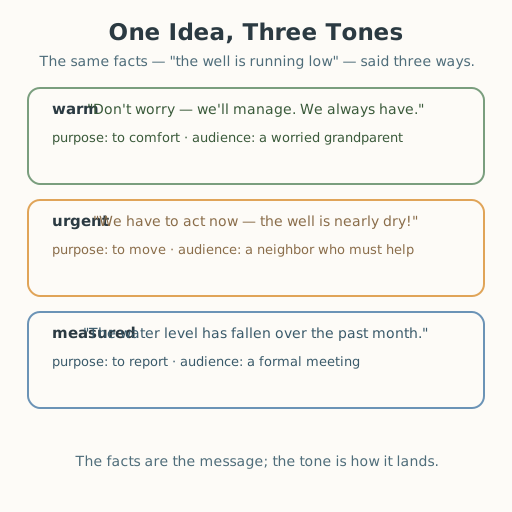
- One idea, three tones worked set · 1 per class The same message written in three tones (e.g., warm, urgent, measured) to compare
- Writing journal · 1 per learner
Low-tech / no-cost
- Paper sheet with the three rows drawn by hand Purpose / audience / tone words, plus space to draft
- Voice and body Read the same sentence in three tones aloud and have a listener guess the intended audience and purpose
Enriched / lab & device
- A word processor with a read-aloud feature (optional) · 1 per learner To hear the tone read back and check it matches the intention
- Short examples of one writer in two tones (optional) · 2 per class E.g., a personal letter and a public statement by the same person, to compare tone shifts
Works in different contexts
- large-group Model the tone plan whole-class, then learners draft individually and read their opening line aloud for the room to guess the tone
- multi-age Younger writers name one tone and write one sentence; older writers plan and hold a tone across a full short piece
- self-directed A learner plans purpose, audience, and tone, writes a short piece, then reads it aloud to check the tone holds
- level-grouped Learners ready to extend revise a piece's tone for a *different* audience without changing the facts, and explain each change
- outdoor-only Choose a real purpose from the surroundings — warn about a hazard, invite to a gathering — and write it in the tone the moment calls for
Lesson 12 — Crafting Prose: Tone for Purpose and Audience
Summary
Learners choose and hold a tone to serve a purpose and reach an audience. They plan purpose, audience, and tone words, study one idea written three ways, then draft a short piece whose word choice and rhythm carry a single, deliberate tone — and revise that piece for a different audience without changing the facts.
Objectives
- Craft prose with deliberate style, varying tone to suit purpose and audience. (D04.S3.10.01)
Connection
The same news — “the well is running low” — can be said gently to a worried grandparent, urgently to a neighbor, and flatly in a formal report. The facts do not change; the tone does, and the tone is what tells the reader how to feel and how to respond. A writer who has not chosen a tone has not really chosen what to say — the words just happen to them. Picking a tone on purpose, and holding it, is what turns a note into a message: a letter that comforts, a call that moves, an argument that persuades.
Materials
- Tone-for-purpose sheet
- “One idea, three tones” worked set
- Writing journal
Preparation
- Copy the tone-for-purpose sheet and the worked set.
- Retrieval: from Lesson 11, recall sentence rhythm and word choice. Today those tools are aimed at a purpose and an audience. From Lesson 4, recall register — tone is register’s emotional color.
- Prepare one worked example: one idea written warm, urgent, and measured.
Facilitator note
This lesson is written to the learner (“you”). The idea to land: tone is the emotional register of a piece, chosen to serve a purpose and an audience; it is carried by word choice and rhythm, and it must hold steady or it loses the reader. Tone and register (Lesson 4, S-237) are cousins: register is formality, tone is feeling. A deliberate writer plans both. The writing-craft evidence is explicit: adolescents write better when taught to plan for audience and purpose and to revise with models, not when left to intuition (S-102).
Model the skill once, then let learners practice (worked example → guided practice → independent work; S-011). The intellectual lens is the spine: the tone-for-purpose plan is a small act of design — name the goal, then choose the words that meet it. The ethics lens: tone can be used to calm or to inflame, to clarify or to mislead — the same facts, two tones, two effects; choosing tone is a moral choice as much as a craft one. The egalitarian lens: a reader’s home language and dialect shape which tones feel warm or cold; there is no universal “professional” tone, and a learner’s own way of putting things is not a defect to edit away. The global lens: cultures differ in what tone fits a given moment — what is polite in one may be cold in another — so tone is read in context, never as a fixed rule. The social-emotional lens: writing in a tone that does not come naturally (firm when you are shy, warm when you are formal) is a real stretch; normalize it and let learners name the feeling. Preview: Lesson 13 widens the canvas — composing not just words, but image, sound, and design.
Procedure
- Recall (5 min). From Lesson 11, what two tools did you practice? (Sentence rhythm and word choice.) Today you aim them at a purpose and an audience — that aim is called tone.
- Meet tone (15 min). Look at the “one idea, three tones” set: the same message written warm, urgent, and measured. Read each aloud. For each, name the tone, the purpose (to comfort? to move? to report?), and the likely audience. Notice which words carry the tone.
- Plan your piece (10 min). Fill the tone-for-purpose sheet: what is your purpose, who is your audience, and which three tone words (e.g., warm, steady, firm) will you hold? Choose a real message you want to send — a thank-you, a request, a warning, an argument.
- Draft in one tone (15 min). Write a short piece (a paragraph) that holds your chosen tone from first word to last. Use Lesson 11’s tools: a short sentence where you want emphasis, precise words that fit the tone.
- Read it back and revise (7 min). Read your piece aloud. Where does the tone slip? Fix one word or one sentence so the tone holds. Then — challenge — rewrite your opening line only for a different audience, keeping the facts identical.
- Close (3 min). Remember: the facts are the message; the tone is how it lands. You now choose both. Next time, you compose with more than words.
Differentiation
- Support: Provide a pre-chosen purpose and audience and a list of tone words to select from; draft two sentences rather than a paragraph.
- Extension: Revise the full piece for a second audience of a very different kind, and write a short note explaining each tonal change and why it serves the new reader.
Assessment
- Formative (self): Can the learner name their purpose, audience, and tone, draft a short piece that holds that tone, and explain one revision that restores it?
- Portfolio artifact (unit): The tone-for-purpose plan and the drafted piece, added to the portfolio as the second styled-prose entry.
Home connection
Read your piece to someone at home without telling them the tone you intended, and ask them to name it. If they name something different, that is useful information — revise one line together.
Resources
- On planning for audience and purpose and revising with models: Graham & Perin, Writing Next (2007) (S-102).
- On register and formality as communicative competence: Council of Europe, CEFR Companion Volume, https://www.coe.int/en/web/common-european-framework-reference-languages/companion-volume (S-237).
- On modeling + guided practice before independent work: Kirschner, Sweller & Clark (2006), https://doi.org/10.1207/s15326985ep4102_1 (S-011).