Lesson 03 — Exponential Growth and Decay: Base and Rate
Learners connect the base of an exponential expression to a growth or decay factor, distinguish growth rate from growth factor, and use roots to solve backward for an unknown base or time in doubling and half-life problems. They practice with concrete growth and decay scenarios and check answers by substitution.
Objectives
Objectives
- D05.S1.10.01 Use properties of exponents and roots to simplify expressions and solve problems involving exponential growth and decay.
Essential question
How do the base and the rate of a growth or decay process tell me how fast something doubles or fades, and how do I use roots to solve for the unknown?
Key vocabulary
Materials
Standard materials
- Growth-and-decay problem sheet · 1 per learner Worked and practice problems for doubling, half-life, and finding an unknown base or time with roots
- Math journal · 1 per learner
Low-tech / no-cost
- Counters, seeds, or pebbles Start with a pile and repeatedly multiply (double, halve) to see the factor at work by hand
- A clock or watch To time and narrate a real halving (e.g., a candle, a shadow, a shared amount)
Enriched / lab & device
- Calculator or spreadsheet · 1 per learner or pair To check growth over many steps and see the curve
Works in different contexts
- large-group Solve one worked example whole-class, then learners work in pairs on a mixed set and compare the key step (finding the base with a root)
- multi-age Younger learners compute a few forward steps by repeated multiplication; older learners solve backward for time or base using roots
- self-directed A learner follows the worked examples, then solves the practice set and checks each answer by substituting back
- level-grouped Group by fluency with roots from Lesson 2; a ready group extends to a fractional rate and a three-step decay problem
- outdoor-only Model growth and decay with natural quantities — a doubling plant, a halving shadow — and record each step as a factor
Lesson 3 — Exponential Growth and Decay: Base and Rate
Summary
Learners read the base of an exponential expression as a growth or decay factor, separate the rate from the factor, and use roots to solve backward for an unknown base or time in doubling and half-life problems. They work concrete growth and decay scenarios and check answers by substituting back.
Objectives
- Use properties of exponents and roots to solve problems involving exponential growth and decay — finding the base or the time from a known factor using roots. (D05.S1.10.01)
Connection
A medicine’s instructions might say “half leaves your body every six hours”; a savings notice says “5% a year”; a biologist says “this culture doubles every three hours.” These are the same sentence in different clothes: something is being multiplied by a fixed factor, again and again. If it doubles, the factor is 2; if it halves, the factor is ½. The factor and the rate are two ways of naming the same thing — a 5% growth is a factor of 1.05, a 5% decay is a factor of 0.95. Once you can read that factor, you can also work backward: “how long until it halves?” or “what rate makes it double in ten years?” — and roots are the tool that unlocks the backward question.
Materials
- Growth-and-decay problem sheet
- Math journal
Preparation
- Copy or draw the problem sheet.
- Retrieval: from Lesson 2, roots and rational exponents; from Grade 9, exponential functions in context (D05.S2.09.01). Today we solve backward with roots.
- Prepare worked examples for doubling, half-life, and finding an unknown base.
Facilitator note
This lesson is written to the learner (“you”). The idea to land: in exponential change, the base b is a factor — b = 1 + r for growth, b = 1 − r for decay — and roots let us solve backward for the base or the number of steps. Teach the two directions explicitly: forward (apply the factor repeatedly) and backward (take a root to find the factor, or reason about the number of steps). Use worked examples and guided practice (S-011).
The intellectual lens: the same equation bⁿ = c is read forward (“apply b, n times”) and backward (“what b, or what n, gives c?”). The critical-thinking lens: learners check every backward answer by substituting forward — “does 1.05⁷ actually give about 1.4?” The environment lens: half-life and doubling are the real language of pollution decay, medicine in the body, and population pressure — reading them honestly matters for the planet. The technology lens: sensors and models report growth and decay as rates; converting a rate to a factor is the first step to understanding what a device or dashboard is telling you. Preview: Lessons 7 and 8 build these same factors into full exponential functions and models.
Procedure
- Recall (5 min). From Lesson 2, what does x^(1/n) mean? If x³ = 8, what is x? Today we solve the same shape of question in real growth and decay.
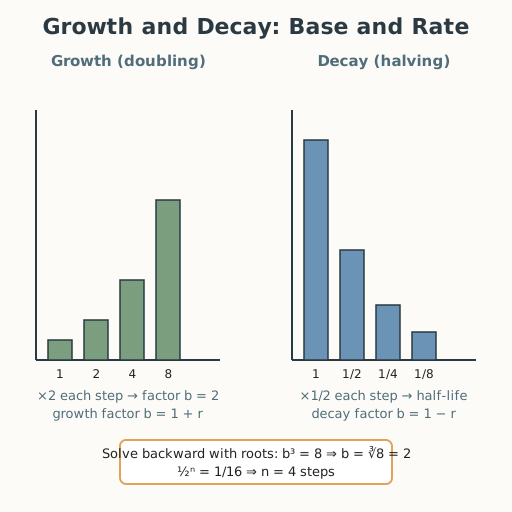
- Meet the factor (10 min). A quantity that changes by a fixed factor each step is exponential. Growth factor b = 1 + r (a 5% growth → b = 1.05). Decay factor b = 1 − r (a 5% decay → b = 0.95). A half-life is decay with b = ½; doubling time is growth with b = 2. Worked example: a culture doubles every 3 hours. Starting from 100, after 3, 6, 9 hours it is 200, 400, 800 — that is 100 · 2¹, 100 · 2², 100 · 2³.
- Solve backward with roots (15 min). Watch two worked examples:
- Find the base: a quantity grows to 8 times its size in 3 steps. Then b³ = 8, so b = ∛8 = 2 — it doubles each step.
- Find the steps: a quantity halves each step; after how many steps is it 1/16 of its start? ½ⁿ = 1/16, so n = 4 steps. Notice the root undoes the power (Lesson 2).
- Guided practice (15 min). With a partner: (a) a medicine has a half-life of 6 hours; after 24 hours, what fraction remains? (b) a population grows 50% a year; what is the yearly factor? (c) an amount grows by a fixed factor each year and triples in 2 years; find the factor. Check each by substituting forward.
- Independent practice (5 min). In your journal, write one growth and one decay scenario from your own life, give each a factor, and solve one backward question about it with a root.
- Close (5 min). Say the difference between a rate (5%) and a factor (1.05), and name the tool that solves backward for the factor.
Differentiation
- Support: Work only forward first (compute 2–3 steps by repeated multiplication), then solve for a whole-number base (b³ = 8).
- Extension: Solve for a base with a fractional exponent, e.g. b⁴ = 10, giving b = 10^(1/4), and interpret the answer.
Assessment
- Formative (peer + self): Can the learner state the factor from a rate (and vice versa) and solve a backward growth/decay problem using a root, with a substitution check?
- Portfolio artifact (unit): The completed problem sheet with the self-written growth and decay scenarios, added to the number toolkit.
Home connection
Find something at home that doubles or halves — yeast rising, a battery draining, a prescription dose. Write its factor, and predict where it will be after three steps. Check your prediction if you can.
Resources
- On worked examples and guided practice: Kirschner, Sweller & Clark (2006), https://doi.org/10.1207/s15326985ep4102_1 (S-011).