Lesson 04 — Complex Numbers: Why New Numbers Arise
Learners discover why a number whose square is negative was invented — not as a trick but as a need that arose from real problems — and learn to write, plot, and operate with complex numbers a + bi. They connect the story to the history of algebra across cultures and explain, in their own words, why new kinds of numbers arise.
Objectives
Objectives
- D05.S1.10.02 Extend number reasoning to complex numbers and explain why new kinds of numbers arise from real problems.
Essential question
Why do we invent a new kind of number whose square is negative, and what can it do that the old numbers cannot?
Key vocabulary
Materials
Standard materials
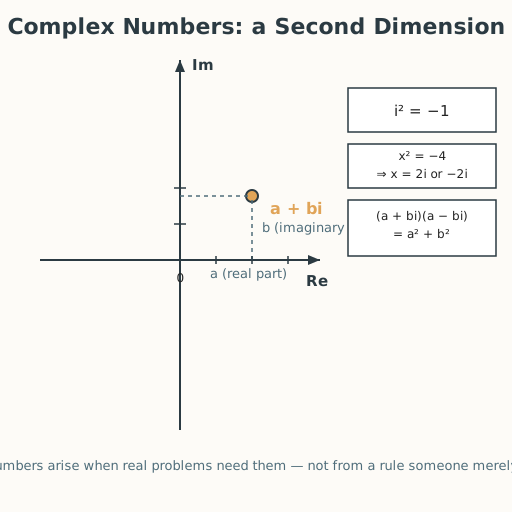
- Complex-number map · 1 per learner A diagram of the complex plane (horizontal real axis, vertical imaginary axis) with a + bi located, plus arithmetic examples
- Math journal · 1 per learner
Low-tech / no-cost
- A number line drawn on the ground Extend it with a second perpendicular axis in chalk or string to make the complex plane by hand
- Voice and body Walk the real axis, then step "off the line" to a second direction — the picture of a second dimension of number
Enriched / lab & device
- Graph paper or a coordinate grid · 1 per learner To plot complex numbers and see addition as the parallelogram of two steps
- Calculator (optional) · 1 per pair To verify products like (3 + 4i)(3 − 4i)
Works in different contexts
- large-group Build the complex plane once whole-class, then learners plot and combine numbers in pairs and compare placements
- multi-age Younger learners plot a + bi as two coordinates; older learners multiply, use conjugates, and explain why i² = −1 is consistent
- self-directed A learner follows the worked arithmetic, plots each result to self-check, then writes the "why new numbers" explanation
- level-grouped Group by comfort with the exponent rules; a ready group extends to the quadratic formula with a negative discriminant
- outdoor-only Lay two crossing ropes as axes outdoors and stand at the point (a, b) to feel a complex number as a place, not just a symbol
Lesson 4 — Complex Numbers: Why New Numbers Arise
Summary
Learners see that a number whose square is negative was needed, not invented for fun — it arose from real problems about solving equations — and learn to write, plot, and operate with complex numbers a + bi. They connect this to the history of algebra across cultures and explain why new kinds of numbers arise.
Objectives
- Extend number reasoning to complex numbers and explain why new kinds of numbers arise from real problems. (D05.S1.10.02)
Connection
Every new kind of number was once a scandal. Zero, negative numbers, and fractions each had to be argued for, because they answered questions the old numbers could not. Now ask: what number times itself gives −1? No ordinary number works — positive squares are positive, negative squares are positive too. For a long time mathematicians hit this wall and turned back. But the wall kept appearing inside real problems — like finding where a curve crosses a line — and the people who finally walked through it found that a “number whose square is −1” opens a whole second dimension of arithmetic. Today we meet that number, call it i, and see that a complex number is just a place on a plane — two ordinary numbers bundled together.
Materials
- Complex-number map
- Math journal
Preparation
- Copy or draw the complex-number map.
- Retrieval: from Lesson 2, roots and the idea that not every length is a fraction; from Grade 9, solving quadratics (D05.S2.09.02). Today: what if a square is negative?
- Prepare worked examples of complex addition, multiplication, and conjugates.
Facilitator note
This lesson is written to the learner (“you”). The idea to land: the imaginary unit i (with i² = −1) extends number to a second dimension, and it was needed — it arose from real problems, not from a rule someone liked. Teach the arithmetic explicitly with worked examples (S-011), and let the “why” story carry the motivation.
The global lens is central: the idea that new numbers are needed to solve equations has deep roots in algebra’s own history. The word “algebra” comes from al-jabr in the 9th-century work of the scholar al-Khwarizmi (S-293, S-431), who solved quadratics by completing the square and justified them geometrically; the Persian poet-mathematician Omar Khayyam (11th–12th century) solved cubic equations by intersecting curves geometrically (S-296). In 16th-century Italy, solving the cubic forced mathematicians to let square roots of negatives appear mid-calculation, even when the final answer was an ordinary real number — the standard account of how complex numbers became respectable (S-240, as a general authority; hold the “first” claim lightly). The intellectual lens: a new number is defined by a consistent rule (i² = −1), and everything else follows. The critical-thinking lens: ask whether a new kind of number is consistent and useful — that, not familiarity, is the test. The technology lens: complex numbers are not an oddity — they are the daily language of alternating current, signal processing, and the wave mathematics behind screens and radio. Preview: Lesson 5 turns from numbers to functions.
Procedure
- Recall (5 min). From Grade 9: solve x² = 4 and x² = −4. The first has answers 2 and −2; the second has none among the numbers you know. Is “no answer” the end, or a door?
- Meet i (10 min). Define the imaginary unit i so that i² = −1. Then x² = −4 has answers 2i and −2i, because (2i)² = 4·(−1) = −4. A complex number is a + bi, where a and b are real: a is the real part, b the imaginary part. Real numbers are the special case b = 0.
- Plot it (10 min). On the complex-number map, put the real part on the horizontal axis and the imaginary part on the vertical axis. Plot 3 + 4i as the point (3, 4). Notice: a complex number is a place, like a coordinate — two ordinary numbers bundled into one.
- Operate (15 min). Worked examples, then guided practice:
- Add: (2 + 3i) + (1 + 5i) = 3 + 8i (add real parts, add imaginary parts).
- Multiply: (2 + i)(1 + 3i) = 2 + 6i + i + 3i² = 2 + 7i − 3 = −1 + 7i, because i² = −1.
- Conjugate: the complex conjugate of a + bi is a − bi. Their product is always a real number: (a + bi)(a − bi) = a² + b².
- Explain why (10 min). In your journal, answer in your own words: why do new kinds of numbers arise? Use zero, negative numbers, or complex numbers as your evidence, and name one real problem each new number solved.
- Close (5 min). Say one thing a complex number can do that a real number alone cannot.
Differentiation
- Support: Plot only first, then add; give the “why” explanation as a sentence starter (“A new number arises when…”).
- Extension: Solve a quadratic with a negative discriminant (e.g. x² + 1 = 0) and express the answers in a + bi form.
Assessment
- Formative (self + peer): Can the learner add, multiply, and conjugate complex numbers, and explain why complex numbers arose?
- Portfolio artifact (unit): The complex-number map with the written “why new numbers arise” explanation, as the unit’s “number extension” page.
Home connection
Tell someone the story of i: “a number whose square is −1 was needed to finish real problems, so we made one — and it turned out to be a place on a plane.” Ask them if they can think of another time people invented a new tool to finish a job.
Resources
- On the word “algebra” and al-Khwarizmi: MacTutor, “Al-Khwarizmi,” https://mathshistory.st-andrews.ac.uk/Biographies/Al-Khwarizmi/ (S-293); and Wikipedia, “Muhammad ibn Musa al-Khwarizmi,” https://en.wikipedia.org/wiki/Muhammad_ibn_Musa_al-Khwarizmi (S-431).
- On Omar Khayyam’s geometric solutions of equations: MacTutor, “Omar Khayyam,” https://mathshistory.st-andrews.ac.uk/Biographies/Khayyam/ (S-296).
- On history-of-mathematics background: MacTutor History of Mathematics Archive, https://mathshistory.st-andrews.ac.uk/ (S-240).
- On worked examples for novices: Kirschner, Sweller & Clark (2006), https://doi.org/10.1207/s15326985ep4102_1 (S-011).