Lesson 05 — Polynomial Functions: Shape and Key Features
Learners grow from linear and quadratic functions to polynomials of higher degree, and learn to read a polynomial's key features — zeros, turning points, and end behavior — from its factored form and graph. They model a real relationship (a box's volume, a projectile's height) and describe what each feature means in context.
Objectives
Objectives
- D05.S2.10.01 Build and interpret polynomial and rational functions that model real relationships and describe their key features.
Essential question
What do the key features of a polynomial function — its zeros, turning points, and end behavior — tell me about the real relationship it models?
Key vocabulary
Materials
Standard materials
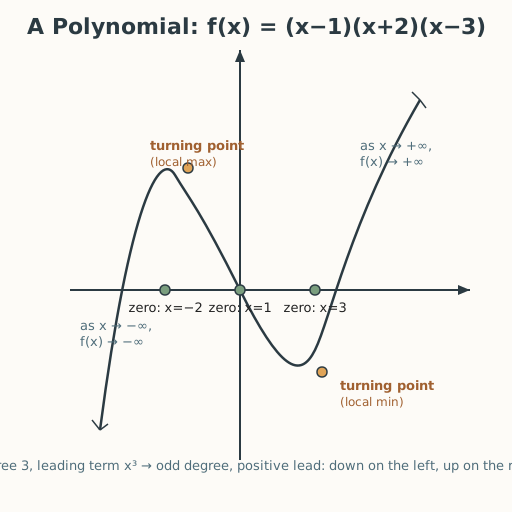
- Polynomial-features chart · 1 per learner A labeled graph of a cubic showing zeros, turning points, and end behavior, with a checklist of features to find
- Graph paper · 1 per learner
- Math journal · 1 per learner
Low-tech / no-cost
- A stick or arm to trace curves in the air Sweep out a cubic's rise-fall-rise shape with a hand to feel the turning points before drawing
- String or rope laid on the ground Bend it into a cubic shape and mark where it crosses a straight line (the zeros)
Enriched / lab & device
- Graphing calculator or graphing software · 1 per learner or pair To graph a cubic and a quartic and confirm the number of turning points
Works in different contexts
- large-group Sketch one cubic whole-class on a large board, then learners sketch their own and compare feature checklists in pairs
- multi-age Younger learners find zeros of factored quadratics; older learners sketch cubics and quartics and reason about end behavior
- self-directed A learner follows the worked sketch, then sketches a new polynomial and checks each feature against the factored form
- level-grouped Group by fluency with factoring from Grade 9; a ready group extends to a polynomial given by its zeros (building the factors)
- outdoor-only Sketch curves in the ground and mark where they cross the baseline; read the crossings as zeros
Lesson 5 — Polynomial Functions: Shape and Key Features
Summary
Learners extend from linear and quadratic functions to polynomials of higher degree, reading a polynomial’s zeros, turning points, and end behavior from its factored form and graph. They model a real relationship — a box’s volume, a projectile’s height — and say what each feature means in context.
Objectives
- Build and interpret polynomial functions that model real relationships and describe their key features. (D05.S2.10.01)
Connection
Cut the corners from a square of cardboard and fold up the sides to make a box. The volume of that box is a polynomial in the side length: too small a cut and the box is shallow, too large and the base is tiny, and somewhere in between the volume is biggest. The shape of that relationship — where it rises, where it turns, where it crosses zero (a box of zero volume) — is exactly what a polynomial function’s key features describe. A thrown ball’s height over time is another polynomial, a parabola. Polynomials are how we describe any smooth curve built from powers of a single quantity, and their features carry real meaning: zeros are “nothing left,” turning points are “the most,” end behavior is “where it goes from here.”
Materials
- Polynomial-features chart
- Graph paper
- Math journal
Preparation
- Copy or draw the polynomial-features chart.
- Retrieval: from Grade 9, linear and quadratic functions and their graphs (D05.S2.09.01, D05.S2.09.02). Today we add degree and look at features that generalize to cubics and beyond.
- Prepare a worked sketch of a factored cubic.
Facilitator note
This lesson is written to the learner (“you”). The idea to land: a polynomial is a sum of powers of x with constant coefficients, and its key features — zeros, turning points, end behavior — can be read from its factored form and carry meaning in a real model. Teach the feature-finding routine explicitly (factor → zeros; degree and leading coefficient → end behavior; sketch → turning points), then let learners practice (S-011).
The intellectual lens: the degree and leading coefficient are a shortcut to the shape, but they can be justified, not memorized. The critical-thinking lens: ask learners to connect each feature to a real question (“when is the volume zero? when is it largest?”). The environment lens: projectile motion — height as a quadratic in time — is a standard, openly licensed model (S-435), and the same shape governs other rise-and-fall processes in nature. The technology lens: a graphing tool confirms a sketch but should not replace the reasoning; read the tool with the math, not instead of it. Preview: Lesson 6 turns to rational functions — ratios of polynomials that model rates and proportions.
Procedure
- Recall (5 min). From Grade 9: what shape is a quadratic, and what do its x-intercepts tell you? What does the sign of the leading coefficient tell you about a parabola?
- Meet polynomials (10 min). A polynomial is a sum of terms like aₙxⁿ. Its degree is the highest power; the leading coefficient is the number on that term. You already know degree 1 (linear) and degree 2 (quadratic). Today we add degree 3 (cubic) and 4 (quartic).
- Read the features (15 min). Worked example: f(x) = (x − 1)(x + 2)(x − 3).
- Zeros: set each factor to zero → x = 1, −2, 3. These are the x-intercepts.
- End behavior: the leading term (after multiplying) is x³, so as x → +∞, f(x) → +∞, and as x → −∞, f(x) → −∞ (an odd degree with a positive leading coefficient).
- Turning points: a cubic has at most two; sketch the curve rising, falling, rising to hit the three zeros in order. Mark each feature on the chart.
- Model something real (15 min). The volume of a box made by cutting squares of side x from a 10-by-10 sheet is V(x) = x(10 − 2x)². Find: (a) the zeros and what each means (x = 0 and x = 5 → zero volume); (b) the end behavior (degree 3, leading term +4x³ → up on the right and down on the left — but the real box only makes sense on 0 < x < 5, where the base’s side 10 − 2x is positive, so the model is restricted to that interval). Sketch it.
- Guided practice (5 min). With a partner, sketch g(x) = x²(x − 2) and identify its zeros and end behavior.
- Close (5 min). Say in one sentence what the zeros, turning points, and end behavior tell you about a real relationship.
Differentiation
- Support: Find zeros of a factored quadratic first, then a factored cubic with integer roots.
- Extension: Sketch a polynomial from its zeros alone (build the factors), and explain why the leading coefficient’s sign sets the far ends.
Assessment
- Formative (peer + self): Can the learner find zeros, describe end behavior, and locate turning points of a factored polynomial, and state what each means in the box model?
- Portfolio artifact (unit): The labeled polynomial-features chart with the box model, added to the functions toolkit.
Home connection
Find a curve around you — an arch, a hill, a ball’s flight. Ask: where does it cross the ground (zeros), where does it peak (turning point), and where does it go far from the middle (end behavior)?
Resources
- On quadratics as models of projectile motion: OpenStax, “Algebra and Trigonometry 2e” (and “College Physics 2e”), https://openstax.org/details/books/algebra-and-trigonometry-2e (S-435).
- On worked examples and guided practice: Kirschner, Sweller & Clark (2006), https://doi.org/10.1207/s15326985ep4102_1 (S-011).