Lesson 14 — Expected Value: Reading Risk and Decisions
Learners meet expected value as the weighted average of outcomes, use it to judge games, insurance, and real decisions, and see that a "fair" choice is a matter of both the arithmetic and of who bears the risk. The lesson closes with a spaced, interleaved review of the unit's four strands and assembly of the portfolio.
Objectives
Objectives
- D05.S4.10.02 Use probability rules to compute probabilities of compound events and interpret expected value in everyday decisions.
Essential question
How does expected value turn a decision under uncertainty into a number I can read — and what does it tell me about games, insurance, and who bears risk?
Key vocabulary
Materials
Standard materials
- Expected-value worksheet · 1 per learner Worked and practice problems for games, insurance, and a real decision, with a decision line
- Math journal · 1 per learner
Low-tech / no-cost
- Counters or coins as "stakes" Play a small game for imaginary stakes and compute its expected value by hand
- A decision line drawn in the ground Place each option's expected value on a line to compare them visibly
Enriched / lab & device
- Spreadsheet or calculator · 1 per learner or pair To compute expected values for several options and compare them quickly
Works in different contexts
- large-group Compute one game's expected value whole-class, then learners evaluate two real options in pairs and compare their lines
- multi-age Younger learners compute a two-outcome expected value by hand; older learners handle multi-outcome decisions and critique insurance pricing
- self-directed A learner follows the worked examples, then evaluates a real decision from their own life and checks the arithmetic
- level-grouped Group by comfort with weighted averages; a ready group extends to comparing a fair game with a rigged one and explaining the gap
- outdoor-only Play a simple stakes game outdoors with found objects, compute its expected value, and judge whether it is fair
Lesson 14 — Expected Value: Reading Risk and Decisions
Summary
Learners meet expected value as the weighted average of outcomes, use it to judge games, insurance, and real decisions, and see that “fair” is a matter of both the arithmetic and of who bears the risk. The lesson closes with a spaced, interleaved review of the unit’s four strands and assembly of the portfolio.
Objectives
- Use probability rules to compute probabilities of compound events and interpret expected value in everyday decisions. (D05.S4.10.02)
Connection
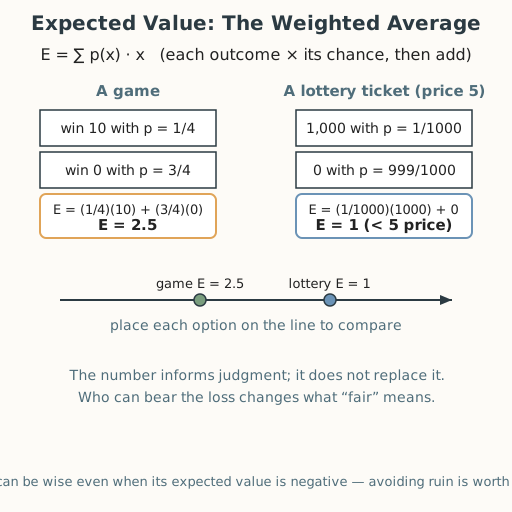
A lottery ticket costs more than it is, on average, worth — the expected value is less than the price, which is exactly how a lottery can fund anything. An insurance premium costs more than the average payout, because the insurer must pay for the service and the risk; yet insurance is still wise for you, because a rare-but-ruinous loss is worth paying to avoid. Expected value turns “should I?” into a number you can read: multiply each outcome by its chance and add them up. But the number is not the whole story — who can afford the loss changes what “fair” means. The arithmetic is for everyone; so is the right to decide with it.
Materials
- Expected-value worksheet
- Math journal
Preparation
- Copy or draw the expected-value worksheet.
- Retrieval (interleaved, brief): from Lesson 1, exponent rules; Lesson 4, complex numbers; Lesson 5/6, function features; Lesson 9/10, trig; Lesson 12/13, probability rules. Today: the decision side of chance, and the unit’s close.
- Prepare the game and insurance worked examples.
Facilitator note
This lesson is written to the learner (“you”). The idea to land: expected value is the probability-weighted average of outcomes, E = Σ p(x)·x, and it lets us compare risky options — but fairness also depends on who bears the risk, not only on the average. Teach the computation with worked examples (S-011), then let learners evaluate a real decision.
The intellectual lens: expected value is a weighted average — each outcome counts in proportion to its likelihood. The critical-thinking lens: a decision can be arithmetically “unfair” and still personally wise (insurance) — the number informs judgment, it does not replace it. The ethics lens: a game rigged against players, or a loan whose average cost falls hardest on the poor, is a moral question the arithmetic can reveal but not settle. The egalitarian lens: who can absorb a loss changes what “fair risk” means; a 1% chance of ruin is trivial to the wealthy and devastating to the poor — so equal odds are not always equal fairness. The global lens: the mathematical study of expected value grew from questions about dividing stakes in interrupted games of chance, worked out by Pascal and Fermat in the 17th century (S-301) — one chapter in a worldwide history of deciding under uncertainty. Close by assembling the unit portfolio and doing a spaced, interleaved recall of all four strands (S-039).
Procedure
- Recall, interleaved (5 min). One line each: what is the growth factor for 5% growth? What is i²? What is an asymptote? What is the sine of 30°? What is P(A|B)?
- Meet expected value (15 min). The expected value of a choice is the weighted average of its outcomes: E = Σ p(x)·x — multiply each outcome by its probability and add. Worked example: a game pays 10 with probability 1/4 and 0 with probability 3/4; its expected value is (1/4)(10) + (3/4)(0) = 2.5. A game is fair if its expected value equals what you pay to play.
- Read a lottery and an insurance (15 min). Worked examples:
- Lottery: a ticket costs 5 and has a 1-in-1,000 chance of 1,000 (and otherwise nothing). Expected value = (1/1000)(1000) + (999/1000)(0) = 1 — less than the 5 price, so the ticket is, on average, a losing bet.
- Insurance: a 1% chance of a 10,000 loss. Expected loss = 100. A premium above 100 pays for the insurer’s cost — yet buying it can still be wise if a 10,000 loss would ruin you. The arithmetic is one thing; your ability to bear the loss is another.
- Decide and defend (10 min). Choose one real decision — a bet, a repair now vs. later, a crop choice, a journey — compute its expected value, and write two sentences: what the number says, and what it leaves out (who bears the risk).
- Assemble the portfolio (5 min). Gather this unit’s artifacts — the power-rules card, the complex-number map, the function charts, the surveying work, the probability tables — into a portfolio. On the cover, write one sentence you now believe about what mathematics is for.
- Close (5 min). Say the difference between “expected value” and “what will happen,” and name one decision the number alone cannot make for you.
Differentiation
- Support: Compute a two-outcome expected value with a worked layout first; use whole-number payoffs.
- Extension: Design a game whose expected value is exactly fair, then modify one payoff to make it unfair and explain the change.
Assessment
- Formative (peer + self): Can the learner compute an expected value, judge a game or premium against it, and explain what the number leaves out?
- Summative (portfolio, unit): The assembled unit portfolio, reviewed for completeness across all four strands and for the learner’s own closing statement.
Home connection
Ask an adult about a real risk they weigh — a purchase, a trip, a repair. Compute its expected value together, and talk about what the number does and does not tell you about the decision.
Resources
- On expected value and the origin of probability theory (Pascal and Fermat): Encyclopaedia Britannica, “Probability and statistics,” https://www.britannica.com/science/probability (S-301).
- On retrieval practice and spacing: Dunlosky et al. (2013), https://doi.org/10.1177/1529100612453266 (S-039).
- On worked examples and guided practice: Kirschner, Sweller & Clark (2006), https://doi.org/10.1207/s15326985ep4102_1 (S-011).