Lesson 13 — Independence and Conditional Probability: Reading Screening Tests
Learners meet conditional probability P(A|B), define independence, and use both to read a screening test honestly — discovering that with a rare disease, most positives can be false. They reflect on what that means for who is tested, how results are communicated, and whether testing is fair.
Objectives
Objectives
- D05.S4.10.01 Understand independence and conditional probability and use them to interpret real situations such as screening tests and risk.
Essential question
How does new information change a probability, and why can a "positive" screening test still mean a person is probably fine?
Key vocabulary
Materials
Standard materials
- Screening-test worksheet · 1 per learner A worked two-by-two table for a rare disease with sensitivity and specificity, plus practice scenarios
- Math journal · 1 per learner
Low-tech / no-cost
- Colored counters for "ill" and "well" Sort counters into a two-by-two table by hand to see true and false positives and negatives
- A two-by-two table drawn in the ground Fill cells with found objects to act out a screening test on a pretend population
Enriched / lab & device
- Spreadsheet · 1 per learner or pair To compute P(disease | positive) for several prevalence levels and see how the answer changes
Works in different contexts
- large-group Work the rare-disease example whole-class on a big table, then learners recompute with a different prevalence in pairs
- multi-age Younger learners sort counters into the table and read the fractions; older learners compute P(A|B), test independence, and explain the base-rate effect
- self-directed A learner follows the worked table, then recomputes for a different disease and writes the "why the positive test can mislead" explanation
- level-grouped Group by comfort with fractions and ratios; a ready group extends to comparing two tests or to a decision about retesting
- outdoor-only Act out a screening test on a group of learners (or found objects) outdoors, filling a ground-drawn table and reading the fractions
Lesson 13 — Independence and Conditional Probability: Reading Screening Tests
Summary
Learners meet conditional probability P(A|B), define independence, and use both to read a screening test honestly — discovering that when a disease is rare, most positive results can be false. They reflect on what that means for who gets tested, how results are communicated, and whether testing is fair.
Objectives
- Understand independence and conditional probability and use them to interpret real situations such as screening tests and risk. (D05.S4.10.01)
Connection
A screening test is 99% accurate. You take it, and it comes back positive. Surely you almost certainly have the disease — right? Not necessarily. If the disease is rare — say 1 in 1,000 people have it — then even a very good test will “find” far more healthy people by mistake than truly sick people, simply because there are so many more healthy people to mistake. The math is a humbling, life-relevant truth: new information changes a probability, but the base rate matters just as much as the test. Reading this honestly protects people from needless fear, needless treatment, and unfair labeling — and it is exactly what conditional probability is for.
Materials
- Screening-test worksheet
- Math journal
Preparation
- Copy or draw the screening-test worksheet.
- Retrieval: from Lesson 12, two-way tables and the multiplication rule; from Grade 9, conditional relative frequencies (D05.S4.09.02). Today we formalize P(A|B) and independence.
- Prepare the rare-disease worked table.
Facilitator note
This lesson is written to the learner (“you”). The idea to land: conditional probability P(A|B) = P(A and B) / P(B) measures how knowing B changes the chance of A; independence means P(A|B) = P(A); and for screening tests the key insight is that with a rare condition, most positives are false — so the prevalence (base rate) matters as much as the test’s accuracy. Teach the computation with worked examples (S-011), and let the 2×2 table carry the reasoning.
The intellectual lens: the formula is just “restrict to the cases where B is true, and ask what fraction are A.” The critical-thinking lens: always ask “given what?” — a probability without its condition is incomplete. The ethics lens: a false alarm is not a harmless number — it is fear, cost, and sometimes treatment a person did not need; honest communication of risk is a duty, not a nicety. The egalitarian lens: who gets screened, who can afford follow-up, and how a “positive” label follows a person are questions of fairness — the same arithmetic lands differently on different people. The technology lens: screening, prediction, and risk scores are everywhere in health and beyond; the base-rate lesson applies to any “it flagged you” system. Preview: Lesson 14 ends the unit with expected value — the decision side of risk.
Procedure
- Recall (5 min). From Lesson 12, what is P(A and B) for two independent events? From Grade 9, what is a two-way table? Today we ask: how does knowing one thing change the chance of another?
- Meet conditional probability (10 min). P(A|B) is read “the probability of A given B” and equals P(A and B) / P(B). Worked example: from a deck, P(king | heart) = P(king and heart) / P(heart) = (1/52)/(13/52) = 1/13. Two events are independent if knowing one does not change the other: P(A|B) = P(A).
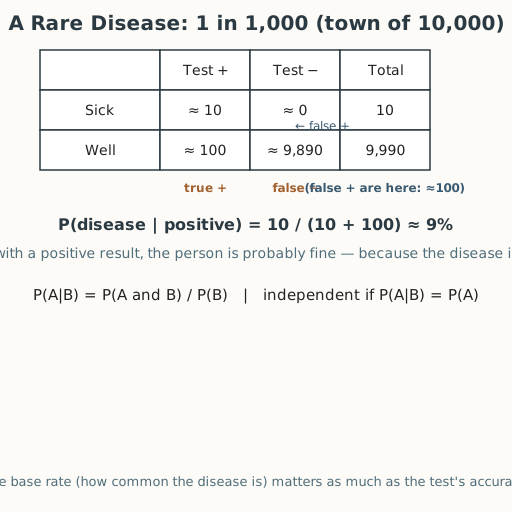
- Read a screening test (20 min). Work the table for a disease with prevalence
1 in 1,000 in a town of 10,000, and a test with sensitivity 99% (catches 99% of
the sick) and specificity 99% (clears 99% of the well):
- Sick: 10; well: 9,990.
- True positives: 99% of 10 ≈ 10. False negatives: ≈ 0.
- False positives: 1% of 9,990 ≈ 100. True negatives: ≈ 9,890.
- So P(disease | positive) ≈ 10 / (10 + 100) ≈ 9%. Even with a positive result, the person is probably fine — because the disease is rare. Recompute with a common disease (prevalence 10%) and see the answer change.
- Reflect (10 min). In your journal, answer: why can a positive test still mean “probably fine”? Who bears the cost of a false alarm — the person, the family, the system? What would make testing fairer?
- Close (5 min). Say in one sentence what P(A|B) measures and why the base rate matters as much as the test.
Differentiation
- Support: Fill the 2×2 table with counters first, then translate counts to fractions.
- Extension: Compute P(well | negative) for the same table and explain what a negative result tells you when the test is very sensitive.
Assessment
- Formative (peer + self): Can the learner compute a conditional probability from a 2×2 table, test for independence, and explain the base-rate effect in a screening scenario?
- Portfolio artifact (unit): The completed screening-test worksheet with the written reflection, added to the data-and-chance toolkit.
Home connection
Ask someone about a test or a prediction they have seen — medical, weather, or a “risk score.” Talk together about what the number was conditioned on, and whether the base rate was part of the story.
Resources
- On the origin of probability theory (for background on reasoning about risk): Encyclopaedia Britannica, “Probability and statistics,” https://www.britannica.com/science/probability (S-301).
- On worked examples and guided practice: Kirschner, Sweller & Clark (2006), https://doi.org/10.1207/s15326985ep4102_1 (S-011).