Lesson 03 — Why We Trust Science: Peer Review, Replication, Open Sharing
Learners meet the three social safeguards that make scientific knowledge trustworthy — peer review, replication, and open sharing — through the story of a claim that was announced, checked, and corrected. They then ask honestly where each safeguard falls short.
Objectives
Objectives
- D06.S1.10.02 Explain how peer review, replication, and open sharing make scientific knowledge trustworthy, and where they fall short.
Essential question
Why should I trust scientific knowledge at all — and what keeps it honest, and where do those safeguards fall short?
Key vocabulary
Materials
Standard materials
- Trust-in-science case sheet · 1 per learner A one-page account of the 2011 "faster-than-light neutrinos" claim (OPERA) and how open sharing, replication, and peer review corrected it
- Science journal · 1 per learner
Low-tech / no-cost
- Whisper-and-check game Pass a claim from person to person and have a second person re-test it, acting out replication without any equipment
- Voice and discussion Talk through the three safeguards aloud; no handouts required
Enriched / lab & device
- Internet access or a science news article · 1 per group Look up one recent retraction or replication study and trace which safeguard caught the error
Works in different contexts
- large-group Tell the OPERA story whole-class, then small groups each take one safeguard (peer review, replication, open sharing) and teach it back
- multi-age Younger learners act out "check with a friend before you believe it"; older learners analyze publication bias and the replication crisis
- self-directed A learner reads the case sheet, maps each safeguard to a step in the story, and writes the "where it falls short" reflection
- level-grouped Group by reading level; a ready group evaluates a second case (a retracted paper) against the same three safeguards
- outdoor-only Run the whisper-and-check game outdoors in a circle, then discuss which safeguard each step modeled
Lesson 3 — Why We Trust Science: Peer Review, Replication, Open Sharing
Summary
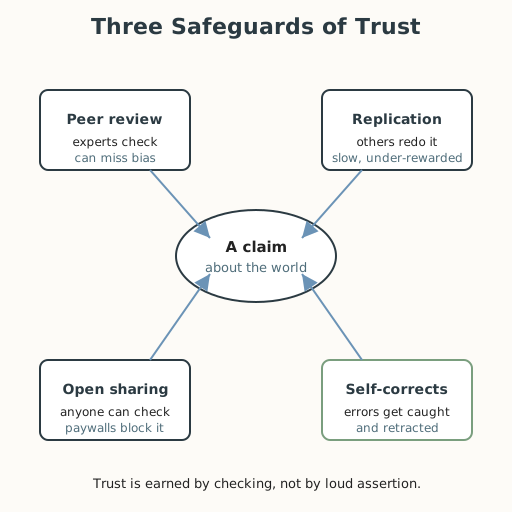
Learners meet the three social safeguards that make scientific knowledge trustworthy — peer review (experts check the work before it is published), replication (others redo the test and see if the result holds), and open sharing (methods and data are published so anyone can check). They see all three at work in the 2011 “faster-than-light neutrinos” claim, which was announced, checked, and honestly retracted. Then they ask where each safeguard falls short.
Objectives
- Explain how peer review, replication, and open sharing make scientific knowledge trustworthy, and where they fall short. (D06.S1.10.02)
Connection
A friend tells you something surprising. Before you believe it, you might ask a second friend to check, or watch it happen yourself, or ask “show me how you know.” Science is that habit, scaled up and made public: before a finding is trusted, other experts check it (peer review), other labs redo it (replication), and the methods are laid open so anyone can inspect them (open sharing). None of these is perfect — but together they make science self-correcting in a way no single person’s claim can be.
Materials
- Trust-in-science case sheet
- Science journal
Preparation
- Copy or draw the trust-in-science case sheet.
- Retrieval: from Grade 9, evaluating sources for reliability and bias (D06.S1.09.02); from Grade 8, how models are revised when new evidence appears (D06.S1.08.02). Today we name the social machinery that makes that revision possible.
- Prepare the OPERA story as a short narrative.
Facilitator note
This lesson is written to the learner (“you”). The idea to land: scientific knowledge is trustworthy not because scientists are infallible but because the process is public and self-correcting — peer review filters, replication tests, and open sharing lets outsiders check; and each of these can fall short (peer review can miss fraud, replication is under-rewarded, paywalls and secrecy block open sharing). Use the OPERA story as a concrete, faithful example of the machinery working (S-011 style: a worked example of “how a claim gets checked”).
The critical-thinking lens: the posture is “trust, but verify” — a finding is more trustworthy when it has been checked by others, not when it is asserted loudly. The ethics lens: honest error is corrected; hiding data or methods is a harm because it blocks correction. The egalitarian lens: open sharing is a justice issue — when knowledge sits behind paywalls, only the wealthy can check it, and that is a real failure of the system, not an accident (the open-access movement exists to fix this). The global lens: science is a worldwide, cross-cultural conversation; the OPERA result was checked by labs on several continents within months. Preview: Lesson 4 turns to life — how traits pass from parents to offspring.
Procedure
- Recall (5 min). From Grade 9, what makes a source reliable, and what is bias? Name one scientific claim you trust. Why do you trust it?
- Meet the three safeguards (15 min). Read the story. In 2011, an experiment (OPERA) seemed to show neutrinos moving faster than light — which would break a cornerstone of physics. The team did not hide it; they shared the result openly and asked others to check. Other labs tried to replicate it. Reviewers and critics pored over the method (peer review). Within months, a loose fiber-optic cable was found, the result was retracted, and physics stood. Trust was earned exactly because the claim could be checked and was checked.
- Map the safeguards (15 min). With a partner, match each safeguard to a step in the story, and then name how each could fail: peer review can miss fraud or bias; replication is slow and under-rewarded, so many results are never re-tested; open sharing fails when paywalls, patents, or secrecy keep others out.
- Reflect (15 min). In your journal, answer: why is a checked claim more trustworthy than an unchecked one? Who is left out when knowledge is locked behind a paywall — and why is that a fairness problem, not just an inconvenience?
- Close (5 min). In one sentence each: what do peer review, replication, and open sharing each contribute, and what is one way each can fall short?
Differentiation
- Support: Use the whisper-and-check game to feel each safeguard before naming it; provide a three-row table with one safeguard per row to fill in.
- Extension: Research one famous retraction or replication failure and write which safeguard caught it and which fell short.
Assessment
- Formative (peer + self): Can the learner explain each of the three safeguards, connect them to the OPERA case, and name at least one shortfall of each?
- Portfolio artifact (unit): The mapped case sheet with the written reflection on trust and access, added to the data-and-evidence toolkit.
Home connection
Ask someone at home: how do you decide whether to trust a surprising claim — online, at work, or in the news? Compare your family’s checks with science’s three safeguards.
Resources
- On peer review, replication, and open scrutiny as the social safeguards of trustworthy science: Understanding Science (UC Museum of Paleontology, Berkeley), “Scrutinizing science: peer review,” https://undsci.berkeley.edu/understanding-science-101/how-science-works/scrutinizing-science-peer-review/ (S-489).
- On the 2011 OPERA faster-than-light neutrino claim and its correction by open sharing, replication, and scrutiny: Wikipedia, “2011 OPERA faster-than-light neutrino anomaly,” https://en.wikipedia.org/wiki/Faster-than-light_neutrino_anomaly (S-488).
- On worked examples for novice learners: Kirschner, Sweller & Clark (2006), https://doi.org/10.1207/s15326985ep4102_1 (S-011).