Lesson 04 — Inheritance: How Traits Travel from Parents to Offspring
Learners explain how genetic information passes from parents to offspring through genes and alleles on chromosomes, and use a Punnett square to predict the traits of the next generation. They see that a trait can skip a generation while the information for it is carried silently.
Objectives
Objectives
- D06.S2.10.01 Explain how genetic information passes from parents to offspring, how mutations arise, and how the environment shapes how genes are expressed.
Essential question
How does genetic information pass from parents to offspring, and how can I predict the traits of the next generation?
Key vocabulary
Materials
Standard materials
- Inheritance worksheet · 1 per learner A worked monohybrid Punnett square (pea flower color) plus two practice crosses and a genotype/phenotype key
- Science journal · 1 per learner
Low-tech / no-cost
- Two colors of counters or seeds One color per allele; pair them into a 2-by-2 grid to act out a cross by hand
- A 2-by-2 grid drawn in the ground Place counters in the cells to build the Punnett square outdoors
- Voice and spoken letters Say each parent's allele aloud ("P or p"), list the four combinations by voice, and hear the 3-to-1 ratio — a non-visual, seated path to the same square
Enriched / lab & device
- Simulation applet or spreadsheet · 1 per learner or pair Run many crosses at once to see the 3:1 ratio emerge from large numbers
Works in different contexts
- large-group Build the worked cross whole-class on a big grid, then learners complete two crosses in pairs and trade to check
- multi-age Younger learners sort counters by color and read the fractions; older learners do a dihybrid cross or a human blood-type (codominance) example
- self-directed A learner follows the worked Punnett square, then self-checks two practice crosses against a key and writes the "why traits skip a generation" explanation
- level-grouped Group by comfort with ratios, not age; a ready group moves to probability-of-a-trait questions
- outdoor-only Use real pea or bean seeds of two colors to build crosses in a grid drawn on the ground
Lesson 4 — Inheritance: How Traits Travel from Parents to Offspring
Summary
Learners explain how genetic information passes from parents to offspring: genes are instructions carried on chromosomes, each parent contributes one allele of each gene, and the combination of alleles (the genotype) shapes the observable trait (the phenotype). They use a Punnett square to predict the next generation and see how a trait can skip a generation while its information is carried silently.
Objectives
- Explain how genetic information passes from parents to offspring, how mutations arise, and how the environment shapes how genes are expressed. (D06.S2.10.01)
Connection
You might have your mother’s eyes and your father’s height — or neither, because a trait can skip a generation. Underneath every visible resemblance is a set of instructions, genes, written in DNA, that you inherited half from each parent. When those two halves combine, they shuffle in a predictable way. A Punnett square is just a small table that lets you read that shuffle — the same logic a farmer or a family uses to wonder, “what will the next generation be like?”
Materials
- Inheritance worksheet
- Science journal
Preparation
- Copy or draw the inheritance worksheet.
- Retrieval: from Grade 5 and 7, traits pass from parents to offspring and vary within a family (D06.S2.05.02, D06.S2.07.01); from Grade 8, genes (DNA) carry instructions (D06.S2.08.01). Today we add the mechanism: alleles, dominant/recessive, and the Punnett square.
- Prepare one worked cross and two practice crosses.
Facilitator note
This lesson is written to the learner (“you”). The idea to land: each parent passes one allele of each gene to each offspring; a Punnett square lists all combinations, so the genotype ratios follow from the parents’ alleles; a recessive trait appears only when both alleles are recessive, which is why it can skip a generation. Teach the square as a worked example (S-011) — it is a procedural skill that benefits from explicit modeling before independent work.
The intellectual lens: the Punnett square is not magic — it is a complete list of equally likely combinations. The ethics lens: a person’s genes say nothing about their worth; history shows the harm of ranking people by inherited traits, and we explicitly reject that. The egalitarian lens: the machinery of inheritance is the same for every human on Earth — “race” is not a genetic category of value, and the variation within any group dwarfs the variation between groups. The global lens: people selected plants and animals with valued traits for thousands of years across every continent (S-178) long before Mendel named the rules in 1866 (S-177). Preview: Lesson 5 asks where new alleles come from — mutation.
Procedure
- Recall (5 min). From Grade 8, what are genes, and what do they do? Name one trait you see running in a family you know.
- Meet alleles and the square (15 min). In pea plants, flower color has two
alleles: P (purple, dominant) and p (white, recessive). Each plant carries
two alleles. Cross two plants that are both Pp (heterozygous):
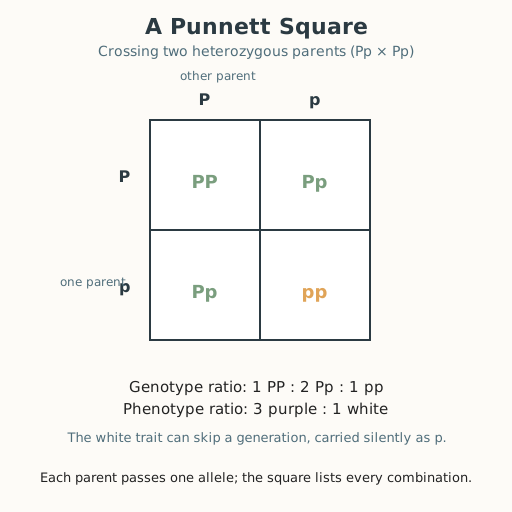
- Each parent can pass P or p. Put one parent’s P and p along the top, the other’s down the side, and fill the four boxes: PP, Pp, Pp, pp.
- Genotype ratio: 1 PP : 2 Pp : 1 pp. Phenotype ratio: 3 purple : 1 white — because purple (P) shows whenever one P is present. The white trait “hid” for a generation, then reappeared when two p’s met.
- Guided practice (15 min). With a partner, complete two crosses: Pp × pp, and PP × Pp. For each, give the genotype ratio and the phenotype ratio, and say whether the recessive trait can appear. Compare and agree before moving on.
- Independent practice (15 min). In your journal, cross Pp × Pp again but this time write, in your own words, why a trait can skip a generation. Then try a question: if a child shows a recessive trait, what must be true about each parent’s alleles?
- Close (5 min). In one sentence: what does a Punnett square actually list, and why can a recessive trait skip a generation?
Differentiation
- Support: Build the square with two colors of counters first, then translate to letters; provide a half-filled square to complete.
- Extension: Work a human blood-type cross (A/B/O) and explain codominance, or a two-gene (dihybrid) cross.
Assessment
- Formative (peer + self): Can the learner complete a Punnett square, state genotype and phenotype ratios, and explain why a recessive trait can skip a generation?
- Portfolio artifact (unit): The completed inheritance worksheet with the “skipping a generation” explanation, added to the living-systems section.
Home connection
Ask about a trait that runs in your family — a shape, a tendency, a look. Talk about which side it seems to come from, and whether it ever “skipped” anyone.
Resources
- On heredity, genes, and Mendelian inheritance: Encyclopaedia Britannica, “Heredity,” https://www.britannica.com/science/heredity-genetics (S-177).
- On worldwide plant and animal selection as background: FAO, Commission on Genetic Resources for Food and Agriculture, https://www.fao.org/cgrfa/en/ (S-178).
- On worked examples and guided practice: Kirschner, Sweller & Clark (2006), https://doi.org/10.1207/s15326985ep4102_1 (S-011).