Lesson 05 — Mutation: Where New Variation Comes From
Learners explain how mutations arise as changes to the DNA sequence — substitution, insertion, deletion — from copying errors and mutagens, and why most are neutral, a few are harmful, and a few are beneficial. They connect mutation to variation, the raw material for evolution.
Objectives
Objectives
- D06.S2.10.01 Explain how genetic information passes from parents to offspring, how mutations arise, and how the environment shapes how genes are expressed.
Essential question
Where does new variation come from, and why are most mutations neither a gift nor a disaster?
Key vocabulary
Materials
Standard materials
- Mutation worksheet · 1 per learner A short DNA letter-string with three mutation types (substitution, insertion, deletion) shown, plus practice strings to mutate and classify
- Science journal · 1 per learner
Low-tech / no-cost
- A string of beads or knots, or a line of letter cards Copy a sequence, then change one bead (substitute), add one (insert), or remove one (delete) to act out mutation
- Voice Read a "sentence" of letters aloud and let a partner change one letter and hear the result
Enriched / lab & device
- An online DNA-sequence viewer or animation · 1 per group See a real gene sequence and where mutations fall, and why some changes are silent
Works in different contexts
- large-group Model the three mutation types once whole-class on a letter string, then learners mutate their own strings in pairs and classify each other's
- multi-age Younger learners change one bead in a bead string and describe the change; older learners map a mutation to its possible effect on a protein
- self-directed A learner mutates practice strings, classifies each change, and writes the "most mutations are neutral" reflection using the worksheet key
- level-grouped Group by comfort with sequences; a ready group explores a real example (e.g., a sickle-cell or lactose-tolerance variant)
- outdoor-only Build a long line of leaves or stones as a "sequence," then substitute, insert, or remove one and describe the change
Lesson 5 — Mutation: Where New Variation Comes From
Summary
Learners explain how mutations arise: changes to the DNA sequence — a letter substituted, inserted, or deleted — caused by copying errors or by mutagens such as UV light, radiation, and certain chemicals. They learn that most mutations are neutral, a few are harmful, and a rare few are beneficial — and that this variation is the raw material that evolution acts on.
Objectives
- Explain how genetic information passes from parents to offspring, how mutations arise, and how the environment shapes how genes are expressed. (D06.S2.10.01)
Connection
Copy a recipe by hand a hundred times and occasionally you will skip a word or write the wrong letter. Your cells copy DNA constantly — and, very occasionally, they make the same kind of copying error. Most of these changes, or mutations, change nothing that matters; a few cause trouble; and a rare few turn out to be useful. That tiny trickle of change is why no two living things are exactly alike, and why life can adapt when the world changes.
Materials
- Mutation worksheet
- Science journal
Preparation
- Copy or draw the mutation worksheet.
- Retrieval: from Lesson 4, genes and alleles; from Grade 7, variation and natural selection (D06.S2.07.01). Today we ask where the variation itself comes from.
- Prepare one worked letter-string with the three mutation types.
Facilitator note
This lesson is written to the learner (“you”). The idea to land: a mutation is a change in the DNA sequence; substitutions, insertions, and deletions have different effects; most are neutral, some are harmful, a few are beneficial; and mutagens raise the rate of change. Teach the three types explicitly on a letter string (S-011), then let learners mutate and classify. Keep the values honest and non-eugenic: variation is normal, not a “defect,” and a mutation’s value depends on context — the same change can help in one environment and harm in another.
The ethics lens: how we talk about genetic difference matters — calling a person “defective” because of a variant is a value judgment, not a fact. The egalitarian lens: genetic variation is ordinary and universal; disability and difference are part of the human range, and every person’s worth is equal regardless of their sequence. The technology lens: mutagens (radiation, certain chemicals, some viruses) raise mutation rates, which is why safety rules and screening exist; and gene-editing tools now let us change sequences on purpose — a power with real ethical weight. The global lens: beneficial mutations — like the one that lets many adults digest milk (lactose tolerance) — spread differently in different human populations depending on history and diet (S-177). Preview: Lesson 6 asks how the environment shapes which genes are used — expression.
Procedure
- Recall (5 min). From Lesson 4, what is an allele? Where do new alleles come from? Today we answer that second question.
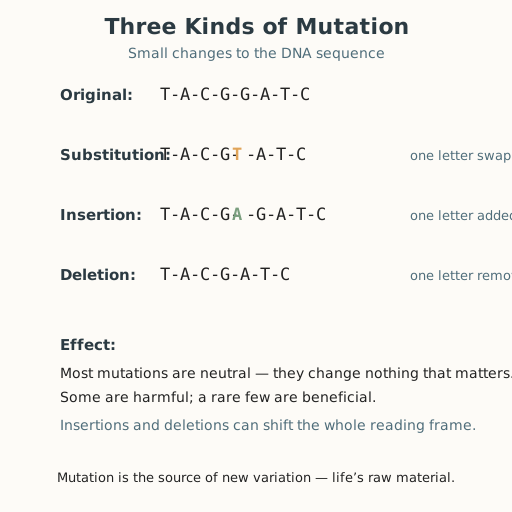
- Meet the three types (15 min). A gene is a string of DNA “letters.” Start with
a short string, e.g., T-A-C-G-G-A-T-C. Three things can go wrong in copying:
- Substitution: one letter swaps for another (T-A-C-G-T-A-T-C).
- Insertion: an extra letter slips in (T-A-C-G-A-G-A-T-C).
- Deletion: a letter is missed (T-A-C-G-A-T-C). Effects: substitutions often change nothing (a “silent” change) or a little; insertions and deletions can shift the whole reading frame, often with a bigger effect. Most mutations are neutral; some are harmful; a few are beneficial.
- Guided practice (15 min). With a partner, take a fresh letter string and apply one substitution, one insertion, and one deletion. Label each, and say whether it is likely neutral, harmful, or helpful — and why you think so. Compare and agree.
- Independent practice (15 min). In your journal, write one paragraph: why are most mutations neutral, and why is a small stream of mutations actually good for a species over long time? Name one mutagen and one safety practice that reduces exposure to it.
- Close (5 min). In one sentence each: what is a mutation, and what are its three common types?
Differentiation
- Support: Use a bead or letter-card string and physically make each change before naming it.
- Extension: Research one real human variant (e.g., lactose tolerance, or the sickle-cell allele and its relation to malaria) and explain its context-dependent value.
Assessment
- Formative (peer + self): Can the learner classify the three mutation types and explain why most are neutral and why variation matters?
- Portfolio artifact (unit): The mutated letter-strings with labels and the “neutral/broken/better” reflection, added to the living-systems section.
Home connection
Ask someone at home about a trait that seems to “run” only in part of the family or region. Wonder together where that difference might have first appeared.
Resources
- On heredity, variation, and mutations: Encyclopaedia Britannica, “Heredity,” https://www.britannica.com/science/heredity-genetics (S-177).
- On variation and natural selection (the role of new variation): Darwin, On the Origin of Species (1859) (S-303); and Grant & Grant, Darwin’s finches https://www.britannica.com/biography/Peter-Raymond-Grant (S-305).
- On worked examples: Kirschner, Sweller & Clark (2006), https://doi.org/10.1207/s15326985ep4102_1 (S-011).