Lesson 06 — Gene Expression: How the Environment Shapes What Genes Do
Learners distinguish genotype from phenotype and explain gene expression: genes are turned on and off, and the environment — nutrition, light, temperature, stress — shapes which genes are used, so the same genotype can produce different phenotypes. They touch epigenetics lightly.
Objectives
Objectives
- D06.S2.10.01 Explain how genetic information passes from parents to offspring, how mutations arise, and how the environment shapes how genes are expressed.
Essential question
If my genes are fixed, why does the environment still change what I become?
Key vocabulary
Materials
Standard materials
- Gene-expression worksheet · 1 per learner Two matched scenarios (same genes, different environment — a plant in sun vs. shade; nutrition affecting height) plus a "switch" diagram to label
- Science journal · 1 per learner
Low-tech / no-cost
- Two sprouts or seeds in two places Grow or imagine the same seed in light and in shade; compare what results
- Voice and drawing Draw the same "switchboard" of genes with some switches on and others off
Enriched / lab & device
- Time-lapse video of plants responding to light · 1 per group See gene expression visibly change a plant's shape without changing its genes
Works in different contexts
- large-group Build the "gene switchboard" once whole-class, then learners label it in pairs and trade examples
- multi-age Younger learners compare a plant in sun vs. shade; older learners connect expression to height/nutrition and epigenetics
- self-directed A learner completes the worksheet, self-checks against the key, and writes the "same genes, different environment" reflection
- level-grouped Group by comfort with cause-and-effect; a ready group researches an epigenetic example (e.g., how stress or diet leaves chemical tags)
- outdoor-only Find two plants of the same kind growing in different conditions outdoors and infer what the environment "turned on" in each
Lesson 6 — Gene Expression: How the Environment Shapes What Genes Do
Summary
Learners distinguish the genotype (the alleles you carry) from the phenotype (the traits you show), and explain gene expression: genes are switched on and off, and the environment — nutrition, light, temperature, stress, and toxins — shapes which genes are used. The same genotype can produce very different phenotypes, a fact with deep consequences for how we understand difference and opportunity.
Objectives
- Explain how genetic information passes from parents to offspring, how mutations arise, and how the environment shapes how genes are expressed. (D06.S2.10.01)
Connection
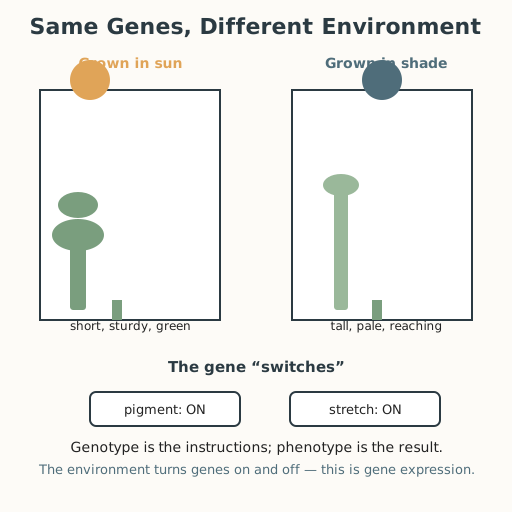
Plant two seeds from the same packet — one in bright sun, one in a dark corner. The sun-grown plant is short and sturdy; the shaded one stretches tall and pale, reaching for light. Same genes, different result. What changed was not the instructions but which instructions were used — which genes were switched on. Your own body does the same: what you eat, how you sleep, and the air you breathe all help decide which of your genes are active, and so help shape who you become.
Materials
- Gene-expression worksheet
- Science journal
Preparation
- Copy or draw the gene-expression worksheet.
- Retrieval: from Lesson 4, genotype and phenotype; from Grade 8, the environment interacts with genes (D06.S2.08.01). Today we name the mechanism: expression and regulation.
- Prepare the “gene switchboard” diagram.
Facilitator note
This lesson is written to the learner (“you”). The idea to land: genotype is the instructions, phenotype is the result, and expression is the volume control — the environment turns genes up, down, on, and off, so the same genotype can produce very different phenotypes. Teach the switchboard explicitly (S-011), then let learners apply it. This lesson carries a strong egalitarian point: because environment shapes expression, two children with equal potential can develop very differently under unequal conditions — a fact that points to fairness, not blame.
The ethics lens: understanding that environment shapes expression turns “he’s just built that way” into a question — what conditions shaped this? — which is the beginning of responsibility. The egalitarian lens: unequal environments produce unequal outcomes from equal potential; growth is measured against a wide normal range, not a single number (S-177). The environment lens: the same logic runs through the living world — a crop’s yield, a tree’s shape, an animal’s size all depend on what its surroundings switch on. The global lens: identical twins raised apart, or the same seed grown on two continents, show how much of any trait is environment — a reminder to be humble before any claim that a difference is “just in the genes.” Preview: Lesson 7 moves from the gene to the ecosystem and asks how human activity disrupts it.
Procedure
- Recall (5 min). From Lesson 4, what is the difference between genotype and phenotype? Name one trait of yours you think is more “genes” and one more “environment.”
- Meet the switchboard (15 min). Picture each gene as a switch with a volume knob. Your genotype is the full set of switches you were born with; your phenotype is the result of which switches are on and how loud. The environment moves the switches: sunlight turns on a plant’s pigment genes; good nutrition turns up growth genes; prolonged stress can change which genes are read. Some of these changes are temporary; some leave small chemical “tags” that persist — the beginning of epigenetics (changes in expression, not in the DNA sequence itself).
- Guided practice (15 min). With a partner, work two scenarios on the worksheet: a plant in sun vs. shade, and two children with the same height potential but very different nutrition. For each, name what the environment switched on or off, and what the resulting phenotype was. Compare and agree.
- Independent practice (15 min). In your journal, write: why can two people with the same genes (like identical twins) still turn out different? Then name one environmental condition in your own life that you think “switches on” something in you — and what.
- Close (5 min). In one sentence: what is gene expression, and how does the environment change it?
Differentiation
- Support: Use the sun/shade plant picture and label only “on” and “off” switches.
- Extension: Research one epigenetic example (e.g., how early nutrition or stress leaves chemical tags) and explain it in your own words.
Assessment
- Formative (peer + self): Can the learner explain genotype vs. phenotype, give a concrete example of the environment switching a gene on or off, and connect it to why the same genes can produce different outcomes?
- Portfolio artifact (unit): The completed switchboard worksheet with the “same genes, different environment” reflection, added to the living-systems section.
Home connection
Ask someone at home: what in our home or neighborhood might be “switching on” or “switching off” something in us — food, sleep, light, noise, or stress? Wonder together which is environment and which is genes.
Resources
- On heredity, environment, and gene expression: Encyclopaedia Britannica, “Heredity,” https://www.britannica.com/science/heredity-genetics (S-177).
- On worked examples and guided practice: Kirschner, Sweller & Clark (2006), https://doi.org/10.1207/s15326985ep4102_1 (S-011).