Lesson 07 — Human Activity and Ecosystems: Land Use, Pollution, Introduced Species
Learners analyze how three kinds of human activity — land use, pollution, and introduced species — change ecosystems, tracing cause-and-effect chains through food webs and carrying capacity. They ask who feels the effects first, and why that is a fairness question as much as an ecology one.
Objectives
Objectives
- D06.S2.10.02 Analyze how human activity (such as land use, pollution, and introduced species) affects ecosystems and evaluate responses.
Essential question
How do land use, pollution, and introduced species change ecosystems, and who feels the effects first?
Key vocabulary
Materials
Standard materials
- Ecosystem-impact case sheet · 1 per learner Three short cases — a forest cleared for farmland, a river receiving waste, and a rat arriving on an island — each with a cause-and-effect chain to complete
- Science journal · 1 per learner
Low-tech / no-cost
- A drawn food web on paper or ground Remove one node (deforestation) or add one (introduced species) and trace what ripples outward
- Voice and storytelling Tell each case aloud and trace the chain of effects together
Enriched / lab & device
- A case database or documentary clip · 1 per group Research one real invasive species or deforestation case with numbers on how far the ripple went
Works in different contexts
- large-group Work one case whole-class, then groups take one case each and teach their cause-and-effect chain back
- multi-age Younger learners remove or add one node in a drawn web and describe the ripple; older learners analyze the three drivers and who bears the cost
- self-directed A learner completes the three case chains, self-checks against a key, and writes the "who feels it first" reflection
- level-grouped Group by comfort with systems thinking; a ready group maps a real local case with data
- outdoor-only Walk the local area and list one land-use change, one pollution source, and one introduced species you can see or infer
Lesson 7 — Human Activity and Ecosystems: Land Use, Pollution, Introduced Species
Summary
Learners analyze how three kinds of human activity change ecosystems: land use (habitat loss and deforestation), pollution (waste, chemicals, plastics), and introduced species (new arrivals that can become invasive). They trace cause-and-effect chains through food webs and carrying capacity, and ask who feels the effects first.
Objectives
- Analyze how human activity (such as land use, pollution, and introduced species) affects ecosystems and evaluate responses. (D06.S2.10.02)
Connection
Cut a forest for a field, pour waste into a river, or carry a new animal to an island, and the living web around it changes — sometimes slowly, sometimes all at once. The web is not just “nature out there”; it is the fish people eat, the clean water they drink, and the soil their food grows in. When an ecosystem is damaged, the effects ripple outward, and almost always the people who depend most directly on that ecosystem — often the people who did least to damage it — feel it first.
Materials
- Ecosystem-impact case sheet
- Science journal
Preparation
- Copy or draw the ecosystem-impact case sheet.
- Retrieval: from Grade 6 and 7, energy flow and food webs, and how one population ripples through an ecosystem (D06.S2.06.02, D06.S2.07.02, D06.S2.08.02); from Grade 9, biodiversity and carrying capacity (D06.S2.09.01, D06.S2.09.02). Today we analyze the human drivers of change.
- Prepare the three short cases.
Facilitator note
This lesson is written to the learner (“you”). The idea to land: three human drivers — land use, pollution, and introduced species — change ecosystems by removing, poisoning, or adding members of the web, and the effects cascade; who bears the cost is a question of fairness, because harm falls first on those closest to the land and water. Use the three cases as worked examples of tracing a cause-and-effect chain (S-011), then let learners complete chains themselves.
The environment lens: the three drivers are, together, the leading direct causes of biodiversity loss worldwide (S-437). The ethics lens: harm to an ecosystem is harm to the people within it — there is no clean line between “nature” and “human.” The egalitarian lens: the costs of deforestation, pollution, and invasive species fall unevenly — on subsistence fishers, forest-dwelling communities, and the poor — while the benefits often flow elsewhere; that mismatch is injustice, not bad luck. The global lens: introduced species travel the world’s trade routes and change ecosystems on every continent — a rat on an island, a water hyacinth choking a lake — so this is a shared, planetary pattern (S-152, S-437). Preview: Lesson 8 asks what we can do in response, and how to evaluate those responses.
Procedure
- Recall (5 min). From Grade 9, what is biodiversity and why does it matter? From Grade 7, what happens to a food web when one population changes?
- Meet the three drivers (15 min). Read the three cases and trace each chain:
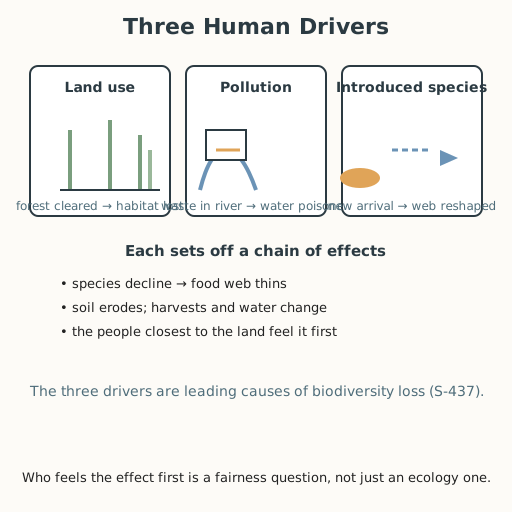
- Land use: a forest is cleared for a single crop. Habitat is lost; species that need the forest decline; soil erodes; the food web thins (S-220).
- Pollution: waste enters a river. Oxygen drops, fish die, and the water people drink downstream is contaminated (S-216, S-437).
- Introduced species: a rat reaches an island. With no predators, it eats eggs and seeds; native species crash; the web is reshaped (S-437). In each, name what was removed, poisoned, or added, and follow the ripple.
- Guided practice (15 min). With a partner, complete the three cause-and-effect chains on the sheet, and for each answer: who depends on this ecosystem, and who feels the effect first — the people closest to it or farthest? Compare and agree.
- Independent practice (15 min). In your journal, describe one real or possible example from your own region (a field, a river, a new plant or animal) and trace its chain of effects. Then write why the fairness question — “who feels it first?” — matters as much as the ecology question.
- Close (5 min). In one sentence each: name the three human drivers, and state why their costs fall unequally.
Differentiation
- Support: Use a drawn food web and physically remove or add one node, describing the ripple before writing it.
- Extension: Research one invasive species or deforestation case with real numbers (acres lost, species affected, people displaced) and present the chain with data.
Assessment
- Formative (peer + self): Can the learner trace a cause-and-effect chain for each driver, and explain why the costs fall first on those closest to the ecosystem?
- Portfolio artifact (unit): The completed case sheet with the “who feels it first” reflection, added to the living-systems section.
Home connection
Ask someone at home: what has changed in our local land, water, or wildlife in your lifetime? Trace one change back to a human cause together.
Resources
- On the direct drivers of biodiversity loss (land/sea use change, pollution, invasive species): IPBES, Global Assessment Report on Biodiversity and Ecosystem Services (2019), https://www.ipbes.net/global-assessment (S-437).
- On forests as habitat and deforestation: FAO, Forestry, https://www.fao.org/forestry/en/ (S-220).
- On ecosystems as living + nonliving interdependence: National Geographic Education, “Ecosystem,” https://education.nationalgeographic.org/resource/ecosystem/ (S-152).
- On plastic pollution: UNEP, Plastic Pollution, https://www.unep.org/plastic-pollution (S-216).