Lesson 13 — The Big Bang Model and Its Evidence
Learners explain the Big Bang model — the universe expanding from a hot, dense early state about 13.8 billion years ago — and the evidence that supports it: galaxies receding (redshift), the cosmic microwave background, and the abundance of light elements. They practice the crucial distinction between a model grounded in evidence and a revealed truth.
Objectives
Objectives
- D06.S4.10.01 Explain the Big Bang model and the evidence that supports it, and distinguish a model from revealed truth.
Essential question
What is the Big Bang model, what evidence supports it, and how is a model different from a revealed truth?
Key vocabulary
Materials
Standard materials
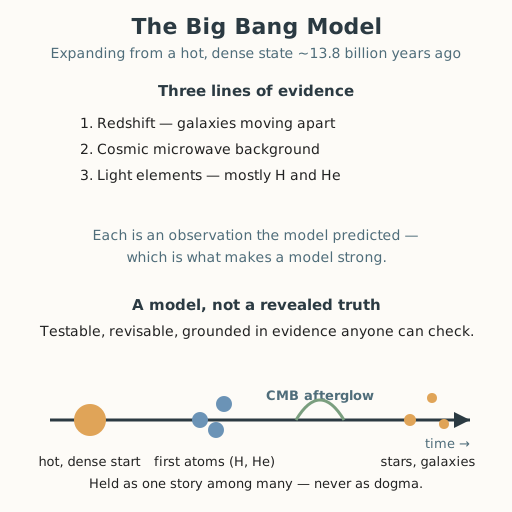
- Big-Bang evidence sheet · 1 per learner A one-page summary of the model (expanding from a hot dense state ~13.8 billion years ago) and its three main lines of evidence
- Science journal · 1 per learner
Low-tech / no-cost
- A balloon or stretched cloth Mark dots on a balloon and inflate it to see every dot move away from every other — a feel for expansion without a center
- Voice and storytelling Tell the story of the evidence aloud; no equipment needed
- No-breath / no-motor option Draw dots on a piece of paper and stretch or unfold it, or move two open hands apart, to model expansion without inflating anything — a seated alternative
Enriched / lab & device
- A short video or image of the cosmic microwave background · 1 per group See the oldest light in the universe mapped across the sky
Works in different contexts
- large-group Present the model and its evidence whole-class, then small groups each take one line of evidence and teach it back
- multi-age Younger learners model expansion with a balloon and retell the story; older learners weigh the evidence and the model-versus-truth distinction
- self-directed A learner reads the evidence sheet, matches each line of evidence to what it shows, and writes the "model, not revealed truth" reflection
- level-grouped Group by comfort with the distinction; a ready group compares the Big Bang model with another account side by side without ranking
- outdoor-only Look at the night sky (or recall it) and discuss what "looking far away is looking back in time" means for the evidence
Lesson 13 — The Big Bang Model and Its Evidence
Summary
Learners explain the Big Bang model: the universe expanding from a hot, dense early state about 13.8 billion years ago, and the evidence that supports it — galaxies receding (redshift), the cosmic microwave background (the oldest observable light), and the abundance of the light elements hydrogen and helium. They practice the crucial distinction between a model grounded in evidence and a revealed truth.
Objectives
- Explain the Big Bang model and the evidence that supports it, and distinguish a model from revealed truth. (D06.S4.10.01)
Connection
Look at the night sky and you are looking back in time: the light from a distant star left it long ago. Turn that around, and the whole sky becomes a record of the past. The Big Bang is the story scientists tell about that record — that everything we see was once far hotter and denser, and has been expanding and cooling ever since. It is not a claim someone simply asserts; it is a model, built from evidence anyone can inspect, and it is held as a model — open to revision — never as a truth that must be accepted.
Materials
- Big-Bang evidence sheet
- Science journal
Preparation
- Copy or draw the Big-Bang evidence sheet.
- Retrieval: from Grade 8 and 9, stars and the life cycle of stars, and evidence for the age of the universe (D06.S4.08.01, D06.S4.09.02); from Kindergarten onward, the Big Bang told as a story to wonder at (D06.S4.K.01). Today we give the Grade 10 treatment: the model and its evidence, and the model-versus-truth distinction.
- Prepare the evidence sheet and a balloon or cloth for the expansion demo.
Facilitator note
This lesson is written to the learner (“you”). The idea to land: the Big Bang model says the universe expanded from a hot, dense early state ~13.8 billion years ago; three lines of evidence support it — galaxies receding (redshift), the cosmic microwave background, and the abundance of light elements; and a model is a testable, revisable account grounded in evidence, not a revealed truth. Hold the tone of philosophy §11 carefully: this is a story scientists tell because of the evidence, held alongside other peoples’ origin stories, never ranked over them, and never taught as dogma. The balloon demo makes expansion concrete: every dot recedes from every other, with no center.
The critical-thinking lens: the key move is “what would I have to observe for this model to be true — and do I observe it?” The global lens: every culture has origin stories; the Big Bang is one account among many, distinguished not by being “truer” in some final sense but by being built from publicly checkable evidence. The ethics lens: honesty about what we know and don’t know — and about the difference between evidence and belief — is a form of respect for learners and for other traditions. The intellectual lens: a model that predicts observations (like the afterglow of the Big Bang) is the heart of how science works. Preview: Lesson 14 turns from the cosmos to our own planet and how human activity is changing Earth systems.
Procedure
- Recall (5 min). From Grade 9, how do scientists measure the age of the universe? From early grades, what do you remember of the Big Bang story?
- Meet the model (10 min). The model: about 13.8 billion years ago the universe was in an extremely hot, dense state, and it has been expanding and cooling ever since — not an explosion into space, but a stretching of space itself (S-002, S-018). Mark dots on a balloon and inflate it: every dot moves away from every other, and no dot is the “center.” That is expansion.
- Meet the evidence (15 min). Three lines support the model:
- Redshift: light from distant galaxies is stretched toward the red, showing they are moving away from us — the universe is still expanding (S-002).
- Cosmic microwave background: a faint glow of light in every direction, the afterglow of the hot early universe, cooled over billions of years (S-002).
- Light elements: the model predicts the early universe made mostly hydrogen and a little helium, and that is exactly what we measure (S-002, S-018). Each is an observation the model predicted — which is what makes the model strong.
- Model vs. revealed truth (10 min). With a partner, answer: what makes a model different from a revealed truth? (A model is testable, revisable, and grounded in evidence; a revealed truth is accepted on authority.) Why does that difference matter for how we hold this story alongside others?
- Independent practice (10 min). In your journal, write one paragraph: what is the Big Bang model, and what is the single most convincing piece of evidence to you — and why is it still a model, not a certainty?
- Close (5 min). In one sentence each: what is the Big Bang model, and what is one line of evidence for it?
Differentiation
- Support: Use the balloon demo and retell the story in your own words before naming the three lines of evidence.
- Extension: Research one further line of evidence (e.g., the formation of the first stars, S-361) or compare the Big Bang model with one other origin account side by side without ranking them.
Assessment
- Formative (peer + self): Can the learner state the Big Bang model, name at least two lines of evidence, and explain the model-versus-revealed-truth distinction?
- Portfolio artifact (unit): The evidence sheet with the “model, not revealed truth” reflection, added to the Earth-and-origins section.
Home connection
Ask someone at home what story they grew up with about how everything began. Listen to theirs, then share the Big Bang model and its evidence — held side by side, neither ranked above the other.
Resources
- On the Big Bang and its evidence (cosmic microwave background, first stars): NASA, “The Big Bang,” https://science.nasa.gov/universe/the-big-bang/ (S-002).
- On the Big Bang told for learners: NASA Space Place, “What Is the Big Bang?,” https://spaceplace.nasa.gov/big-bang/en/ (S-018).
- On the life cycle of stars and the formation of elements: NASA, “Star Lifecycle,” https://science.nasa.gov/universe/stars/ (S-361).