Lesson 03 — The Artist's Explanation: Style, Influences, and Honest Credit
Learners assemble their visual body of work and write an artist's explanation that names their recurring idea, how the work changed, their influences with honest credit, and how any living tradition they engaged was honored — completing the visual-arts objectives for the unit.
Objectives
Objectives
- D07.S1.10.01 Develop a personal style by making a body of work and explain how it reflects their ideas and influences.
- D07.S1.10.02 Distinguish cultural appreciation from appropriation in art, citing examples, and explain how to honor living traditions respectfully.
Essential question
How do I explain my personal style and name my influences honestly — including how I honor living traditions?
Key vocabulary
Materials
Standard materials
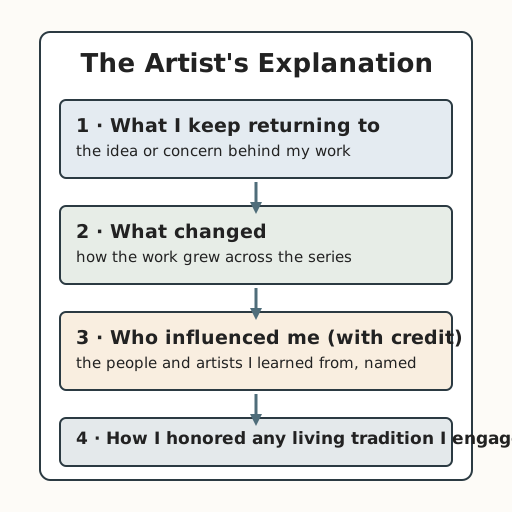
- Artist-statement frame · 1 per learner A short scaffold — what I keep returning to, what changed, who influenced me, and how I honored any living tradition I engaged
- The learner's growing visual portfolio · 1 per learner Their motif pages from Lessons 1–3
- Drawing tools · 1 set per learner
Low-tech / no-cost
- Any paper for the statement, written by hand The statement is words; it needs no special materials
- The learner's own pages Already made in earlier lessons
Enriched / lab & device
- A shared device to photograph or scan the body of work (optional) · 1 per group To make a simple digital record of the series
- Examples of real artist statements (optional) · 2–3 to view To model how artists name influences honestly
Works in different contexts
- large-group Model one strong artist statement whole-class, then learners draft independently and share in small groups of three
- multi-age Younger learners write two sentences (what I make and who influenced me); older learners write the full four-part statement
- self-directed A learner drafts against the frame, then reads it aloud once and revises anything unclear
- level-grouped Learners ready to extend trade statements and check that each names at least one influence with honest credit
- outdoor-only Lay the body of work out on the ground and speak the statement aloud to a partner before writing it
Lesson 3 — The Artist’s Explanation: Style, Influences, and Honest Credit
Summary
Learners assemble their visual body of work and write an artist’s explanation that names what they keep returning to, how the work changed, who influenced them — with honest credit — and how any living tradition they engaged was honored. This completes the unit’s visual-arts strand: a personal style, explained and credited.
Objectives
- Develop a personal style by making a body of work and explain how it reflects their ideas and influences. (D07.S1.10.01)
- Distinguish cultural appreciation from appropriation in art, citing examples, and explain how to honor living traditions respectfully. (D07.S1.10.02)
Connection
Every maker you admire was shaped by other makers — teachers, family, artists they studied — and the honest ones say so. A carpenter names the person who taught them the joint; a poet names the poet they imitate while finding their own voice. Naming your influences is not admitting you lack originality; it is how originality is honestly made. Today you write that public, honest explanation for your own work.
Materials
- Artist-statement frame
- Your growing visual portfolio
- Drawing tools
Preparation
- Retrieval: from Lessons 1–2, recall your motif and your two-sentence rule for honoring living traditions. Today you put them into one written explanation.
- Prepare the artist-statement frame and one worked example statement.
Facilitator note
This lesson is written to the learner (“you”). The idea to land: a body of work plus an honest explanation is what turns “I drew some things” into a personal style with a traceable history. The artist’s explanation has four moves — the recurring idea, the change across the work, the influences (named and credited), and how any living tradition was honored. The fourth move is the ethics check from Lesson 2, made routine: an artist says where their forms came from.
The ethics lens: honest credit is a habit, not a penalty — it is how a community of makers stays fair. The egalitarian lens: anyone can have a style and an explanation; the statement needs no expensive materials, only honest looking at your own work. The global lens: real artist statements across cultures name lineage and place — the makers they learned from — rather than claiming to have invented everything alone; kente and adinkra carry meaning because their makers name what each pattern means (S-084), and Māori arts tie form to whakapapa, belonging through ancestry (S-115). The technology lens: a digital record lets learners see their whole series at once, which is exactly what makes the through-line visible. The environment lens: a body of work made from reused materials is a statement of care too. Preview: Lesson 4 moves to sound — composing an idea in music.
Model the four moves once (worked example → guided practice → independent writing; S-011). Keep this low-stakes: the statement is a draft the learner can revisit all unit. Assessment is about whether the four moves are present and honest, never about ranking the art.
Procedure
- Recall (5 min). Lay out every visual page you have made so far. You now have a body of work — more than one piece around one idea.
- Meet the four moves (10 min). Watch a worked example artist’s statement. It does four things: names what I keep returning to, describes what changed across the work, names who influenced me with credit, and says how I honored any living tradition I engaged.
- Look at your own arc (10 min). Study your pages. What stays the same? What changed? Who taught you or inspired you — a family member, a friend, an artist you studied? Write notes for each move.
- Write the statement (15 min). Using the frame, write four to six sentences: the idea, the change, the influences (named), and the honor (if you engaged another tradition, how you asked, learned, and credited).
- Read it back (10 min). Read your statement aloud once, alone or to a partner. Does it name at least one influence honestly? Does it say how you honored any tradition you touched? Revise anything unclear.
- Close (5 min). Add the statement to your portfolio beside your body of work. You have now done what every strand in this unit asks: made a series and explained it. Next: sound.
Differentiation
- Support: Provide sentence starters for each move (“I keep returning to ______ because ______”).
- Extension: Add a fifth move — a one-sentence note on what you want the work to say to an audience, previewing Grade 11’s art-with-a-message.
- Non-visual / non-writing path: Speak the four-move statement aloud and record it in voice (or have a partner transcribe it); the explanation is judged on the four moves being present and honest, not on handwriting or spelling.
- Language: The statement may be composed in the learner’s home language and translated to a shared language for the portfolio, keeping the credit of influences intact in whichever language names them most accurately.
Assessment
- Summative (portfolio): The learner presents a body of at least three related works and a statement that (a) names the recurring idea, (b) names the change, (c) credits at least one influence, and (d) explains how any living tradition was honored — observable across the four moves of the frame.
- Self-assessment: The learner self-places on the mastery checklist for D07.S1.10.01 and D07.S1.10.02 and notes their next step.
Home connection
Show your body of work and statement to someone at home. Ask: what did you already know about my style that I only just noticed?
Resources
- On naming lineage and credit in living visual traditions: Smithsonian National Museum of African Art, kente cloth, https://africa.si.edu/ (S-084); Te Papa Tongarewa, Māori arts, https://www.tepapa.govt.nz/ (S-115).
- On deliberate use of the elements of art: J. Paul Getty Museum, “Understanding Formal Analysis,” https://www.getty.edu/education/teachers/building_lessons/formal_analysis.html (S-365).
- On worked examples and guided practice: Kirschner, Sweller & Clark (2006), https://doi.org/10.1207/s15326985ep4102_1 (S-011).