Lesson 04 — Composing an Idea: Sound That Says Something
Learners compose an original short piece that expresses a clear idea or feeling, choosing melody, rhythm, dynamics, and texture deliberately and notating the result on a graphic score so another person could follow it.
Objectives
Objectives
- D07.S2.10.01 Compose and record an original piece that expresses a clear idea or feeling, and explain the techniques used.
Essential question
How do I compose an original piece of music that expresses a clear idea or feeling?
Key vocabulary
Materials
Standard materials
- Graphic-score sheet · 1 per learner A blank page with a time axis to mark sound events without traditional notation
- A sound source (voice, clap, instrument, or found object) · 1 per learner Voice and body are instruments too
Low-tech / no-cost
- Voice, body percussion, and found objects (a cup, a stone, a stick) Everything needed to compose is already in the room
- Any paper for a graphic score Drawn by hand
Enriched / lab & device
- A simple notation app or DAW (optional) · 1 per learner or group To lay out the piece and hear it immediately
- One pitched instrument (keyboard, guitar, tuned percussion) if available · 1 per group To shape a melody as well as rhythm
Works in different contexts
- large-group Model one short composed phrase whole-class, then learners compose individually and share in small listening circles
- multi-age Younger learners compose a rhythm-only piece with a clear feeling; older learners add pitch and a written idea statement
- self-directed A learner writes the idea first, then builds the piece and notates it on the graphic score, listening back and revising
- level-grouped Learners ready to extend add a second contrasting section (A/B form) and explain the contrast
- outdoor-only Compose with found natural sounds (stone taps, leaf rustle, voice) and mark them on the ground or in a drawn score
Lesson 4 — Composing an Idea: Sound That Says Something
Summary
Learners compose an original short piece that expresses a clear idea or feeling, choosing melody, rhythm, dynamics, and texture deliberately and notating the result on a graphic score so another person could follow it. This is the first half of the music objective — the second (recording craft) comes in Lesson 5.
Objectives
- Compose and record an original piece that expresses a clear idea or feeling, and explain the techniques used. (D07.S2.10.01)
Connection
You already compose every time you hum a tune that is yours, tap a rhythm to match how you feel, or make up a song for a child. The difference between that and composing is only intention: deciding on an idea or feeling, then choosing each sound because it serves that idea. Today you make the intention explicit — and write the piece down so someone else could play it.
Materials
- Graphic-score sheet
- A sound source (voice, clap, instrument, or found object)
Preparation
- Retrieval: from Lessons 1–3, recall how a body of work grows around one idea. Music works the same way — one idea, developed.
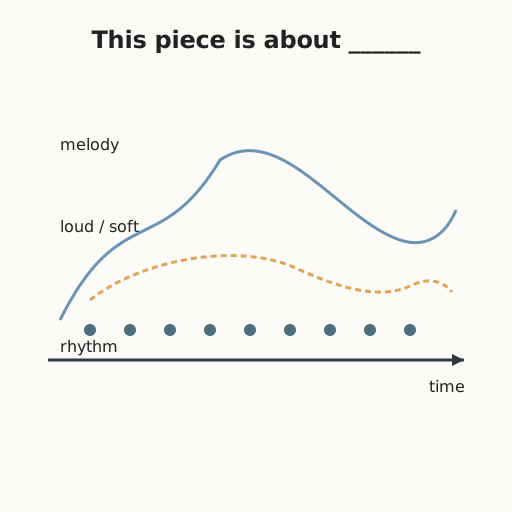
- Prepare one worked example: a four-bar phrase expressing “calm” (slow, soft, a falling melody) marked on a graphic score.
Facilitator note
This lesson is written to the learner (“you”). The idea to land: composing is choosing sound on purpose — a clear idea or feeling, expressed through deliberate choices of melody, rhythm, dynamics, and texture, and notated so the choice is visible. A graphic score (any drawn map of sound over time) is a universal, low-tech notation that needs no staff-reading, so every learner can compose and document, not just perform. The unit’s through-line holds: a motif (a short musical idea) developed across the piece is the sonic twin of the visual motif from Lesson 1.
The ethics lens: composing your own idea (rather than only copying) is the honest starting point — originality here means your choice, made visible. The egalitarian lens: the voice and body are instruments; no purchased instrument or training is required to be a composer. The global lens: every musical tradition has its own ways of organizing sound and of writing it down — the graphic score is one such system, alongside staff notation, Indian raga frameworks (S-366), and the oral transmission of West African griots (S-446); none is “the” one true system. The technology lens: recording and notation tools let a composer hear and revise instantly — but a pencil works too. The environment lens: found-object instruments remind us that sound comes from the world around us, with no footprint at all.
Model one worked example (worked example → guided practice → independent composition; S-011). Keep it short — a piece can be eight seconds and still express a clear idea.
Procedure
- Recall (5 min). From Lesson 1: you built a visual body of work around one motif. Today you build a piece around one musical idea.
- Meet the elements (10 min). Watch a worked example: a four-bar phrase that says “calm” — slow, soft, with a melody that falls. See how it is marked on a graphic score: a time line, a rising/falling line for melody, dots for rhythm, a swelling shape for loud and soft.
- Choose your idea (5 min). Pick one idea or feeling — sunrise, a long wait, a chase, arriving home. Write it at the top of your score: “This piece is about ______.”
- Build the piece (15 min). Make a short musical idea (a motif) and repeat or change it. Decide: is the melody high or low? The rhythm fast or slow, even or uneven? The dynamics loud or soft? The texture one voice or many? Mark each choice on the score.
- Notate it (10 min). Draw your piece on the graphic score so clearly that a friend could follow the shape without hearing you first.
- Close (5 min). Play or speak your score once for a partner. Keep the score in your portfolio. Next time, you record it and explain your techniques.
Differentiation
- Support: Compose a rhythm-only piece with a single clear feeling, and mark only fast/slow and loud/soft on the score.
- Extension: Add a contrasting B section and explain, in a sentence, how the contrast serves the idea.
- Non-hearing path (deaf or hard of hearing): Compose through what is felt and seen rather than heard — feel the beat through a drum skin, a balloon held against the chest, or the floor under bare feet, and use the graphic score (a visual map) plus hand signals for loud/soft and fast/slow. The score itself is the document of the piece; a hearing partner can perform it while the composer watches and adjusts.
- Neurodivergent support: The graphic score gives a predictable, concrete frame for a task that can otherwise feel open-ended; allow repetition and a fixed structure (one idea, then variations), and let learners choose a single element (rhythm or dynamics) to focus on at a time.
Assessment
- Formative (self): Can the learner state the idea in one sentence, make a short piece, and point to at least two deliberate choices (melody, rhythm, dynamics, or texture) on their score?
- Portfolio artifact (unit): The graphic score with the idea statement, added to the portfolio as the music-composition draft.
Home connection
Listen for one piece of music at home (a song, a ringtone, a lullaby) and name the single feeling it is built to carry — and one choice (speed, loudness, shape) that creates it.
Resources
- On music as organized sound across traditions: Encyclopaedia Britannica, “Raga” (Indian classical music), https://www.britannica.com/art/raga (S-366); Encyclopaedia Britannica, “Griot,” https://www.britannica.com/art/griot (S-446).
- On recording and preserving the world’s music as living heritage: Smithsonian Folkways Recordings, https://folkways.si.edu/ (S-188).
- On arts education practice for composing: Kennedy Center, Education, https://www.kennedy-center.org/education/ (S-189).
- On worked examples before independent work: Kirschner, Sweller & Clark (2006), https://doi.org/10.1207/s15326985ep4102_1 (S-011).