Lesson 05 — Recording Craft: Capturing and Shaping Sound
Learners record their composed piece, capturing at least one clean take and then shaping the sound through deliberate choices, logging each technique so they can explain how the recording expresses their idea — completing the music objective.
Objectives
Objectives
- D07.S2.10.01 Compose and record an original piece that expresses a clear idea or feeling, and explain the techniques used.
Essential question
How do I record my composition and explain the techniques that shaped its sound?
Key vocabulary
Materials
Standard materials
- A recording device (phone, recorder, or shared device) · 1 per learner or group Any device that captures sound; one per pair is enough
- Techniques log · 1 per learner A short sheet to note each recording choice and why
- The learner's graphic score from Lesson 4 · 1 per learner
Low-tech / no-cost
- A "performance recording" — a careful live rendition witnessed and described With no device, the recording is a repeatable live performance, documented in writing by a listener
- Voice and body The instrument and the "recording" alike
Enriched / lab & device
- A simple DAW or recording app with two tracks (optional) · 1 per group To overdub, balance, and revise the piece in layers
- A microphone or second device for room sound (optional) · 1 per group To hear how placement changes the capture
Works in different contexts
- large-group Pairs record each other, then a short whole-class listening of three examples with technique call-outs
- multi-age Younger learners make one clean take and name one thing they changed; older learners overdub and balance two layers
- self-directed A learner records alone, logs each take and choice, then listens back and revises before the final capture
- level-grouped Learners ready to extend compare two mixes of the same piece and argue which serves the idea better
- outdoor-only Record the piece with environmental sound as a texture — wind, birds, water — and log how it changes the feeling
Lesson 5 — Recording Craft: Capturing and Shaping Sound
Summary
Learners record their composed piece, capturing a clean take and then shaping the sound through deliberate choices, logging each technique so they can explain how the recording expresses their idea. This completes the music objective begun in Lesson 4.
Objectives
- Compose and record an original piece that expresses a clear idea or feeling, and explain the techniques used. (D07.S2.10.01)
Connection
A story changes depending on how it is told — whispered or shouted, up close or from across the room, with pauses or in one rush. Recording is the same craft applied to sound: you do not just capture the music; you choose how it will be heard — how near, how loud against the room, what stays and what fades. Today you make those choices visible and name them.
Materials
- A recording device (phone, recorder, or shared device)
- Techniques log
- Your graphic score from Lesson 4
Preparation
- Retrieval: from Lesson 4, recall your piece and its idea. Today you capture it and shape how it is heard.
- Prepare one worked example: the same phrase recorded two ways — close and far, or one layer versus two — so learners hear that capture changes meaning.
Facilitator note
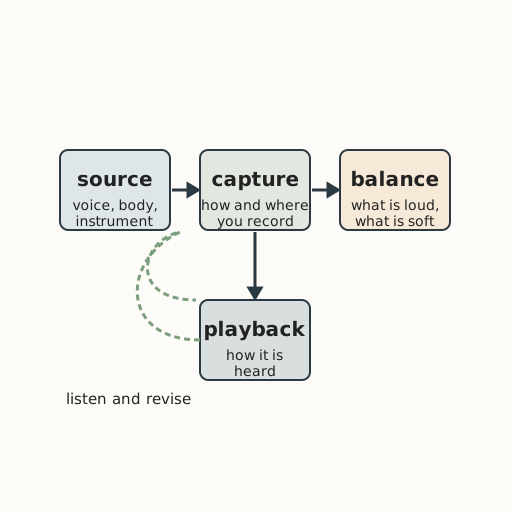
This lesson is written to the learner (“you”). The idea to land: recording is a craft, not a lucky tap of a button — the composer chooses capture, balance, and revision, and can explain each choice. The signal path (source → capture → balance → playback, with a “listen and revise” loop) gives learners a concrete, observable frame for their techniques log. The low-tech path is essential: with no device, a repeatable live performance documented by a listener is the recording — the craft is still in the choosing and the describing.
The ethics lens: a recording is a document; being able to say exactly what you did and why is honesty about your own work (and, in Lesson 6, about others’ work you engage). The egalitarian lens: the craft of listening and choosing needs no expensive gear — a phone or even a careful live rendition works; recording is not gated by a studio. The global lens: recordings are how music travels and how living traditions are documented — Smithsonian Folkways has preserved the world’s music since 1948 precisely so communities’ own voices are heard (S-188). The technology lens is the spine: the microphone and the DAW changed what music can be — layered, edited, replayed — and understanding the path is understanding that power. The environment lens: devices carry a material cost (rare minerals, e-waste), a reminder to use and reuse them with care (S-397; previewed fully in Lesson 11). Preview: Lesson 6 turns to the ethics of engaging with other people’s music.
Procedure
- Recall (5 min). You have a piece and a score. Today it becomes a recording — a document others can hear.
- Meet the path (10 min). Watch a worked example: one phrase recorded two ways. Notice the four stages — source, capture (how and where you record), balance (what is loud, what is soft, how layers sit), and playback (how it is heard). Then notice the loop: you listen and revise.
- Set up (5 min). Decide where and how to capture. Closer or farther? In a quiet room or with the world as a texture? Write the plan in your techniques log.
- Record takes (15 min). Record at least two takes of your piece. Between takes, change one thing — distance, speed, a layer added or removed. Note each change and why.
- Listen and choose (10 min). Listen back to both takes. Which serves your idea better? Write your final choice and the reason in the log.
- Close (5 min). You now have a composed and recorded piece, with a log that explains it. Keep both in your portfolio. Next time: whose music can I use, and how?
Differentiation
- Support: Make one clean take and log one technique (e.g., “I recorded close so the voice sounds near”).
- Extension: Make a two-layer overdub and explain in a sentence how the layers serve the idea.
- Non-hearing path (deaf or hard of hearing): Replace “listen and choose” with seeing and feeling — use a visual waveform on the device if one is shown, place a hand on the speaker to feel the difference between takes, or have a peer describe in writing (or sign) what changed between takes. The techniques log is written/visual, so the craft of capture and balance is still fully documented.
- No-device path: The low-tech “performance recording” (a careful live rendition witnessed and described in writing by a listener) is the recording; the craft is in the choosing and the describing, not the device.
Assessment
- Summative (portfolio): The learner presents a recorded (or documented live-performed) piece with a log naming at least two techniques — capture placement, balance, layering, or revision — each tied to the piece’s idea.
- Self-assessment: The learner self-places on the mastery checklist for D07.S2.10.01 and notes what to improve on the next take.
Home connection
Record a ten-second sound from your home — a kettle, a door, a voice — two ways (near and far), and ask someone which feels different and why.
Resources
- On recording and preserving music as living heritage: Smithsonian Folkways Recordings, https://folkways.si.edu/ (S-188).
- On arts education practice for music-making and recording: Kennedy Center, Education, https://www.kennedy-center.org/education/ (S-189).
- On the material footprint of the devices we record with: WHO, “Electronic waste (e-waste) fact sheet,” https://www.who.int/news-room/fact-sheets/detail/electronic-waste-%28e-waste%29 (S-397).
- On worked examples and guided practice: Kirschner, Sweller & Clark (2006), https://doi.org/10.1207/s15326985ep4102_1 (S-011).