Lesson 06 — Honoring Living Musicians: Engagement, Not Appropriation
Learners sort music scenarios to distinguish respectful engagement with a musical tradition from appropriation, learning to ask, learn context, credit, and share benefit — and to honor the living musicians and communities who made the music.
Objectives
Objectives
- D07.S2.10.02 Distinguish respectful engagement with a musical tradition from appropriation, and explain how to honor living musicians and communities.
Essential question
How do I tell respectful engagement with a musical tradition from appropriation, and how do I honor living musicians and communities?
Key vocabulary
Materials
Standard materials
- Engagement-or-appropriation scenario cards · 1 set per pair Four music scenarios — learning, sampling, covering, and profiting — to sort and discuss
- Two-column reflection sheet · 1 per learner Headings "Honors living musicians" and "Takes from them" with room for reasons
Low-tech / no-cost
- Four scenarios described aloud by the facilitator No cards needed — voice carries the situations
- Any paper for the reflection Drawn by hand
Enriched / lab & device
- Short listening clips (optional) · 2–3 clips Reggae, a spiritual, and a griot's song, each with its origin and makers named
- Shared device to look up who wrote and owns a song (optional) · 1 per group To trace credit and royalties behind a familiar track
Works in different contexts
- large-group Sort one scenario whole-class, then pairs sort the rest and report one reason each
- multi-age Younger learners identify "credited or not" and "asked or not"; older learners add the benefit-and-power question
- self-directed A learner sorts all four scenarios, writing a reason for each, then checks against a short answer guide
- level-grouped Learners ready to extend research one real sampling or cover controversy and propose a fairer path
- outdoor-only Discuss the scenarios in a circle by voice; record the reasons in a shared spoken summary or on the ground
Lesson 6 — Honoring Living Musicians: Engagement, Not Appropriation
Summary
Learners sort music scenarios to tell respectful engagement with a musical tradition from appropriation, learning to ask, learn the context, credit, and share benefit — and to honor the living musicians and communities who made the music. Reggae, spirituals, and the griot tradition show how music carries a community’s history, so using it carries an ethical responsibility.
Objectives
- Distinguish respectful engagement with a musical tradition from appropriation, and explain how to honor living musicians and communities. (D07.S2.10.02)
Connection
You would not want someone to take a song you wrote, perform it for money, and never say your name. That instinct — credit the maker, share the benefit — is the whole lesson. Music is never just sound; it is made by people in places, carrying their history. Engaging with it respectfully means treating those people as the point, not as a free library of sounds.
Materials
- Engagement-or-appropriation scenario cards
- Two-column reflection sheet
Preparation
- Retrieval: from Lesson 2, recall your rule for honoring living visual traditions. Today you apply the same four questions — ask, context, credit, benefit — to music.
- Prepare the four scenarios (see Facilitator note) and the reflection sheet.
Facilitator note
This lesson is written to the learner (“you”). The idea to land: the same four questions from visual art govern music — did they ask? learn the context? credit? share benefit? — because music, too, is a living tradition made by living people. Reggae originated among marginalized groups in western Kingston, Jamaica, and became “a voice for all” on injustice, resistance, love, and humanity (S-450; S-445). African American spirituals are religious folk songs born of enslavement that carry a people’s history (S-385). West African griots are hereditary oral historians and musicians who keep a community’s memory — their music is not decoration but archive (S-446). Because music travels and is sampled in one click, credit and permission are more urgent, not less.
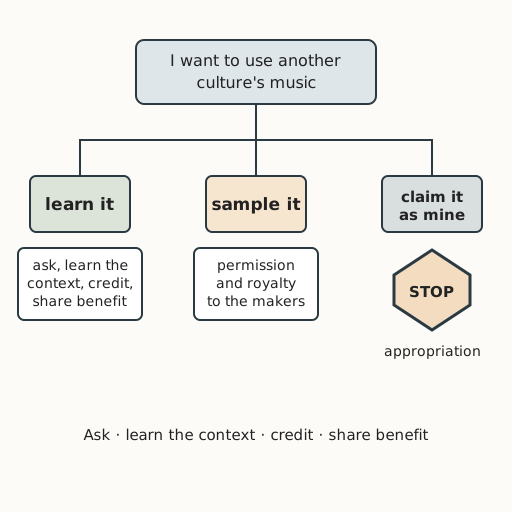
Keep it concrete and never flatten a tradition into a stereotype. The ethical distinction is about power and consent: learning a tradition from its practitioners, crediting composers and performers, paying royalties where due, and amplifying the community’s own voices is engagement; sampling or performing without permission or credit, claiming others’ forms as your own “discovery,” or profiting while the makers earn nothing is appropriation. UNESCO’s living-heritage frame (S-056) and the Universal Declaration on Cultural Diversity (S-389) support treating music as owned and passed on by communities.
The ethics lens is the spine. The egalitarian lens: musical appropriation almost always flows from the less powerful to the more powerful — credit and shared benefit are how the balance is corrected. The global lens: traditions are people’s, alive now, not “world music” free for the taking. The technology lens: sampling and streaming made reuse effortless, so the ethical work (permission, credit, royalty) is the part a machine cannot do. The environment lens: honoring a tradition includes honoring the places and materials it grew from, not extracting the sound and discarding the rest. Preview: Lesson 7 turns to the body — devising a movement piece.
Four scenarios (adapt to your place; keep specific and respectful): 1. A musician studies with a community’s players, learns the meaning of the form, credits them, and shares the earnings. 2. A producer samples a traditional recording without permission, lists no composer, and keeps the profit. 3. A choir learns a spiritual from recordings and from a living singer of that tradition, and names the tradition in the program. 4. A brand uses a people’s ceremonial song in an advertisement without asking or paying, turning a sacred sound into a jingle.
Procedure
- Recall (5 min). From Lesson 2: four questions — ask, context, credit, benefit. Today you run them on music.
- Meet the distinction (10 min). Watch a worked example: a musician who studies with a community, credits them, and shares earnings — versus a producer who samples without permission, lists no composer, and keeps the profit. One honors; one takes.
- Sort the scenarios (15 min). With a partner, read the four cards. Place each under “Honors living musicians” or “Takes from them,” and write one reason using the four questions.
- Hear the history (10 min). Consider three real traditions: reggae as the voice of Kingston’s marginalized communities (S-450), spirituals born of enslavement (S-385), and griots as keepers of memory (S-446). Why does context matter so much for music like this?
- Write your rule (10 min). Write your own two-sentence rule for engaging with another culture’s music. Start: “I will honor living musicians by ______.”
- Close (5 min). Add the sheet to your portfolio. Next: the moving body.
Differentiation
- Support: Give the four questions as a checklist and ask only “credited — yes or no?” for each scenario.
- Extension: Look up who wrote and who owns a familiar song, and trace where the money from one stream goes — then propose one fairer arrangement.
- Non-hearing / low-literacy path: The four scenarios and the histories of reggae, spirituals, and griots can be read as text rather than listened to; the “hear the history” step becomes “read the history” with no loss. Learners answer aloud or in writing, and the reflection may be recorded in voice.
- Language: Learners may write or speak their rule in their home language first, then translate to a shared classroom language; the four questions carry cleanly across languages.
Assessment
- Formative (self): Can the learner sort each scenario and give one reason (permission, context, credit, or benefit) for at least two of them?
- Portfolio artifact (unit): The two-column reflection with the learner’s own two-sentence rule, added to the portfolio.
Home connection
Pick a song you love. Find out who wrote it, who performs it, and where it comes from. Tell someone at home one thing you learned about its makers.
Resources
- On reggae’s origins and meaning: UNESCO, “Reggae Music of Jamaica,” https://ich.unesco.org/en/RL/reggae-music-of-jamaica-01398 (S-450); Encyclopaedia Britannica, “Reggae,” https://www.britannica.com/art/reggae (S-445).
- On spirituals as living history: Encyclopaedia Britannica, “Spiritual,” https://www.britannica.com/topic/spiritual (S-385).
- On griots as keepers of memory: Encyclopaedia Britannica, “Griot,” https://www.britannica.com/art/griot (S-446).
- On music as living heritage and cultural diversity: UNESCO, Intangible Cultural Heritage, https://ich.unesco.org/ (S-056); UNESCO, Universal Declaration on Cultural Diversity, https://www.unesco.org/en/legal-affairs/unesco-universal-declaration-cultural-diversity (S-389).
- On worked examples before independent work: Kirschner, Sweller & Clark (2006), https://doi.org/10.1207/s15326985ep4102_1 (S-011).