Lesson 07 — Devising a Concept: Movement That Means Something
Learners devise an original movement piece from a clear concept, choosing gesture, levels, and timing deliberately and storyboarding the sequence so the concept is visible in the movement — the first half of the movement-and-drama objective.
Objectives
Objectives
- D07.S3.10.01 Devise and perform an original piece that develops a clear concept and demonstrates craft in movement and expression.
Essential question
How do I devise an original performance piece that develops a clear concept through movement and expression?
Key vocabulary
Materials
Standard materials
- Movement storyboard sheet · 1 per learner A page of blank frames to sketch each moment of the piece, with a caption line under each
- Open floor space · enough to move freely A cleared area where every learner can stretch and travel
Low-tech / no-cost
- The body and voice The only instrument a movement piece requires
- Any paper for the storyboard Drawn by hand
Enriched / lab & device
- A camera or phone to film a rehearsal (optional) · 1 per group To watch the piece back and revise (used fully in Lesson 8)
- A simple prop or cloth (optional) · 1 per learner To extend expression with an object
Works in different contexts
- large-group Model one short devised sequence whole-class, then learners devise in pairs with a brief showing at the end
- multi-age Younger learners devise a three-moment sequence with a clear beginning, middle, and end; older learners add a written concept statement
- self-directed A learner writes the concept first, then devises and storyboards the piece, performing it once and revising
- level-grouped Learners ready to extend add contrast — fast/slow, high/low — and explain how it serves the concept
- outdoor-only Devise using the terrain — levels on a slope, travel across a field — and storyboard on the ground or in words
Lesson 7 — Devising a Concept: Movement That Means Something
Summary
Learners devise an original movement piece from a clear concept, choosing gesture, levels, and timing deliberately and storyboarding the sequence so the concept is visible in the movement. This is the first half of the movement-and-drama objective — craft in rehearsal and performance comes in Lesson 8.
Objectives
- Devise and perform an original piece that develops a clear concept and demonstrates craft in movement and expression. (D07.S3.10.01)
Connection
You already speak a whole language without words: the shrug, the slow step of a person who does not want to leave, the sudden straightening of a spine when someone has had enough. Devising is taking that everyday language and making it intentional — a concept, told through the body, one deliberate choice at a time. Today you turn feeling into movement with a plan.
Materials
- Movement storyboard sheet
- Open floor space
Preparation
- Retrieval: from Lessons 1 and 4, recall building a body of work and a piece around one idea. Movement works the same way: one concept, developed through choices.
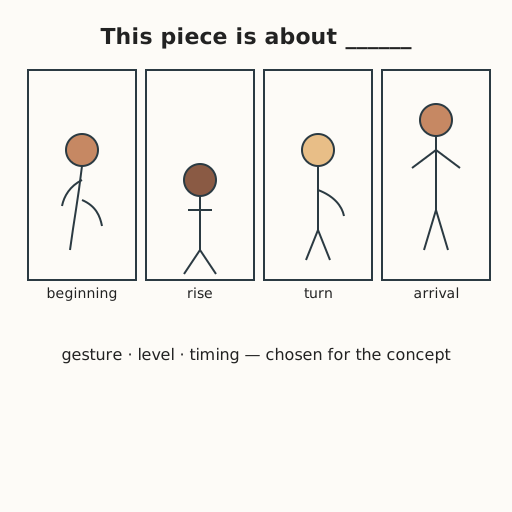
- Prepare one worked example: a four-moment sequence expressing “arrival” — low and closed, then rising, turning, opening — storyboarded frame by frame.
Facilitator note
This lesson is written to the learner (“you”). The idea to land: devising means starting from a concept and choosing movement to serve it — gesture, level (high/mid/ low), and timing (fast/slow, still/moving) — then storyboarding so the concept is visible in the choices. A storyboard (drawn frames with captions) is to movement what the graphic score was to music in Lesson 4: a universal, low-tech way to document an idea before it is polished. The unit’s through-line holds again — one motif, developed.
The ethics lens: devising your own concept is the honest starting point; it is the opposite of copying another culture’s dance and calling it yours (Lesson 9 makes this explicit). The egalitarian lens: every body is an instrument and every body can devise; the piece is built from your movement vocabulary, not a single imposed ideal. The global lens: across cultures, movement carries meaning — gesture, posture, and spacing communicate without words in performance and daily life alike (S-189). The technology lens: a camera lets a deviser watch and revise — but the storyboard does too, with no device. The environment lens: devising outdoors reminds us the body is part of place — terrain becomes part of the concept. The physical and social-emotional lenses: moving is how the body and feeling join; name the feeling first, then let the body speak it.
Model one worked example (worked example → guided practice → independent devising; S-011). Keep it short — four moments are enough to hold a concept.
Procedure
- Recall (5 min). You have made a visual motif and a musical idea. Today you make a movement idea and develop it.
- Meet the choices (10 min). Watch a worked example: a four-moment piece about “arrival.” Notice the choices — gesture (what the hands and face do), level (high, middle, low), timing (fast or slow, still or moving). See each moment storyboarded with a caption.
- Choose your concept (5 min). Pick one concept — leaving home, waiting for news, meeting an old friend, carrying something heavy. Write it: “This piece is about ______.”
- Devise the sequence (15 min). Build four moments: a beginning, a change, a turning point, an arrival. For each, decide the gesture, level, and timing that serve the concept.
- Storyboard it (10 min). Draw each moment in a frame and write a caption under it. Your board should let a friend read the concept without hearing a word.
- Close (5 min). Show your sequence once to a partner, who guesses the concept. Keep the storyboard in your portfolio. Next time: craft in rehearsal.
Differentiation
- Support: Devise a three-moment sequence (beginning, middle, end) using only level changes, and caption each.
- Extension: Add contrast — one fast moment against a slow one, or high against low — and write a sentence on how the contrast serves the concept.
- Non-motor path (seated, limited mobility, or wheelchair): The piece lives in the parts of the body that move freely — hands, face, shoulders, eyes, voice, breath. Levels become close to the body or far from it, high becomes lifted hands or gaze, low becomes dropped head or closed posture. Devising with a partner: the deviser directs with voice while a partner performs the shapes, so the concept is still authored by the learner.
- Non-visual path (blind or low vision): Storyboard in words and spoken captions rather than drawings, and have a partner read back each moment; the sequence can be devised and checked by touch and voice.
- Neurodivergent support: Give the concept as a short menu, keep the four-moment frame predictable, and allow stillness or a repeated calming gesture as a valid moment — pacing and quiet are choices, not failures.
Assessment
- Formative (self): Can the learner state the concept in one sentence, perform a short sequence, and point to at least two deliberate choices (gesture, level, or timing) in their storyboard?
- Portfolio artifact (unit): The movement storyboard with its concept statement, added to the portfolio as the movement-piece plan.
Home connection
Watch for one moment of “body language” at home — someone’s posture when they are tired, glad, or worried — and name the level and timing that carry the meaning.
Resources
- On gesture, posture, and spacing as meaning, and on presenting dance and drama with respect: Kennedy Center, Education, https://www.kennedy-center.org/education/ (S-189).
- On movement traditions as living heritage: UNESCO, Intangible Cultural Heritage, https://ich.unesco.org/ (S-056).
- On worked examples before independent work: Kirschner, Sweller & Clark (2006), https://doi.org/10.1207/s15326985ep4102_1 (S-011).