Lesson 08 — Craft in Rehearsal: Timing, Expression, Ensemble
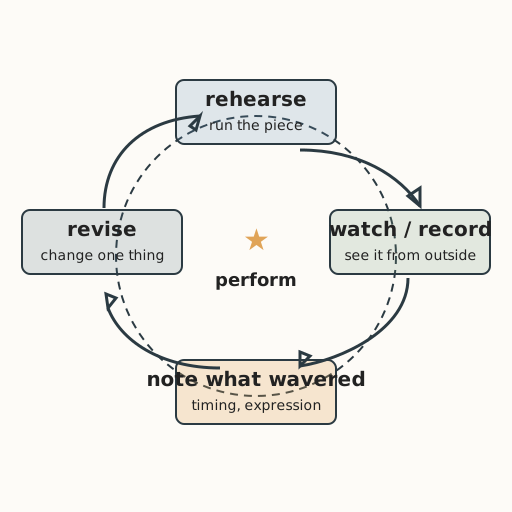
Learners rehearse and refine their devised piece, using a feedback loop — rehearse, watch, note, revise — to sharpen timing, expression, and ensemble, then perform the revised piece, completing the movement-and-drama objective.
Objectives
Objectives
- D07.S3.10.01 Devise and perform an original piece that develops a clear concept and demonstrates craft in movement and expression.
Essential question
How do I refine and perform my piece with craft in timing, expression, and ensemble?
Key vocabulary
Materials
Standard materials
- Rehearsal feedback sheet · 1 per learner Two questions for a peer — what did you see clearly, and where did the timing or expression waver — plus room for one revision note
- Open floor space · enough to move freely
- The learner's storyboard from Lesson 7 · 1 per learner
Low-tech / no-cost
- Voice and body The piece needs nothing else
- Any paper for the feedback sheet Drawn by hand
Enriched / lab & device
- A camera or phone to film the rehearsal (optional) · 1 per group To watch the piece back and revise against what is seen, not only felt
- A simple prop or costume piece (optional) · 1 per learner To sharpen expression and character
Works in different contexts
- large-group Learners rehearse in trios (performer, watcher, note-taker) and rotate roles, then a short whole-class showing of three pieces
- multi-age Younger learners give one observation ("I saw the turn clearly"); older learners give timing-and-expression feedback and a revision note
- self-directed A learner films or mirrors the piece, watches once, and revises one moment against what they actually saw
- level-grouped Learners ready to extend work on ensemble — matching another performer's timing — and reflect on how the piece changed
- outdoor-only Rehearse in the open; a partner watches and describes what read clearly from a distance, then the performer revises one moment
Lesson 8 — Craft in Rehearsal: Timing, Expression, Ensemble
Summary
Learners rehearse and refine their devised piece using a feedback loop — rehearse, watch, note, revise — to sharpen timing, expression, and ensemble, then perform the revised piece. This completes the movement-and-drama objective begun in Lesson 7.
Objectives
- Devise and perform an original piece that develops a clear concept and demonstrates craft in movement and expression. (D07.S3.10.01)
Connection
The first time you tell a story it is a sketch; the fifth time you know where to pause. Rehearsal is not repetition for its own sake — it is the loop where you watch, notice, and fix, turning a sketch into craft. Athletes, musicians, and cooks all do this: do it, look at it, change one thing, do it again. Today your piece goes through that loop, then meets an audience.
Materials
- Rehearsal feedback sheet
- Open floor space
- Your storyboard from Lesson 7
Preparation
- Retrieval: from Lesson 7, recall your piece and concept. Today you sharpen it.
- Prepare one worked example of specific feedback: “your turn came early, so the arrival felt rushed” versus vague “that was nice” — and show how the performer revises one moment.
Facilitator note
This lesson is written to the learner (“you”). The idea to land: craft is a loop — rehearse, watch (or record), note what wavered, revise one thing, repeat — and feedback works only when it is specific and about the work, not the person. Timing (are the pauses and speeds deliberate?), expression (do face and body carry the concept?), and ensemble (do the parts fit with others?) are the three observable targets. The loop mirrors the assessment philosophy: observe what the learner does and say back one concrete thing, never rank (S-011; S-189).
The ethics lens: honest feedback is a gift — specific, kind, and about the work — and receiving it is how a maker grows without losing their own voice. The egalitarian lens: feedback is not a judge’s verdict but a peer’s help; everyone gives and receives, and a “not yet” is a next step, never a ranking. The global lens: rehearsal traditions differ across cultures, but everywhere the watch-and-revise loop is how craft is passed down — from the tinikling dancers who step between bamboo poles in the Philippines (S-116) to the capoeira circle of Brazil (S-325), mastery is made in repeated, watched practice. The technology lens: a camera lets a performer see what a mirror cannot — the piece from the audience’s eyes. The environment lens: rehearsing outdoors teaches the performer to work with place and weather, not against it. The community lens: a showing for an audience who wants the performer to succeed is the natural home of a performance.
Keep the showing low-stakes and cooperative (assessment.md: performance for an audience who wants the learner to succeed). Preview: Lesson 9 turns to the ethics of engaging with other people’s movement and drama traditions.
Procedure
- Recall (5 min). You have a devised piece. Today it becomes crafted — and then performed.
- Meet the loop (10 min). Watch a worked example: a performer runs a piece; a watcher says one specific thing (“the turn came early”); the performer revises one moment and runs it again. That is the loop: rehearse → watch → note → revise.
- Rehearse in a trio (20 min). Take turns: one performs, one watches for timing, one watches for expression. Use the feedback sheet: what did you see clearly? Where did timing or expression waver? Then the performer revises one moment.
- Run it again (10 min). Repeat the loop once more with the revision in place. Notice what changed. If you are working with others, check the ensemble — do your parts fit?
- Perform (10 min). Show your piece once to a small audience — your trio, or the group. Afterward, say one thing you changed and why.
- Close (5 min). Add your feedback sheet and any revised storyboard to your portfolio. Next: whose movement can I learn, and how?
Differentiation
- Support: Focus on one target only (timing) and make one revision guided by a partner’s single observation.
- Extension: Record the piece, watch it back, and write a short reflection naming one thing you would not have noticed without the recording.
- Non-motor / adapted path: A seated or adapted piece rehearses through the same loop — rehearse, watch, note, revise — with “timing” meaning pause and pace and “expression” carried by the face, voice, and available movement. A deviser who does not move can direct a partner and take the “note” role in the trio, so feedback and revision stay fully theirs.
- Non-visual path: A watcher who cannot see the performer can receive the piece as described sound and voice, and can give feedback on timing and expression from what is heard and spoken; the feedback sheet is the same.
Assessment
- Summative (performance + peer): The learner performs the revised piece with observable craft — deliberate timing, clear expression matching the concept, and (where relevant) ensemble fit — and can name one revision made from feedback.
- Self-assessment: The learner self-places on the mastery checklist for D07.S3.10.01 and notes the next thing to sharpen.
Home connection
Perform your piece once for someone at home. Ask them the one question on the sheet: what did they see clearly?
Resources
- On movement and performance craft, and presenting dance/drama traditions with respect: Kennedy Center, Education, https://www.kennedy-center.org/education/ (S-189); UNESCO, Intangible Cultural Heritage, https://ich.unesco.org/ (S-056).
- On living movement traditions as practiced craft: Encyclopaedia Britannica, “Capoeira,” https://www.britannica.com/sports/capoeira (S-325); NCCA Philippines, National Commission for Culture and the Arts, https://ncca.gov.ph/ (S-116).
- On specific feedback and guided practice: Kirschner, Sweller & Clark (2006), https://doi.org/10.1207/s15326985ep4102_1 (S-011).