Lesson 09 — Honoring Living Practitioners: Movement and Drama
Learners sort movement-and-drama scenarios to distinguish respectful engagement with a dance or dramatic tradition from appropriation, learning to seek invitation, learn context, respect what is sacred, and credit living practitioners — the same four questions, applied to the moving body.
Objectives
Objectives
- D07.S3.10.02 Distinguish respectful engagement with a dance or dramatic tradition from appropriation, and explain how to honor living practitioners.
Essential question
How do I tell respectful engagement with a dance or dramatic tradition from appropriation, and how do I honor living practitioners?
Key vocabulary
Materials
Standard materials
- Engagement-or-appropriation scenario cards · 1 set per pair Four movement/drama scenarios — learning from a teacher, performing without permission, adapting a sacred form, and honoring an invitation — to sort and discuss
- Two-column reflection sheet · 1 per learner Headings "Honors living practitioners" and "Takes from them" with room for reasons
Low-tech / no-cost
- Four scenarios described aloud by the facilitator Voice carries the situations; no cards needed
- Any paper for the reflection Drawn by hand
Enriched / lab & device
- Short video clips of capoeira, haka, and tinikling (optional) · 2–3 clips To see living forms performed by their own communities, with meanings named
- Shared device to read a community's own account of a tradition (optional) · 1 per group To hear appreciation in the practitioners' own words
Works in different contexts
- large-group Sort one scenario whole-class, then pairs sort the rest and report one reason each
- multi-age Younger learners identify "invited or not" and "credited or not"; older learners add the context-and-sacred question
- self-directed A learner sorts all four scenarios, writing a reason for each, then checks against a short answer guide
- level-grouped Learners ready to extend research one real case of a dance or drama form taken out of context and propose a fairer path
- outdoor-only Discuss the scenarios in a circle by voice, recording reasons in a shared spoken summary
Lesson 9 — Honoring Living Practitioners: Movement and Drama
Summary
Learners sort movement-and-drama scenarios to distinguish respectful engagement with a dance or dramatic tradition from appropriation, learning to seek invitation, learn the context, respect what is sacred, and credit living practitioners. Capoeira, haka, and tinikling show that movement forms are held by living communities — so borrowing them carries an ethical responsibility.
Objectives
- Distinguish respectful engagement with a dance or dramatic tradition from appropriation, and explain how to honor living practitioners. (D07.S3.10.02)
Connection
If a guest at your home watched one dance you do at a family occasion, then performed a half-remembered, joking version of it on a public stage for money, you would feel something was taken. It is not that the dance cannot be shared — it is that how it is taken matters: were they invited, did they learn what it means, did they name you? Today you learn to be the guest who asks.
Materials
- Engagement-or-appropriation scenario cards
- Two-column reflection sheet
Preparation
- Retrieval: from Lessons 2 and 6, recall the four questions — ask, context, credit, benefit. Today you run them on movement and drama, with one addition: is the form sacred or ceremonial, and does that close it to outsiders?
- Prepare the four scenarios (see Facilitator note) and the reflection sheet.
Facilitator note
This lesson is written to the learner (“you”). The idea to land: the same four questions govern movement and drama, with one more layer — some forms are sacred, ceremonial, or owned by a specific community, and for those, respect may mean not performing them at all. Capoeira is an Afro-Brazilian art of movement and song that developed among enslaved Africans in Brazil and carries strength and identity (S-325). Haka is a family of Māori posture dances — not one single “war dance” — each with its own words, meaning, and iwi (tribe), performed on real occasions (S-447). Tinikling is a Philippine folk dance in which dancers step between bamboo poles imitating the tikling bird (S-116). Each is alive — owned, taught, and performed by people now.
Keep it concrete and never flatten a tradition. The distinction is about power and consent: learning a form from its practitioners, on their invitation, honoring its context, and crediting them is engagement; performing a sacred or ceremonial form without invitation or understanding, mocking or simplifying it, or profiting while the community earns nothing is appropriation. UNESCO’s living-heritage frame (S-056) and the Universal Declaration on Cultural Diversity (S-389) support treating these forms as held by communities, not free material.
The ethics lens is the spine. The egalitarian lens: the question “who is allowed, who is invited, who profits” is a question of power — respect corrects an imbalance. The global lens: forms are people’s, alive now, not costumes from a “world culture” bin. The technology lens: video made any dance one click from any stage, so permission and credit are more urgent, not less. The environment lens: a form often grows from its place — the bamboo poles of tinikling, the roda (circle) of capoeira — and stripping the place strips the meaning. Preview: Lesson 10 turns to making — designing for a community need.
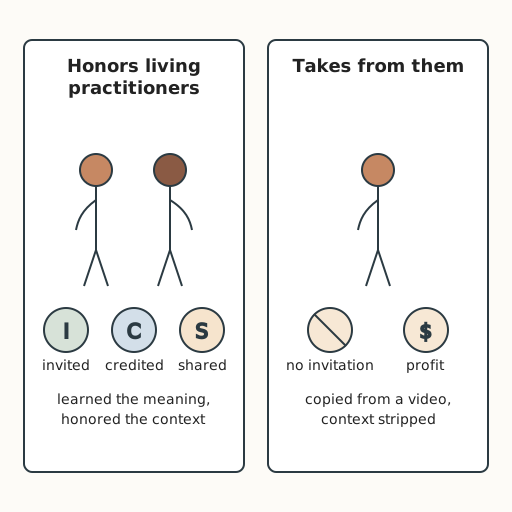
Four scenarios (adapt to your place; keep specific and respectful): 1. A dancer learns a form from its own teacher, by invitation, learns its meaning, and credits the community in the program. 2. A performer copies a ceremonial dance from a video, performs it as entertainment, and never asks or credits anyone. 3. A theater group invites a practitioner to teach and co-direct, and shares the ticket money. 4. A film uses a people’s sacred gesture as a joke, flattening a living tradition into a punch line.
Procedure
- Recall (5 min). From Lessons 2 and 6: four questions — ask, context, credit, benefit. Today add a fifth for the body: is it sacred, and is it mine to do?
- Meet the distinction (10 min). Watch a worked example: a dancer who learns from a teacher by invitation, learns the meaning, and credits the community — versus a performer who copies a ceremonial dance from a video for laughs and profit. One honors; one takes.
- Sort the scenarios (15 min). With a partner, read the four cards. Place each under “Honors living practitioners” or “Takes from them,” and write one reason using the five questions.
- Meet three living forms (10 min). Consider capoeira (S-325), haka (S-447), and tinikling (S-116). Why does each one’s context — its history, its occasion, its community — matter so much to how we engage it?
- Write your rule (10 min). Write your own two-sentence rule for engaging with another culture’s movement or drama. Start: “I will honor living practitioners by ______.”
- Close (5 min). Add the sheet to your portfolio. Next: design.
Differentiation
- Support: Give the five questions as a checklist and ask only “invited or not” and “credited or not” for each scenario.
- Extension: Research one real case of a dance or drama form taken out of context, and write a short proposal for a fairer path (invitation, credit, shared benefit).
- Non-visual / low-literacy path: The four scenarios and the three living forms (capoeira, haka, tinikling) can be read as text rather than viewed on video, and learners answer aloud or in voice-recorded form instead of writing.
- Language: Learners may write or speak their rule in their home language first, then translate to a shared classroom language; the five questions (ask, context, credit, benefit, is-it-sacred) translate cleanly across languages.
Assessment
- Formative (self): Can the learner sort each scenario and give one reason (invitation, context, sacredness, credit, or benefit) for at least two of them?
- Portfolio artifact (unit): The two-column reflection with the learner’s own two-sentence rule, added to the portfolio.
Home connection
Ask someone at home about a dance, gesture, or ceremony your family or community does, and whether an outsider would need permission to join or perform it.
Resources
- On living movement traditions: Encyclopaedia Britannica, “Capoeira,” https://www.britannica.com/sports/capoeira (S-325); Te Ara, “Haka,” https://teara.govt.nz/en/haka (S-447); NCCA Philippines, National Commission for Culture and the Arts, https://ncca.gov.ph/ (S-116).
- On dance and drama as living heritage and cultural diversity: UNESCO, Intangible Cultural Heritage, https://ich.unesco.org/ (S-056); UNESCO, Universal Declaration on Cultural Diversity, https://www.unesco.org/en/legal-affairs/unesco-universal-declaration-cultural-diversity (S-389).
- On worked examples before independent work: Kirschner, Sweller & Clark (2006), https://doi.org/10.1207/s15326985ep4102_1 (S-011).