Lesson 01 — Starting with Care: Honoring Every Body, Every Pace
Learners build the shared agreements that make this unit safe and honest, name what "accurate information, dignity, and care" mean in practice, and set up a wonder box so every question can be asked without fear.
Objectives
Objectives
- D03.S4.10.01 Analyze the risks and responsibilities of sexual activity, including contraception and preventing infections, using accurate information.
Essential question
How do we talk about bodies, sex, and health with dignity, accuracy, and care — and why does that shape every decision that follows?
Key vocabulary
Materials
Standard materials
- Class norms chart · 1 for the group A shared list of agreements (dignity, accuracy, consent to share or pass, confidentiality and its limits)
- Wonder box or question jar · 1 A place for written, anonymous questions
- Paper and pen · per learner
Low-tech / no-cost
- Voice and a drawn circle Agree on norms aloud and record them with chalk or a stick in the ground; ask questions aloud instead of writing
- A "pass" signal A raised hand or folded-arm gesture any learner can use to opt out of sharing at any moment
Enriched / lab & device
- Digital shared document · 1 for the group A co-edited norms list learners can revisit and add to anonymously
- Anonymous polling app · 1 per group For private, low-stakes temperature checks on how the unit is feeling
Works in different contexts
- large-group Build the norms chart whole-class with quick pair-share first; keep the wonder box central so quiet learners can ask without speaking up
- multi-age Younger learners help set simple norms (listen, pass is okay); older learners model asking questions with care and explain the wonder box
- self-directed A learner reads the commitments, writes their own personal agreements, and sets a private place to keep questions
- level-grouped Group learners who are new to this topic together for extra framing; a ready group drafts a "why these agreements matter" note for the room
- outdoor-only Hold the circle outdoors; draw the four commitments on the ground and place a stone on the one each learner values most
Lesson 1 — Starting with Care: Honoring Every Body, Every Pace
Summary
Learners build the shared agreements that make this unit safe and honest, name what “accurate information, dignity, and care” mean in practice, and set up a wonder box so every question can be asked without fear. This lesson does not teach sexual content yet; it builds the container that makes the rest of the unit possible.
Objectives
- Analyze the risks and responsibilities of sexual activity using accurate information, beginning with the responsibility to talk about bodies with dignity and care. (D03.S4.10.01)
Connection
When you need medical help — a fever, a broken arm, a worry that will not go away — you would never want to be lied to or shamed for asking. You would want the truth, said plainly and kindly, and the chance to ask anything. That is exactly what we are building here: a place where questions are met with accurate information and care, never fear. Every body is different, every person moves at their own pace, and every family lives in its own way — all of it honored.
Materials
- Class norms chart
- Wonder box or question jar
- Paper and pen
Preparation
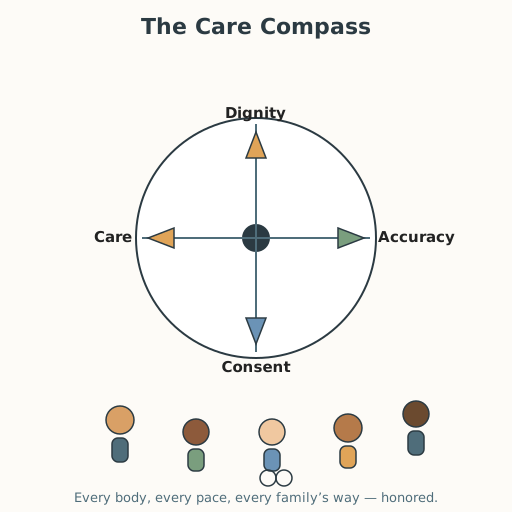
- Prepare the norms chart with four starting words: Dignity, Accuracy, Consent, Care.
- Set up the wonder box where learners can drop questions privately.
Facilitator note
This lesson is written to the learner (“you”). Your job is to co-build a safe container. Land these four commitments and keep returning to them all unit long: dignity (no shame about any body), accuracy (we use real, sourced information, never rumor or fear), consent (everyone may share or pass; no one is forced to disclose), and care (questions get honest answers and a path to help).
Sensitive-topic guidance (non-negotiable): learners may opt out of sharing at any time with a signal — no forced disclosure of personal experience, ever. If a learner’s question or comment suggests they may be unsafe, hurt, or in need of help, do not promise secrecy; follow your setting’s safeguarding procedure and connect them with a trusted adult or local health service (school counselor, clinic, helpline). State the limits of confidentiality plainly at the start so no one is surprised.
The ethics lens: dignity and honest information are the right way to care for people. The egalitarian lens: these agreements protect everyone equally — the quiet, the different, the unsure. The global lens: different cultures and families have different ways of living, and none is above another. The social-emotional lens: naming that this topic can feel tender is itself a skill. Use the wonder box for every lesson; answer a few questions each day with accurate, non-shaming information.
Procedure
- Gather and breathe (5 min). Sit in a circle. Notice your body: is it relaxed or tense? Both are okay. This unit is about your body and your health, and it starts with how we treat each other.
- Name the four commitments (10 min). Look at the four words — Dignity, Accuracy, Consent, Care. With a partner, say what each one means in one sentence. Then share one idea aloud or in writing.
- Build the agreements (10 min). Together, turn the four words into real rules: “No shame about any body.” “We use accurate information, not rumor.” “Everyone may share or pass.” “Questions get honest answers.” Add one agreement of your own.
- Meet the wonder box (5 min). This box is for any question, asked in writing, with no name required. Write one question now if you have one — or write a question you imagine someone else might be afraid to ask.
- The pass signal (5 min). Practice it: a raised hand, a folded arm, or a card. Anyone may use it at any time, no explanation needed. You always own your own story.
- Check yourself (10 min). Write two sentences in your journal: “One thing I need from this room is…” and “One question I hope this unit answers is…” Keep it private or share by choice.
- Close (5 min). Say one word that describes how you want this room to feel. Remember: every body, every pace, every family’s way — honored.
Differentiation
- Support: Offer sentence starters for the two journal sentences; allow drawing or voice notes instead of writing.
- Extension: Ask learners to draft a short “why these agreements matter” note for a younger learner, in plain words.
Assessment
- Formative (self + observation): Can the learner name the four commitments and use (or witness) the pass signal? Did they contribute one agreement or one question — aloud, in writing, or anonymously?
- Artifact (portfolio): The two-sentence journal entry, kept private or added to the portfolio by choice.
Home connection
If it feels safe in your family, ask an adult: “What does our family believe about how to talk about bodies and health?” If that is not safe or comfortable, that is okay — write the question for your wonder box or a trusted adult instead. No one is required to have this conversation at home.
Resources
- UNESCO — International Technical Guidance on Sexuality Education (consent and the right to decide freely over one’s own body, held as a widely shared framework): https://www.unesco.org/en/health-education/cse (S-412).
- United Nations Convention on the Rights of the Child (right to be safe and be heard): https://www.ohchr.org/en/instruments-mechanisms/instruments/convention-rights-child (S-060).