Lesson 02 — Consent: Freely Given, Informed, Reversible
Learners define real consent as freely given, informed, reversible, specific, and enthusiastic, practice checking for a genuine "yes" in everyday and relationship scenarios, and learn that a "yes" can be withdrawn at any time.
Objectives
Objectives
- D03.S4.10.01 Analyze the risks and responsibilities of sexual activity, including contraception and preventing infections, using accurate information.
Essential question
What makes a "yes" real — and how do I check for it, give it, and take it back if I need to?
Key vocabulary
Materials
Standard materials
- Consent conditions worksheet · 1 per learner The conditions of real consent with a short scenario practice
- Scenario cards · 1 set per small group Everyday (non-sexual) and relationship scenarios to test consent thinking
Low-tech / no-cost
- Voice and role-play Act out asking and answering in pairs; no paper needed
- A drawn stoplight Green = clear yes, yellow = unsure/check again, red = no or not now
Enriched / lab & device
- Shared digital scenarios · 1 per group A slide deck or document of scenarios for discussion and anonymous voting
Works in different contexts
- large-group Model one scenario whole-class with a volunteer pair, then small groups practice; collect anonymous answers on the tricky cases
- multi-age Younger learners practice everyday consent (borrowing, touching hair, sharing food); older learners extend to relationship scenarios
- self-directed A learner reads the conditions, works the scenarios alone, and writes a reflection on a time they checked for a real yes
- level-grouped A ready group writes the "how to check for a yes" script; a still-learning group sorts yes/unsure/no examples with support
- outdoor-only Use physical movement — step forward for "yes," back for "no," side for "unsure" — to sort scenarios outdoors
Lesson 2 — Consent: Freely Given, Informed, Reversible
Summary
Learners define real consent as freely given, informed, reversible, specific, and enthusiastic, practice checking for a genuine “yes” in everyday and relationship scenarios, and learn that a “yes” can be withdrawn at any time — before and during. This is the foundation of the unit’s “responsibilities” thread.
Objectives
- Analyze the risks and responsibilities of sexual activity using accurate information, beginning with consent as the non-negotiable first responsibility. (D03.S4.10.01)
Connection
Consent is not only about sex. You already use it every day: “Can I borrow your phone?” “Is it okay if I sit here?” “Want to try this food?” A real yes is freely given — not pressured, not assumed from silence, not owed because of a gift or a date. The same skill, sharpened, is what protects everyone when a relationship becomes physical: a yes you can trust, given and received with care.
Materials
- Consent conditions worksheet
- Scenario cards
Preparation
- Copy the consent conditions worksheet and the scenario cards.
- Retrieval (spiral): from Lesson 1, the four commitments (dignity, accuracy, consent, care); from Grade 9, the basics of consent and body autonomy.
Facilitator note
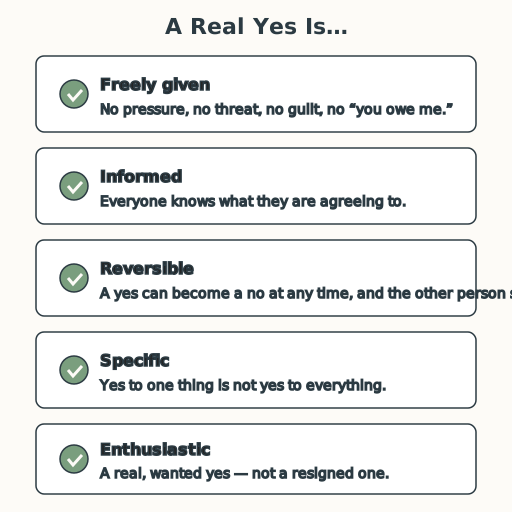
This lesson is written to the learner (“you”). Land the five conditions: consent is freely given (no pressure, no threat, no guilt), informed (everyone knows what they are agreeing to), reversible (a yes can become a no at any moment), specific (yes to one thing is not yes to everything), and enthusiastic (a genuine yes, not a resigned one). A widely used memory aid spells them FRIES (freely given, reversible, informed, enthusiastic, specific) — the underlying principles (freely given, informed, reversible) are the international framing in UNESCO’s guidance on sexuality education (S-412); “enthusiastic” and “specific” are the additions of a popular mnemonic (Planned Parenthood). Silence, freezing, or “sure, I guess” under pressure is not consent. These conditions hold in every kind of relationship — between people of any gender, and whether a relationship is same-sex or different-sex; consent is never tied to one kind of couple.
Sensitive-topic guidance: learners may opt out of sharing — use role-play scenarios that are fictional and mostly non-sexual; no learner should ever be asked to describe their own experiences. If a learner’s question suggests coercion, abuse, or being unsafe, do not promise secrecy; follow your safeguarding procedure and refer to a trusted adult or local service.
The ethics lens: respecting another person’s autonomy is the right thing to do, in every relationship. The egalitarian lens: consent protects everyone equally regardless of gender, and pressure can be exerted by anyone on anyone — in every kind of relationship, including same-sex relationships and families of every form; no relationship type is ranked above another. The global lens: cultures express agreement and refusal differently, but the principle that a person decides over their own body is a shared human-rights commitment. The social-emotional lens: reading another person’s yes or no is an emotional skill — tone, hesitation, and body language all carry meaning.
Procedure
- Retrieve (5 min). What were the four commitments from Lesson 1? From Grade 9: what does “my body belongs to me” mean?
- Meet the five conditions (10 min). Read the five conditions. For each, say a plain-language version aloud: freely given = no pressure; informed = we both know what we’re agreeing to; reversible = I can change my mind; specific = yes to one thing isn’t yes to all; enthusiastic = a real, wanted yes.
- Read the signals (10 min). What does a real yes sound like and look like? What does a no look like — including silence, freezing, “maybe,” “I don’t know,” or laughing it off? A no does not have to be loud to be real. Practice saying an ordinary no out loud with a partner (“No, thank you”) and hearing it calmly.
- Work the scenarios (15 min). In pairs or small groups, sort each scenario: is this a real yes, a clear no, or an “unsure — check again”? Use the worksheet.
- The reversible rule (5 min). Say it together: a yes can become a no at any time, and the other person stops. Changing your mind is not a betrayal; it is the rule.
- Reflect (5 min). Write one sentence: “The way I will check for a real yes is…” and one: “The way I will say no when I need to is…”
- Close (5 min). Reminder: consent is the first responsibility, in every relationship and every step of one.
Differentiation
- Support: Use only the everyday scenarios; offer the stoplight (green/yellow/ red) as a visual for yes/unsure/no.
- Extension: Write a short dialogue in which one person withdraws a yes and the other responds with care, then read it aloud.
Assessment
- Formative (peer + self): Can the learner name the five conditions and correctly sort a scenario as real yes, no, or unsure — with a reason?
- Artifact (portfolio): The two reflection sentences, kept private or shared by choice.
Home connection
If it feels safe, talk with a trusted adult about how your family asks for and gives permission in daily life (“may I…”, “do you mind…”). If that is not comfortable, write the question for your wonder box instead. No one is required to discuss this at home.
Resources
- UNESCO — International Technical Guidance on Sexuality Education (consent as freely given, informed, reversible; right to decide over one’s own body): https://www.unesco.org/en/health-education/cse (S-412).
- United Nations Convention on the Rights of the Child (protection and the right to be heard): https://www.ohchr.org/en/instruments-mechanisms/instruments/convention-rights-child (S-060).