Lesson 09 — Peer, Marketing, and Pressure: Reading Bias
Learners see that health information comes with a motive — to help, to belong, or to sell — and practice detecting bias in peer advice and marketing, including sponsored content and influencer posts, so they can listen without being steered.
Objectives
Objectives
- D03.S4.10.02 Evaluate sources of health information, including online, peer, and marketing sources, for accuracy and bias.
Essential question
How do peers and marketers shape what I believe about health — and how do I hear them without being steered by them?
Key vocabulary
Materials
Standard materials
- Motive cards · 1 set per group Three motive types — to help (expert/clinic), to belong (peer), to sell (marketer) — with sample messages
- Bias-detector worksheet · 1 per learner A frame for naming who is speaking, their motive, and what they gain
Low-tech / no-cost
- Voice and role-play Three learners each read a message as peer, marketer, or expert; others name the motive
- Drawn three-column chart Sort sample messages into help / belong / sell
Enriched / lab & device
- Real ads and sponsored posts · 1 per group Collect current health-product ads and influencer posts to analyze (personal info removed)
Works in different contexts
- large-group Role-play the three voices whole-class, then small groups sort messages and report the tell-tale signs of each motive
- multi-age Younger learners learn "does this person want to help me, fit in with me, or sell to me?"; older learners analyze subtler sponsored posts
- self-directed A learner works the bias detector on several messages and writes how to hear friends' advice without being steered
- level-grouped A ready group dissects an influencer post for undisclosed sponsorship; a still-learning group sorts obvious examples
- outdoor-only Use three marked areas — help, belong, sell — and walk to the motive you hear in each message
Lesson 9 — Peer, Marketing, and Pressure: Reading Bias
Summary
Learners see that health information comes with a motive — to help, to belong, or to sell — and practice detecting bias in peer advice and marketing, including sponsored content and influencer posts, so they can listen without being steered.
Objectives
- Evaluate sources of health information, including peer and marketing sources, for accuracy and bias. (D03.S4.10.02)
Connection
A friend who says “everyone’s doing it” is usually trying to make you feel normal, not to give you facts — and “everyone” is often fewer people than it sounds. An ad that shows beautiful, confident people using a product is selling a feeling, not a fact. Neither is lying exactly; each has a motive. Reading the motive — help, belong, or sell — is how you keep your decisions yours, made on evidence and your own values rather than on someone else’s purpose.
Materials
- Motive cards
- Bias-detector worksheet
Preparation
- Copy the motive cards and bias-detector worksheet.
- Retrieval (spiral): from Lesson 7, the five questions; from Lesson 8, the four moves and red flags. Today: the same tools aimed at people — peers and marketers.
Facilitator note
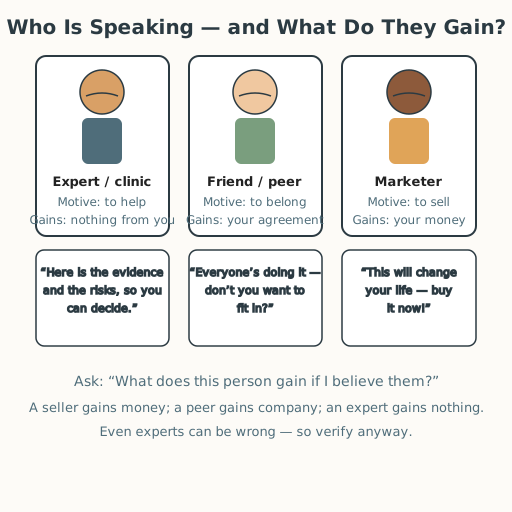
This lesson is written to the learner (“you”). Land the three motives (using NAMLE, S-151, and WHO’s marketing framing, S-312): to help (a clinic, a health authority, a professional — motive: your wellbeing), to belong (a peer or social group — motive: connection, fitting in, sometimes shared pressure), and to sell (a company, a sponsored influencer — motive: profit). Teach learners to ask “what does this person gain if I believe them?” A marketer gains money; a friend gains your company or agreement; an expert gains nothing from your choice — which is a clue to trust, though even experts can be wrong, so verify anyway. Show how sponsored content and influencer posts blur “help” and “sell” on purpose, which is why disclosure labels and the five questions matter.
Sensitive-topic guidance: peer-pressure examples may touch on sex and bodies; keep them non-graphic and use fictional scenarios. Explicitly normalize resisting pressure — saying no, waiting, or checking facts — as strength, never weakness. Learners may opt out. If a message or disclosure suggests coercion or unsafe circumstances, respond privately and follow your safeguarding procedure to a trusted adult or health service.
The ethics lens: persuading with facts is honest; persuading with manufactured fear or false “everyone does it” is not. The egalitarian lens: marketing disproportionately targets the young, the uncertain, and the under-served — reading bias is a shield for those with the least to spare. The global lens: the same product is sold with different emotional appeals in different cultures, but the motive — sell — is the same. The technology lens: algorithms place marketing beside genuine help so they look identical, which is precisely why motive-reading is a survival skill online. The social-emotional lens: wanting to belong is human and good — the skill is noticing when that want is being used.
Procedure
- Retrieve (5 min). The five questions (Lesson 7) and the four moves (Lesson 8) — say them fast. Today we aim them at people.
- Meet the three motives (10 min). Learn them: help, belong, sell. For each, ask: what does this person gain if I believe them? A seller gains money; a peer gains company; an expert gains nothing — a clue worth noticing.
- Role-play the voices (10 min). Three volunteers read the same health advice as a caring expert, a friend (“everyone’s doing it”), and a marketer (“change your life”). The group names each motive and the tell-tale sign.
- Sort the messages (15 min). In small groups, sort the message cards into help, belong, or sell — and for each, name the tell: a source? a fear? an “everyone”? a price? Check your sorting against the key.
- Spot the blur (5 min). Look at a sponsored post or influencer message. Where does “sell” disguise itself as “help”? What label gives it away?
- Reflect (5 min). Write: “When a friend or an ad tells me something about my health or body, I will ask…”
- Close (5 min). Tomorrow we bring it all together into your own decision guide and source check.
Differentiation
- Support: Focus on help vs. sell with clearly labeled examples; use the three-column sort.
- Extension: Find a real influencer post or ad (personal info removed), identify undisclosed sponsorship, and write a short “what they gain” analysis.
Assessment
- Formative (peer + self): Can the learner name the three motives, sort messages by motive, and identify the “what do they gain” question for a sponsored post?
- Artifact (portfolio): The “when a friend or ad tells me…” reflection.
Home connection
If it feels safe, look at a product ad with a trusted adult and name its motive together. If not comfortable, practice on any ad you see. No home conversation is required.
Resources
- NAMLE — Key Questions to Ask When Analyzing Media Messages: https://namle.org/resources/key-questions/ (S-151).
- WHO — Set of recommendations on the marketing of foods and non-alcoholic beverages to children (marketing aimed at the young): https://www.who.int/publications/i/item/9789241500210 (S-312).