Lesson 08 — Online Health Information: Reading Laterally
Learners learn to read laterally — leave the page and check the source, find better coverage, and trace claims to their origin — and learn the red flags of online health misinformation, applying the moves to a real claim.
Objectives
Objectives
- D03.S4.10.02 Evaluate sources of health information, including online, peer, and marketing sources, for accuracy and bias.
Essential question
How do I check an online health claim by stepping outside the page — and what are the red flags of misinformation?
Key vocabulary
Materials
Standard materials
- Lateral-reading worksheet · 1 per learner The four moves — stop, investigate the source, find better coverage, trace claims — with practice space
- Red-flags list · 1 per group Miracle cures, fear, no author, no date, selling, "doctors hate this," one-sided outrage
Low-tech / no-cost
- Voice and a chant Learn the four moves by heart; practice deciding "leave the page" vs. "trust it"
- Printed examples Hand-copied web pages and posts to evaluate without devices
Enriched / lab & device
- Connected devices · 1 per group Open a real claim, then open new tabs to investigate the source and find better coverage
Works in different contexts
- large-group Model one lateral read on a projector, then small groups verify a shared claim and report what the new tabs revealed
- multi-age Younger learners learn "leave the page to check it"; older learners complete the full four moves and report
- self-directed A learner follows the worked example, then runs the four moves on one claim and writes what they found
- level-grouped A ready group verifies a subtle health-news claim; a still-learning group sorts red flags from green flags
- outdoor-only Use printed claims and the chant; learners act out "leave the page" by stepping to a new spot for each move
Lesson 8 — Online Health Information: Reading Laterally
Summary
Learners learn to read laterally — leave the page and check the source, find better coverage, and trace claims to their origin — and learn the red flags of online health misinformation, applying the moves to a real claim.
Objectives
- Evaluate sources of health information, including online sources, for accuracy and bias. (D03.S4.10.02)
Connection
When you are told something surprising, a wise move is to ask a second person — not just the person who told you. Reading online is the same, except the “second person” is other pages: open a new tab and see what the rest of the web says about the source and the claim. A page can look polished and still be wrong; the test is not how it looks, but what other sources say about it. This move — called lateral reading — is how fact-checkers separate signal from noise.
Materials
- Lateral-reading worksheet
- Red-flags list
Preparation
- Copy the worksheet and red-flags list.
- Retrieval (spiral): from Lesson 7, the five questions (who, why, for whom, what evidence, what is left out). Today: the four moves that answer them online.
Facilitator note
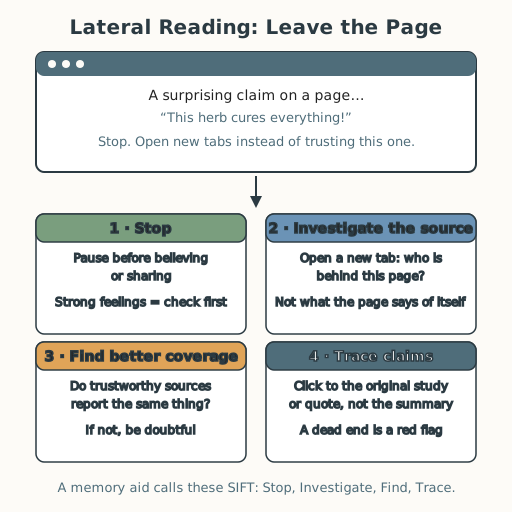
This lesson is written to the learner (“you”). Land the four moves (lateral reading; the verification habit documented by First Draft, S-394, and framed for learners by Common Sense, S-063): (1) Stop — pause before believing or sharing; (2) Investigate the source — open a new tab and find out who is actually behind the page (not what the page says about itself); (3) Find better coverage — see whether trustworthy sources report the same thing; (4) Trace claims — click through to the original study or quote rather than trusting the summary. A memory aid calls these SIFT (Stop, Investigate, Find, Trace). Red flags: miracle cures, fear and urgency, no author or date, anonymous sources, “doctors hate this,” a page that is really an ad (sponsored content), and claims that only one site makes.
Sensitive-topic guidance: some health misinformation targets sexual health and bodies; keep examples non-graphic, treat claims as material to verify (never to try), and let learners opt out. If a claim raises a real concern, respond privately and follow your safeguarding procedure to a trusted adult or health service. The point is protection through skill, not fear of the internet.
The ethics lens: sharing only what you have checked is a form of honesty to everyone who trusts your feed. The egalitarian lens: misinformation spreads fastest where trust in institutions is lowest — checking is a skill that protects the most vulnerable first. The global lens: the same false health claim can be translated and re-posted across countries; the moves work in any language. The technology lens: recommendation feeds rank by engagement, not accuracy, so a compelling falsehood can out-travel a dull truth — exactly why we must be the filter.
Procedure
- Retrieve (5 min). The five questions from Lesson 7 — say them fast. Today we learn the four moves that answer them online.
- Meet the four moves (10 min). Learn them: Stop, Investigate the source, Find better coverage, Trace the claim. Say them as a chant. Notice the central idea: leave the page — the truth is rarely found on the same page that made the claim.
- Worked example (10 min). Follow a model: a site claims a herb “cures” an infection. Stop. Investigate: the site is anonymous, sells the herb, and is not a health authority. Find better coverage: trusted health sources say no such cure exists. Trace: the “study” links back to the same site. The claim fails every move.
- Practice lateral reading (15 min). In groups, take a claim. Run all four moves — using devices if you have them, or the printed examples. Write what each move revealed.
- Name the red flags (5 min). Which flags appeared in your claim? Say them: miracle cure, fear, no author, no date, selling, one-sided.
- Reflect (5 min). Write: “Before I share a health claim, I will…”
- Close (5 min). Next: the same skill, applied to the people and ads around us — peer pressure and marketing.
Differentiation
- Support: Focus on the first two moves (Stop, Investigate) with clearly flagged examples; offer a “red flag or green flag” sort.
- Extension: Take a real claim from your own feed (personal info removed), run all four moves, and write a short “verified or not” brief with your evidence.
Assessment
- Formative (peer + self): Can the learner name the four moves and use them to find a source’s identity, locate better coverage, and spot at least one red flag?
- Artifact (portfolio): The “before I share, I will…” reflection.
Home connection
If it feels safe, fact-check one health claim together with a trusted adult using the four moves. If not comfortable, practice alone on any surprising claim you see. No home conversation is required.
Resources
- First Draft — Verifying Online Information: The Absolute Essentials (lateral reading; archived): https://web.archive.org/web/2019/https://firstdraftnews.org/latest/verifying-online-information-the-absolute-essentials/ (S-394).
- Common Sense Education — News & Media Literacy: https://www.commonsense.org/education/digital-citizenship/topic/news-and-media-literacy (S-063).