Lesson 03 — Periodizing a Global Era: Arguing for Turning Points
Learners treat periodization as an argument: they divide a global era into periods, choose turning points, and defend them with evidence, learning to answer a counterclaim rather than search for a single "correct" answer.
Objectives
Objectives
- D08.S1.10.02 Argue for a way to divide a global era into periods and defend where its turning points should fall.
Essential question
How do I argue for a way to divide a global era into periods and defend where its turning points should fall?
Key vocabulary
Materials
Standard materials
- Periodization worked example · 1 per learner One page modeling how to divide a global era (e.g., 1450–1800) into periods with turning points, evidence, and a defense
- History journal · 1 per learner
Low-tech / no-cost
- Hand-drawn timeline Draw a long line and mark three candidate turning points yourself; no printed sheet needed
- Voice and debate Argue a turning point aloud to a partner, then let them counter it
Enriched / lab & device
- Device or atlas · 1 per pair A timeline tool or map to check dates and places across regions at once
Works in different contexts
- large-group Model one full periodization on the board, then have small groups defend competing turning points and the class vote on the strongest defended, not the "rightest"
- multi-age Younger learners place two given events in order and pick one turning point; older learners build and defend a three-part periodization with evidence
- self-directed A learner works the worked example, then writes and defends their own periodization of a chosen era with three pieces of evidence
- level-grouped Group by argument readiness, not age; a ready group moves to anticipating and answering a counterclaim
- outdoor-only Mark a "timeline" on the ground with stones and walk the turning points, arguing each step aloud
Lesson 3 — Periodizing a Global Era: Arguing for Turning Points
Summary
Learners treat periodization — dividing history into periods — as an argument, not a fact. Using a worked example, they divide a global era into periods, choose turning points, and defend them with evidence, then practice answering a counterclaim.
Objectives
- Argue for a way to divide a global era into periods and defend where its turning points should fall. (D08.S1.10.02)
Connection
Every time you tell a story you divide it: “before,” “when everything changed,” and “after.” You might say a friendship changed “when we moved,” or “when the drought came.” Historians do the same thing at the scale of the whole world, calling the dividing lines “turning points.” But two people can pick different turning points for the same story — and both can be reasonable. Periodization is an argument you defend, not an answer you find.
Materials
- Periodization worked example
- History journal
Preparation
- Copy or draw the periodization worked example.
- Retrieval: from Lessons 1–2, recall that time is counted many ways and that its shape changes what is remembered (S-315). Today we argue about where to draw the lines.
Facilitator note
This lesson is written to the learner (“you”). The idea to land: periodization is a claim about where the most important changes fall, and it is defended with evidence and by answering a counterclaim — there is no single “correct” dividing line. This is a foundational skill, so teach it with an explicit worked example and guided practice before independent argument (S-011).
The critical-thinking lens is the spine: a turning point is a judgment about significance, so two defensible periodizations can disagree. The global lens: the worked example divides a global era (roughly 1450–1800), so a turning point must matter across regions — the Columbian Exchange that joined the hemispheres and began colonizing the Americas (S-273, S-326) is a strong candidate, but so is the later industrial take-off, and a learner may defend a different one. The egalitarian lens: whose turning point counts? A line that marks “discovery” for one people marks invasion for another — ask learners to name for whom the turning point turned. The ethics lens: dividing the past is never neutral; it is a choice about what matters, so say what you are counting as significant. Preview: Lesson 4 moves to the ethics of how knowledge and culture move between peoples.
Procedure
- Recall (5 min). From earlier: what is one thing a calendar or a shape of time changes about memory? Now think of one event in your life that “changed everything” — that is your turning point.
- Meet the worked example (15 min). Look at the periodization example. To divide
a global era (say 1450–1800) into periods:
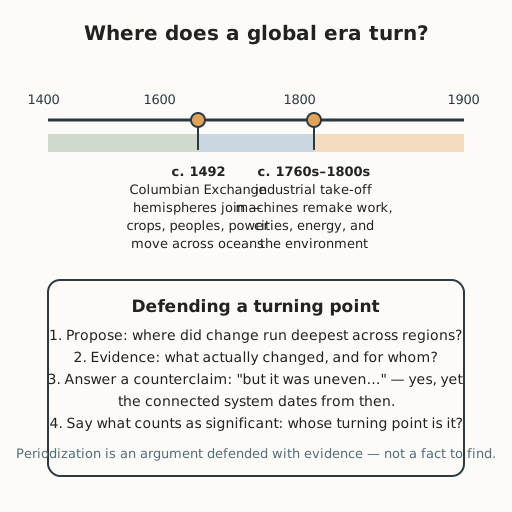
- Propose turning points: where did change run deepest across regions? (e.g., c. 1492, the Columbian Exchange joining hemispheres; c. 1760s–1800s, the industrial take-off.)
- Give evidence for each: what actually changed, and for whom? (new crops, peoples, and power moving across oceans; machines remaking work and cities.)
- Defend against a counterclaim: “but 1492 didn’t change everyone at once” — answer it (changes were uneven, yet the system of connected hemispheres dates from then).
- State what you are counting as significant: movements of people, power, and environment — not just one region’s events. Watch this worked example once, step by step.
- Guided practice (15 min). In pairs, take the same era. Choose one turning point you would move or replace, give one piece of evidence, and answer one counterclaim. Compare and agree on what makes a defense strong.
- Independent work (15 min). In your journal, write a three-part periodization of a global era you choose (1450–1800, or 1800–present). For each turning point: one evidence sentence and one counterclaim you can answer.
- Close (5 min). Say in one sentence: why is periodization an argument, not a fact? Next time: the ethics of sharing and taking knowledge and culture.
Differentiation
- Support: Use a half-built periodization with the turning points given and the evidence blank, to fill in.
- Extension: Defend a competing periodization — argue that a commonly accepted turning point should be moved or that a quieter one matters more.
- Access (blind / low vision): Lay a rope straight as the timeline, with knots or stones at each turning point, and read the dates and evidence notes aloud in order; the argument (propose → evidence → answer a counterclaim) is fully spoken, so no seeing is required.
Assessment
- Formative (peer + self): Can the learner propose a turning point, support it with evidence, and answer one counterclaim?
- Portfolio artifact (unit): The written periodization with evidence and a counterclaim, as the unit’s “defended argument” artifact.
Home connection
Ask an adult: where does our family’s story “turn”? (A move, a birth, a season, a decision.) Together, write that turning point, one piece of evidence it mattered, and one reason someone else might place it differently.
Resources
- On the Columbian Exchange as a global turning point: Alfred W. Crosby, The Columbian Exchange (1972) (S-273), and Encyclopaedia Britannica, “Western colonialism,” https://www.britannica.com/topic/colonialism (S-326).
- On periodization as an interpretive choice, see the unit’s framing in
docs/philosophy.md§5 (evidence vs. values) and §11 (inquiry over creed).