Lesson 04 — The Ethics of Sharing, Borrowing, and Taking
Learners evaluate the ethics of sharing, borrowing, and taking knowledge and culture across peoples, using consent, credit, power, and harm as criteria, and examine cases of suppression and revival.
Objectives
Objectives
- D08.S2.10.01 Evaluate the ethics of sharing, borrowing, and taking knowledge and culture across peoples, and who has been credited or harmed.
Essential question
What is the difference between sharing, borrowing, and taking knowledge and culture — and who has been credited, and who harmed?
Key vocabulary
Materials
Standard materials
- Share / Borrow / Take case cards · 1 set per pair Three short cases of knowledge or culture moving between peoples, to sort as sharing, borrowing, or taking and to argue why
- History journal · 1 per learner
Low-tech / no-cost
- Hand-written cases Write the three cases on paper or tell them aloud; no printed cards needed
- Voice and circle Discuss one case in a circle, each person naming what makes it share, borrow, or take
Enriched / lab & device
- Device or library · 1 per pair A short excerpt on a suppressed or revived knowledge tradition (e.g., the Dresden Codex, a language-revival program)
Works in different contexts
- large-group Sort the three cases whole-class on a three-column board, then small groups argue the hardest case and report one criterion each
- multi-age Younger learners name what "asking first" and "giving credit" mean; older learners weigh consent, power, and harm in the cases
- self-directed A learner sorts the cases alone and writes a one-paragraph ruling for each with a stated criterion
- level-grouped Group by readiness to weigh, not age; a ready group drafts a shared "ethics of exchange" rubric
- outdoor-only Use plants or seeds as the moving "knowledge" — ask who may gather, who is credited, and what is owed back to the source
Lesson 4 — The Ethics of Sharing, Borrowing, and Taking
Summary
Learners evaluate the ethics of how knowledge and culture move between peoples. Using consent, credit, power, and harm as criteria, they sort cases as sharing, borrowing, or taking, and examine what happens when knowledge is suppressed and later revived.
Objectives
- Evaluate the ethics of sharing, borrowing, and taking knowledge and culture across peoples, and who has been credited or harmed. (D08.S2.10.01)
Connection
Imagine a friend shows you a song they wrote, and you sing it at a gathering. If you said “this is my friend’s song,” you shared it with credit. If you sang it without naming them, you took it — and they might feel erased. The same question runs through history, across whole peoples: when knowledge and culture move from one people to another, who is credited, who consents, and who is harmed?
Materials
- “Share / Borrow / Take” case cards
- History journal
Preparation
- Copy or write the three case cards.
- Retrieval: from Grade 9, recall that knowledge traditions can be suppressed, marginalized, or lost through conquest, and that peoples work to preserve and revive them (S-474, S-424).
Facilitator note
This lesson is written to the learner (“you”). The idea to land: the ethics of how knowledge and culture move turns on consent, credit, power, and harm — sharing is given and credited, borrowing is taken with credit and a continuing relationship, and taking is done without consent or credit, at the cost of the source people. Model the three-way sort with a worked case before learners rule on their own (S-011).
The ethics lens is the spine: the same object (a song, a medicine, a script) can be shared, borrowed, or taken depending on consent and credit. The egalitarian lens: power decides whose knowledge is valued and whose is taken as “raw material” — colonizers suppressed Maya codices while keeping what they learned from them, and renamed medicines and foods without the peoples who stewarded them (S-474, S-427). The global lens: examples span continents — the Maya bark-paper codices, African and Indigenous ecological knowledge, and languages under pressure to assimilate. The critical-thinking lens: “credit” and “harm” are judgments — name your criterion and test it against a hard case. Preview: Lesson 5 traces how knowledge actually moved across the world, and who got written out of the record.
Procedure
- Recall (5 min). From Grade 9: name one way a people’s knowledge has been suppressed, and one way it has been revived. (e.g., Spanish authorities destroyed most Maya codices; communities and scholars now study and revive Maya astronomy.)
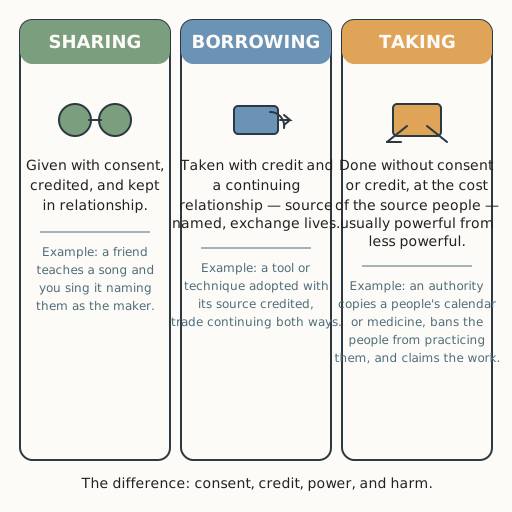
- Meet the sort (15 min). Look at the three-column chart.
- Sharing: given with consent, credited, and kept in relationship.
- Borrowing: taken with credit and a continuing relationship — the borrower names the source and the exchange continues.
- Taking: done without consent or credit, at the cost of the source people — often by a more powerful party from a less powerful one. Watch one worked case: a colonial authority copies a people’s calendar and medicine, bans the people from practicing them, and publishes them under its own name — sort it as taking, and say why (no consent, no credit, harm).
- Guided practice (15 min). In pairs, sort the three case cards. For each, name the criterion that decided it: consent, credit, power, or harm. Compare and agree before moving on.
- Independent work (15 min). In your journal, write one paragraph ruling on a hard case: when is borrowing also taking? State your criterion and apply it.
- Close (5 min). Say in one sentence: what separates taking from sharing? Next time: the real routes knowledge traveled.
Differentiation
- Support: Use only two cards (sharing and taking) and a two-column sort.
- Extension: Draft a short “ethics of exchange” rubric (consent, credit, power, harm) and apply it to a current cultural or knowledge dispute you know of.
- Access (blind / low vision): The three columns are already spoken in the Procedure (sharing, borrowing, taking), so the sort works by voice alone; offer a paper folded into three sections, or simply sort the cases aloud.
Assessment
- Formative (peer + self): Can the learner sort a case correctly and name the criterion (consent, credit, power, harm) that decided it?
- Portfolio artifact (unit): The one-paragraph hard-case ruling, kept in the unit’s “knowledge and culture” section.
Home connection
Ask an adult: is there a recipe, song, or skill in our family that came from another people — and do we know who to credit? Together, find one thing and name whose it was.
Resources
- On the suppression and survival of Maya knowledge (the Dresden Codex and its astronomical tables): Encyclopaedia Britannica, “Dresden Codex,” https://www.britannica.com/topic/Dresden-Codex (S-474).
- On language, culture, and the politics of the colonizer’s tongue: Ngũgĩ wa Thiong’o, Decolonising the Mind (1986) (S-424); and on Indigenous knowledge and reciprocity: Robin Wall Kimmerer, Braiding Sweetgrass (2013) (S-427).