Lesson 05 — Knowledge Traditions Moving Across the World
Learners trace how paper, the decimal system and zero, and scholarly manuscripts moved across the world through trade and translation, and weigh where credit was given and where it was erased.
Objectives
Objectives
- D08.S2.10.01 Evaluate the ethics of sharing, borrowing, and taking knowledge and culture across peoples, and who has been credited or harmed.
Essential question
How did knowledge actually move across the world, and who was credited — and who was written out of the record?
Key vocabulary
Materials
Standard materials
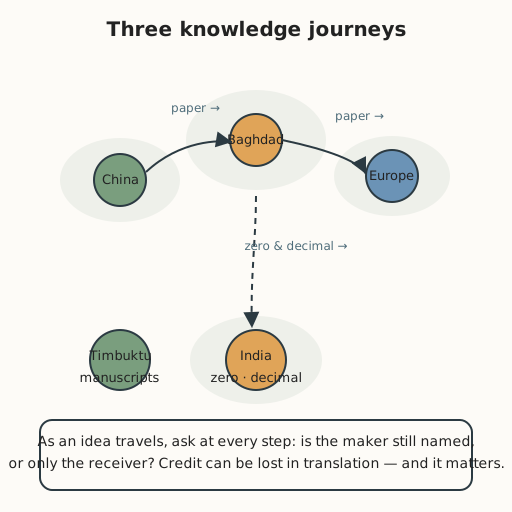
- Knowledge-journey map · 1 per learner A simple map tracing paper from China westward, the decimal system and zero from India through the Islamic world, and manuscripts preserved at Timbuktu
- History journal · 1 per learner
Low-tech / no-cost
- Hand-drawn journey map Draw the routes yourself as arrows between labeled places; no printed map needed
- Voice and retelling Tell the journey of one idea aloud from person to person, noticing where credit sticks and where it drops
Enriched / lab & device
- Device or library · 1 per pair A digital image or short excerpt of a Timbuktu manuscript or an early numeral, to examine as evidence
Works in different contexts
- large-group Trace the three journeys whole-class on a big map, then small groups each defend where credit should fall and where it was lost
- multi-age Younger learners follow one journey (paper) and name who made it; older learners compare three journeys and weigh credit versus erasure
- self-directed A learner traces the journeys on the map and writes one paragraph on how an idea's origin can be lost in travel
- level-grouped Group by readiness to weigh, not age; a ready group researches one more transmission (e.g., printing, medicine) and reports its credit trail
- outdoor-only Mark "places" across the ground and walk an idea from maker to maker, pausing to ask at each step whether the source is still named
Lesson 5 — Knowledge Traditions Moving Across the World
Summary
Learners trace real routes by which knowledge moved across the world — paper from China, the decimal system and zero from India, and scholarly manuscripts preserved at Timbuktu — and weigh where credit was given and where it was erased in translation.
Objectives
- Evaluate the ethics of sharing, borrowing, and taking knowledge and culture across peoples, and who has been credited or harmed. (D08.S2.10.01)
Connection
The number you write as “0” and the paper you write it on both traveled thousands of kilometers, through many hands and languages, to reach you. Along the way, each idea changed and — sometimes — its makers’ names were forgotten while the idea kept their stamp. Tracing how knowledge actually moves is how we see both the brilliance of exchange and the quiet erasure that can ride with it.
Materials
- Knowledge-journey map
- History journal
Preparation
- Copy or draw the knowledge-journey map.
- Retrieval: from Lesson 4, recall the difference between sharing, borrowing, and taking (consent, credit, power, harm). Today we look at real journeys and ask where credit held and where it dropped.
Facilitator note
This lesson is written to the learner (“you”). The idea to land: knowledge moves through trade, translation, and apprenticeship — and while exchange enriches everyone, the record has often named the receiver and not the maker, which is a question of credit and power, not of accuracy. Teach the three journeys as worked examples before learners weigh credit on their own (S-011).
The global lens is the spine: paper was invented in China and refined around 105 CE, carried along the Silk Roads through Central Asia to Baghdad’s paper mills and into Europe by the 1100s (S-264); the decimal place-value system and zero were developed in India and transmitted through Arabic/Islamic scholars to Europe, changing calculation everywhere (S-272, S-023); and Timbuktu under Songhai rule (1464–1591) kept a great manuscript tradition of astronomy, mathematics, medicine, and law, preserved by families for centuries (S-268, S-201). The ethics and egalitarian lenses: ask learners who is named in each story — too often the last receiver, not the first maker — and what that erasure costs. The technology lens: paper and the decimal system are technologies of knowledge whose spread remade what people could record and compute. Preview: Lesson 6 turns to how global trade and technology transform cultural traditions today.
Procedure
- Recall (5 min). From Lesson 4: what separates taking from sharing? (consent and credit.) Now: where did the numeral “0” come from? Keep the question open.
- Meet the map (15 min). Trace three journeys on the map:
- Paper: invented in China, refined c. 105 CE; carried along the Silk Roads to Baghdad’s mills, then into Europe by the 1100s (S-264).
- Decimal system and zero: developed in India; transmitted through Arabic/Islamic scholars (e.g., al-Khwarizmi’s 9th-century work) to Europe, where they transformed calculation (S-272, S-023).
- Timbuktu’s manuscripts: a scholarly tradition of astronomy, mathematics, medicine, and law preserved by families through centuries of trade and empire (S-268, S-201). Watch one worked example: at each step of paper’s journey, ask — is the maker still named, or only the receiver? Notice where “paper” loses its Chinese origin in the telling.
- Guided practice (15 min). In pairs, take the zero’s journey. At each step, name who made it and who is usually credited in a textbook you have seen. Compare and agree on where credit held and where it dropped.
- Independent work (15 min). In your journal, write one paragraph: how can an idea’s origin be lost as it travels, and why does naming the maker matter?
- Close (5 min). Say in one sentence: what does translation and trade carry, besides the idea itself? Next time: how trade and technology transform traditions today.
Differentiation
- Support: Follow only paper’s journey and answer two guided questions about who is named.
- Extension: Research one more transmission (e.g., the spread of printing, or of a medical tradition) and trace its credit trail with a source.
- Access (blind / low vision): Describe each route as a spoken journey (paper: China → Baghdad → Europe; zero: India → Baghdad → Europe; manuscripts: kept at Timbuktu), and lay yarn on a flat surface for each route so the learner can trace it with a finger while you name each stop.
Assessment
- Formative (peer + self): Can the learner trace one journey and name where credit held and where it was erased?
- Portfolio artifact (unit): The credit-trail paragraph, added to the unit’s “knowledge and culture” section.
Home connection
Ask an adult: is there something we use every day (a number, a food, a tool) whose origin we do not know? Together, find its origin story and name the people who made it.
Resources
- On the journey of paper from China to Europe: British Library learning pages on writing materials and the Silk Roads (S-264).
- On the non-European roots of mathematics: George Gheverghese Joseph, The Crest of the Peacock (S-272), and Georges Ifrah, The Universal History of Numbers (S-023).
- On Timbuktu’s manuscript tradition: UNESCO World Heritage Centre, “Timbuktu” (S-268), and UNESCO Memory of the World (S-201).