Lesson 06 — Global Trade and Technology Transform Traditions
Learners analyze how global trade and technology spread and transform cultural traditions — foods, music, language, and dress — distinguishing fusion (new, credited blends) from homogenization (thinning into sameness), while the home tradition keeps living.
Objectives
Objectives
- D08.S2.10.02 Analyze how global trade and technology have spread and transformed cultural traditions in the modern world.
Essential question
How have global trade and technology spread and transformed cultural traditions in the modern world?
Key vocabulary
Materials
Standard materials
- Tradition in motion examples · 1 set per pair Four short examples of a tradition transformed by trade or technology (a food, a music, a language, a garment), each with what changed and what stayed
- History journal · 1 per learner
Low-tech / no-cost
- Told examples Tell the four examples aloud or recall them from memory; no printed set needed
- Voice and body Sing or move a fragment of a tradition and notice what a recording or a screen would change about it
Enriched / lab & device
- Device or library · 1 per pair A short audio or video of a tradition that has traveled (a food, a dance, a song) to compare its "home" and "traveled" forms
Works in different contexts
- large-group Present the four examples whole-class, then small groups each trace one and report what fused and what thinned
- multi-age Younger learners name one food or song that traveled to their table or screen; older learners weigh fusion against homogenization with evidence
- self-directed A learner works the four examples and writes one paragraph on a tradition of their choice that has been transformed by trade or media
- level-grouped Group by readiness to analyze, not age; a ready group compares two media (print vs. streaming) and their different effects on one tradition
- outdoor-only Trace a crop's journey (e.g., the potato from the Andes to tables worldwide) and ask what traveled with it and what stayed home
Lesson 6 — Global Trade and Technology Transform Traditions
Summary
Learners analyze how global trade and technology spread and transform cultural traditions in the modern world. Using foods, music, language, and dress, they distinguish fusion (new, credited blends) from homogenization (thinning into sameness), and see that the home tradition keeps living through both.
Objectives
- Analyze how global trade and technology have spread and transformed cultural traditions in the modern world. (D08.S2.10.02)
Connection
Think of a dish your family loves. Its ingredients may have crossed oceans: the potato began in the Andes, the tomato in the Americas, spices along Indian Ocean and Silk Road routes (S-054, S-323). And think of a song you stream: it may have left its home, met other sounds, and come back changed. Trade and technology do not just move things — they change the traditions they carry, in two different directions at once.
Materials
- “Tradition in motion” examples
- History journal
Preparation
- Copy or write the four examples.
- Retrieval: from Lesson 5, recall that knowledge moves through trade and translation, and that credit can be lost. Today we see traditions transform as they move, not just arrive.
Facilitator note
This lesson is written to the learner (“you”). The idea to land: global trade and media technology spread traditions, and they transform them in two ways at once — fusion creates new, credited blends, while homogenization thins distinct traditions toward sameness; the home tradition also keeps living and adapting. Model the two outcomes with one worked example before learners analyze their own (S-011).
The global lens is the spine: Haitian Creole is a full language born of contact between enslaved Africans and French colonists, now spoken by millions — not a broken version of anything (S-475); a food like the potato moved from the Andes into countless cuisines, becoming “native” to new tables (S-054); music, dance, and craft travel through recordings and screens, protected as living heritage by UNESCO’s intangible-heritage framework (S-056). The technology lens: the printing press, radio, recording, and streaming each changed how a tradition spreads — faster and further, but also more filtered through whoever controls the channel. The ethics and egalitarian lenses: fusion with credit is exchange; fusion without credit is taking (recall Lesson 4); and homogenization often favors the powerful. Preview: Lesson 7 turns to how colonization reshaped populations, environments, and borders.
Procedure
- Recall (5 min). From Lesson 5: name one idea that traveled and whose maker we must remember to credit. Now: name one food or song in your life that came from far away.
- Meet the examples (15 min). Look at the four “tradition in motion” examples.
For each, mark what fused (a new, credited blend) and what thinned (sameness):
- a food whose ingredients crossed oceans and became a new dish;
- a music that left home, met other sounds, and returned changed;
- a language born of contact between peoples (like Haitian Creole, S-475);
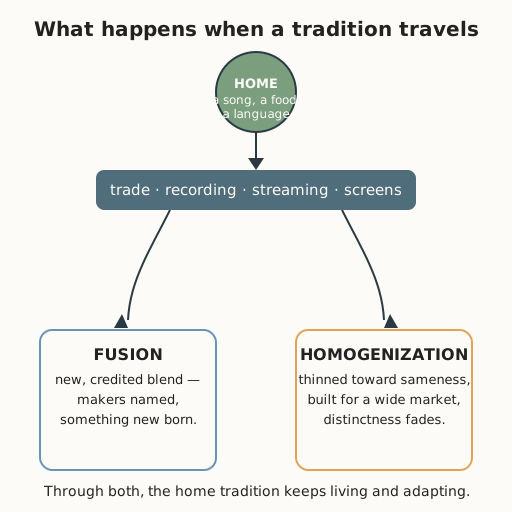
- a garment or craft that traveled through trade and media. Watch one worked example: trace a song from its home form, through a recording, to both a credited remix (fusion) and a stripped-down version built for a global market (homogenization) — and notice the home form is still sung.
- Guided practice (15 min). In pairs, take one example each. Name one fusion and one homogenization, and say who is credited in the fusion. Compare and agree.
- Independent work (15 min). In your journal, choose a tradition you know. Write one paragraph on how trade or media has transformed it — one fusion, one thinning, and one thing that stayed.
- Close (5 min). Say in one sentence: what two directions can a tradition change as it travels? Next time: how colonization reshaped the world.
Differentiation
- Support: Use only the food example with two guided questions (what fused, what thinned).
- Extension: Compare two media (print vs. streaming) and argue their different effects on one tradition, with a source.
- Access (blind / low vision): Describe the branch aloud — one home tradition forks into fusion (a credited blend) and homogenization (a thinned copy) while the home form keeps living — and model the fork with three strands of yarn held apart.
Assessment
- Formative (peer + self): Can the learner name one fusion and one homogenization in a traveling tradition, and say who is credited in the fusion?
- Portfolio artifact (unit): The one-paragraph transformation analysis, added to the unit’s “knowledge and culture” section.
Home connection
Ask an adult: which food, song, or saying in our family came from another people — and what changed when it arrived here? Write one fusion and one thing that stayed.
Resources
- On a language born of contact: Encyclopaedia Britannica, “Haitian Creole,” https://www.britannica.com/topic/Haitian-Creole (S-475).
- On crops that traveled the world: International Potato Center, “Potato” (S-054), and Alfred W. Crosby, The Columbian Exchange (S-273).
- On living heritage and its protection: UNESCO Intangible Cultural Heritage (S-056).