Lesson 07 — Colonization Reshaped the World
Learners analyze how colonization reshaped populations, environments, and borders across the world — through epidemic and displacement, extraction and introduced species, and borders drawn across peoples' lands — holding the effects on Indigenous peoples with care and accuracy.
Objectives
Objectives
- D08.S3.10.01 Analyze how colonization reshaped populations, environments, and borders across the world, and its effects on Indigenous peoples.
Essential question
How did colonization reshape populations, environments, and borders across the world?
Key vocabulary
Materials
Standard materials
- Three reshapings chart · 1 per learner One page with three columns — populations, environments, borders — and a short documented example in each
- History journal · 1 per learner
Low-tech / no-cost
- Hand-drawn chart Draw the three columns yourself and fill them from a short reading or told account; no printed chart needed
- Voice and map Talk through one example of each reshaping and mark places on a rough hand-drawn map
Enriched / lab & device
- Device or atlas · 1 per pair A digital map to compare pre-colonial and post-colonial borders in one region
Works in different contexts
- large-group Work the three columns whole-class on the board, then small groups each research one region and report one reshaping
- multi-age Younger learners name one thing colonization changed (people, land, or borders); older learners analyze causes and effects in each column
- self-directed A learner completes the chart from a short reading and writes one paragraph on the longest-lasting reshaping
- level-grouped Group by readiness to analyze, not age; a ready group traces one border from a colonial conference to its present-day consequences
- outdoor-only Mark a "border" on the ground and walk how an arbitrary line can cut through one people's land; name the real case it echoes
Lesson 7 — Colonization Reshaped the World
Summary
Learners analyze how colonization reshaped populations, environments, and borders across the world, and its effects on Indigenous peoples. They work with three documented reshapings — epidemic and displacement, extraction and introduced species, and borders drawn across peoples’ lands — with care and accuracy.
Objectives
- Analyze how colonization reshaped populations, environments, and borders across the world, and its effects on Indigenous peoples. (D08.S3.10.01)
Connection
Look at a map of almost any continent and you will see lines that cut straight through mountains, rivers, and the lands of a single people. Those lines were often drawn far away, by people who had never walked the land. Colonization — the rule of one people over another’s land and lives — reshaped not just maps but populations and environments, and its effects are still lived today. Studying it honestly means seeing both what was taken and how peoples endured.
Materials
- “Three reshapings” chart
- History journal
Preparation
- Copy or draw the three-column chart.
- Retrieval: from Grade 8, recall that European colonization spread globally from the late 1400s, taking land and suppressing languages and practices (S-326). Today we analyze its scale: populations, environments, borders.
Facilitator note
This lesson is written to the learner (“you”). The idea to land: colonization reshaped the world along three axes — populations (through epidemic and displacement), environments (through extraction and introduced species), and borders (drawn across peoples’ lands) — and its effects on Indigenous peoples are real, documented, and still lived. Model the three columns with worked examples before independent analysis (S-011).
Emotional safety: this is difficult but not graphic content. Give a brief warning at the start (“today covers real harms — loss of land, life, and self-rule”), tell learners they may step out or pass at any time, name a trusted adult or counselor for anyone who needs it, and ground the class afterward (a slow breath, a quiet minute). Do not show graphic images; keep numbers brief and human. Always pair the loss with agency and endurance — peoples survived, resisted, and rebuilt (S-274, S-273).
The egalitarian lens is the spine: colonization is a system of power — who gained and who was dispossessed is the question. The global lens: this happened across the Americas, Africa, Asia, and Oceania, not in one place (S-326). The technology and environment lenses: ships, firearms, and introduced species (the Columbian Exchange moved crops, animals, and disease in both directions, devastating Indigenous peoples while remaking landscapes, S-273); and the transatlantic trade forcibly displaced millions of African people (S-274, S-322). The ethics lens: naming the harm accurately is a duty to the truth, not a verdict on any person today. Preview: Lesson 8 centers Indigenous effects and endurance in depth.
Procedure
- Recall (5 min). From Grade 8: when did European colonization spread globally, and what did it take? (Land, self-rule, languages — from the late 1400s.)
- Meet the chart (15 min). Look at the three-column chart.
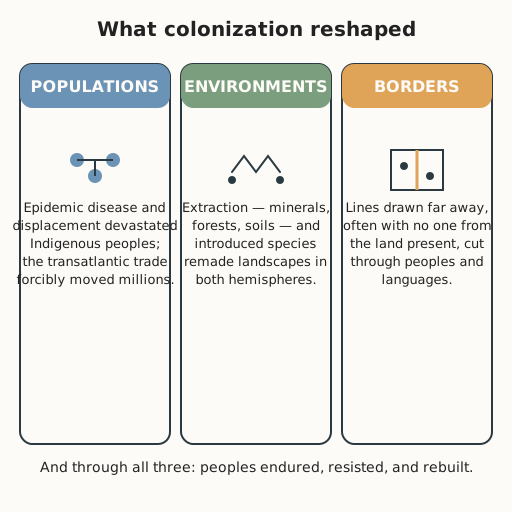
- Populations: epidemic disease and displacement devastated Indigenous peoples; the transatlantic trade forcibly moved millions of African people (S-273, S-274).
- Environments: extraction (minerals, forests, soils) and introduced species (crops, animals, and pathogens) remade landscapes in both hemispheres (S-273).
- Borders: lines drawn far away — often at conferences with no one from the land present — cut through peoples, languages, and ways of life (S-326). Watch one worked example: trace one region through all three columns, and name both the harm and the endurance of the people there.
- Guided practice (15 min). In pairs, take one column. Give one documented example and one effect on Indigenous peoples. Compare and agree before moving on.
- Independent work (15 min). In your journal, write one paragraph on the reshaping that lasted longest — population, environment, or borders — and why.
- Close (5 min). Say in one sentence: what three things did colonization reshape, and what must we also remember? Next time: Indigenous effects and endurance.
Differentiation
- Support: Use one column (borders) with a guided example and two questions.
- Extension: Trace one colonial-era border to a present-day consequence, with a source, and explain the link.
- Access (blind / low vision): The three reshapings (populations, environments, borders) are fully spoken in the Procedure, so the lesson works by voice; use a paper folded into three sections, or read each example aloud with no chart at all.
Assessment
- Formative (peer + self): Can the learner name the three reshapings and give a documented example with an effect on Indigenous peoples for one of them?
- Portfolio artifact (unit): The one-paragraph “longest-lasting reshaping” analysis.
Home connection
Ask an adult: do we know whose land our region was, and how its borders were drawn? Together, find one border or place name and trace where it came from.
Resources
- On the global reach and effects of Western colonialism: Encyclopaedia Britannica, “Western colonialism,” https://www.britannica.com/topic/colonialism (S-326).
- On the Columbian Exchange (populations and environments): Alfred W. Crosby, The Columbian Exchange (S-273).
- On the transatlantic slave trade: UNESCO, Routes of Enslaved Peoples (S-274), and the SlaveVoyages database (S-322).