Lesson 09 — Modern Migration and Displacement
Learners analyze modern migration and displacement driven by conflict, economy, and climate, distinguish voluntary from forced movement, and weigh the human consequences — never reducing people to numbers.
Objectives
Objectives
- D08.S3.10.02 Analyze modern migration and displacement driven by conflict, economy, and climate, and weigh their causes and human consequences.
Essential question
What drives modern migration and displacement — conflict, economy, and climate — and what are the human consequences?
Key vocabulary
Materials
Standard materials
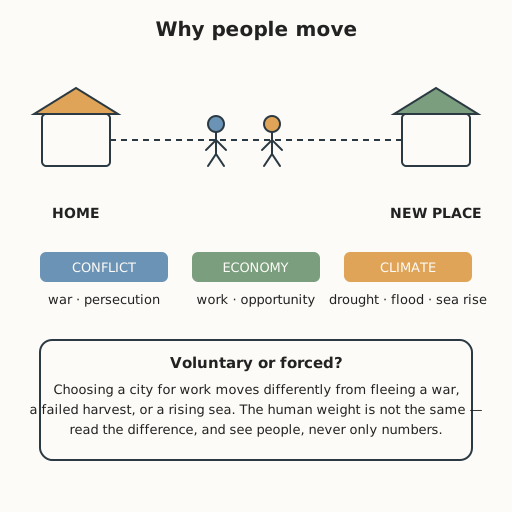
- Why people move chart · 1 per learner One page with three drivers — conflict, economy, climate — and a short human-scale example for each
- History journal · 1 per learner
Low-tech / no-cost
- Hand-drawn chart Draw the three drivers and fill them from a told account; no printed chart needed
- Voice and story Tell one family migration story and name its driver and its cost
Enriched / lab & device
- Device or library · 1 per pair A short data source (UNHCR or IOM) to check the scale and causes of displacement today
Works in different contexts
- large-group Work the three drivers whole-class, then small groups each take one driver and report its human consequences, not just its numbers
- multi-age Younger learners name one reason people move (safety, work, weather); older learners weigh the three drivers and distinguish voluntary from forced
- self-directed A learner completes the chart and writes one paragraph weighing causes and human consequences for one driver
- level-grouped Group by readiness to analyze, not age; a ready group compares two drivers and argues which shapes more lives today, with a source
- outdoor-only Discuss a place people left because of flood, drought, or conflict, and a place they went; mark both on a rough map
Lesson 9 — Modern Migration and Displacement
Summary
Learners analyze modern migration and displacement driven by conflict, economy, and climate, and weigh their causes and human consequences. They distinguish voluntary from forced movement and learn to see people, never just numbers.
Objectives
- Analyze modern migration and displacement driven by conflict, economy, and climate, and weigh their causes and human consequences. (D08.S3.10.02)
Connection
People have always moved — for family, for work, for safety, for the land’s health (S-086). What changes is why and how freely. A person who chooses a new city for work moves differently from a person who must flee a war, a failed harvest, or a rising sea. The same word — “migration” — covers both, but the human weight is not the same. Reading the difference is how we see people, not statistics.
Materials
- “Why people move” chart
- History journal
Preparation
- Copy or draw the three-driver chart.
- Retrieval: from Grade 8, recall the difference between voluntary and forced migration, and that environmental change (drought, flood, sea-level rise) has driven people to move, past and present (S-383, S-005).
Facilitator note
This lesson is written to the learner (“you”). The idea to land: modern migration is driven by three forces — conflict, economy, and climate — and the difference between moving by choice and being forced to flee changes everything about the human weight of the story. Model the three drivers with worked examples before independent analysis (S-011).
Emotional safety: this lesson touches real hardship (war, displacement, climate loss) but without graphic detail. Give a brief warning, allow stepping out, name a trusted adult, and ground afterward. Keep the human consequences concrete and dignified — a family, a place, a choice or a forced flight — never only counts.
The global lens is the spine: displacement is worldwide — UNHCR documents tens of millions of forcibly displaced people (refugees, asylum-seekers, and internally displaced people), driven primarily by conflict and persecution, with climate a growing driver (S-493, S-383, S-005); IOM documents that migration is longstanding human behavior with economic, family, safety, and environmental drivers (S-086). The egalitarian and ethics lenses: who can move safely and legally, and who is turned away or trapped, is a question of power and justice — hold it as a question. The technology lens: climate-driven displacement is partly a consequence of technologies and energy systems that warmed the planet, which places the question of responsibility across borders. Preview: Lesson 10 begins the unit’s most careful section — studying atrocity and remembrance.
Procedure
- Recall (5 min). From Grade 8: what is the difference between voluntary and forced migration? Name one environmental driver of movement.
- Meet the chart (15 min). Look at the three-driver chart.
- Conflict: war and persecution force people to flee as refugees, asylum-seekers, or internally displaced people — the largest driver of forced displacement today (S-493).
- Economy: people move for work and opportunity, often by choice, but poverty can make “choice” narrow (S-086).
- Climate: drought, flood, and sea-level rise are growing drivers, within and across borders (S-383, S-005). Watch one worked example: one family forced by conflict and one person choosing a job abroad — name the driver and the different human weight of each.
- Guided practice (15 min). In pairs, take one driver. Give one human-scale example and name whether the movement is voluntary or forced. Compare and agree.
- Independent work (15 min). In your journal, write one paragraph weighing causes and human consequences for one driver, naming at least one person-scale detail.
- Close (5 min). Say in one sentence: why does “voluntary or forced” matter to how we see migration? Next time: studying atrocity with care.
Differentiation
- Support: Use one driver (conflict) with a guided example and two questions.
- Extension: Compare two drivers (e.g., climate vs. conflict) and argue which shapes more lives today, citing a source.
- Access (blind / low vision): Name the three drivers aloud — conflict, economy, climate — and show push versus pull with two sticks or fingers (pull toward the new place, push away from home); the human-scale story carries the lesson by voice.
Assessment
- Formative (peer + self): Can the learner name the three drivers, give a human-scale example for one, and say whether it is voluntary or forced?
- Portfolio artifact (unit): The one-paragraph causes-and-consequences analysis.
Home connection
Ask an adult: has anyone in our family or community moved for work, safety, or the weather? Together, name the driver and whether the move was chosen or forced.
Resources
- On why people move: International Organization for Migration, “Who is a migrant?” (S-086).
- On forced displacement today: UNHCR, Global Trends (S-493).
- On climate as a driver: IOM, “Climate Action” (S-383), and the IPCC (S-005).