Lesson 08 — Indigenous Peoples: Effects and Endurance
Learners analyze the effects of colonization on Indigenous peoples — loss of land, language, and self-rule — and center their endurance, resistance, and revival, refusing a story of only loss.
Objectives
Objectives
- D08.S3.10.01 Analyze how colonization reshaped populations, environments, and borders across the world, and its effects on Indigenous peoples.
Essential question
What did colonization do to Indigenous peoples, and how have they endured, resisted, and revived?
Key vocabulary
Materials
Standard materials
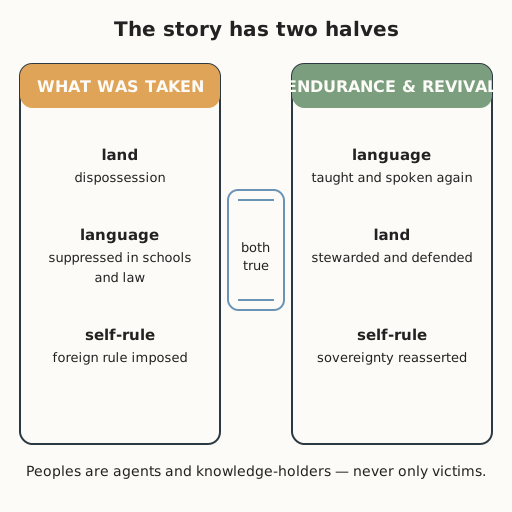
- Loss and endurance chart · 1 per learner One page with two columns — what was taken (land, language, self-rule) and how peoples endured and revived — with documented examples
- History journal · 1 per learner
Low-tech / no-cost
- Hand-drawn chart Draw the two columns and fill them from a told account or short reading; no printed chart needed
- Voice and story Listen to or retell one story of a people's revival in your own words
Enriched / lab & device
- Device or library · 1 per pair A short first-person account or interview from an Indigenous community about land, language, or self-rule today
Works in different contexts
- large-group Fill the two columns whole-class, then small groups each take one example of revival and present it as the people's own agency, not just loss
- multi-age Younger learners name one thing taken and one thing kept; older learners analyze how land, language, and self-rule are connected
- self-directed A learner completes the chart and writes one paragraph centering a people's endurance and revival, not only their loss
- level-grouped Group by readiness to analyze, not age; a ready group compares two revival efforts (a language program and a land-rights movement)
- outdoor-only Name the Indigenous peoples of the land you stand on, and discuss one way they care for it that continues today
Lesson 8 — Indigenous Peoples: Effects and Endurance
Summary
Learners analyze what colonization took from Indigenous peoples — land, language, and self-rule — and, with equal care, center how those peoples endured, resisted, and revived. The lesson refuses a story of only loss: continuity and agency are the other half of the truth.
Objectives
- Analyze how colonization reshaped populations, environments, and borders across the world, and its effects on Indigenous peoples. (D08.S3.10.01)
Connection
A people is more than what was done to it. When you meet a living language, a harvest that follows ancient knowledge, or a community governing its own affairs, you are meeting endurance — a people who held on through dispossession and are still here, still stewarding the land and reviving the words. The honest story of colonization has two halves: what was taken, and what was never lost.
Materials
- “Loss and endurance” chart
- History journal
Preparation
- Copy or draw the two-column chart.
- Retrieval: from Lesson 7, recall the three reshapings (populations, environments, borders). Today we center the peoples those reshapings most affected — and their endurance.
Facilitator note
This lesson is written to the learner (“you”). The idea to land: colonization took land, language, and self-rule from Indigenous peoples, but it did not take their continuity — peoples endured, resisted, and revived, and any honest account centers both halves. Model the two-column chart with worked examples, then let learners center agency (S-011).
Emotional safety: this lesson names real loss (land, language, self-rule) but its
center of gravity is endurance. Give a brief warning, allow stepping out, name a
trusted adult, and ground afterward. Use no graphic detail. Frame loss and continuity
side by side, so learners meet Indigenous peoples as agents and knowledge-holders,
never only as victims (philosophy §4; see also the framing in docs/facilitation.md).
The egalitarian lens is the spine: who was dispossessed, and who kept their dignity and self-determination, is the question. The global lens: examples span the Americas, Africa, Asia, and Oceania — the Inuit Circumpolar Council represents peoples across four Arctic regions (S-058); Maya peoples still speak their languages and, with scholars, revive Maya mathematics and astronomy after colonial authorities destroyed most codices (S-474); the Haudenosaunee Confederacy’s consensus councils are a living way of governing (S-203). The technology and ethics lenses: written and digital technologies now aid language revitalization — a tool turned toward repair — and naming the harm accurately is a duty to truth, not a verdict. Preview: Lesson 9 turns to modern migration and displacement.
Procedure
- Recall (5 min). From Lesson 7: name one reshaping of colonization. Now: name one way a people might hold on through it.
- Meet the chart (15 min). Look at the two-column chart.
- What was taken: land (dispossession), language (suppressed in schools and law), and self-rule (foreign government imposed) (S-326, S-424).
- How they endured and revived: languages revitalized and taught again; land stewarded and defended; self-rule and sovereignty reasserted (S-058, S-474, S-203). Watch one worked example: follow one people through both columns — the loss and the living continuation — so neither half is left out.
- Guided practice (15 min). In pairs, take one people or region. Name one thing taken and one thing kept or revived. Compare and agree before moving on.
- Independent work (15 min). In your journal, write one paragraph that centers endurance: describe a people’s revival (language, land, or self-rule) as their act, not just their survival.
- Close (5 min). Say in one sentence: why must the story of colonization be told in two halves? Next time: modern migration and displacement.
Differentiation
- Support: Use one people with two guided questions (what was taken, what was kept).
- Extension: Compare two revival efforts (a language program and a land-rights or sovereignty movement) and analyze what each needed to succeed.
- Access (blind / low vision): The two halves — what was taken, what endured — are fully spoken in the Procedure; use a paper folded into two sections, or work by voice, reading each example aloud.
Assessment
- Formative (peer + self): Can the learner name one effect on Indigenous peoples and one way they endured or revived, framed as the people’s own agency?
- Portfolio artifact (unit): The endurance-centered paragraph, added to the unit’s “colonization and Indigenous peoples” section.
Home connection
Ask an adult: whose traditional land is the place we live on, and what do we know about the people who have stewarded it? Together, learn one name and one living practice.
Resources
- On the effects of colonialism and the suppression of languages: Encyclopaedia Britannica, “Western colonialism,” https://www.britannica.com/topic/colonialism (S-326), and Ngũgĩ wa Thiong’o, Decolonising the Mind (S-424).
- On Indigenous continuity and knowledge: Inuit Circumpolar Council (S-058); Robin Wall Kimmerer, Braiding Sweetgrass (S-427); and the Maya codices and their revival (S-474).