Lesson 13 — Rebuilding and What Justice Requires
Learners analyze how communities rebuild after genocide and mass violence, and what justice requires — truth, accountability, repair, and remembrance — weighing what each path can and cannot do.
Objectives
Objectives
- D08.S4.10.02 Analyze how ordinary people have resisted oppression, sheltered others, and rebuilt after atrocity, and what remembrance and justice require.
Essential question
After atrocity, how do people rebuild — and what does justice require in the form of accountability, truth, repair, and remembrance?
Key vocabulary
Materials
Standard materials
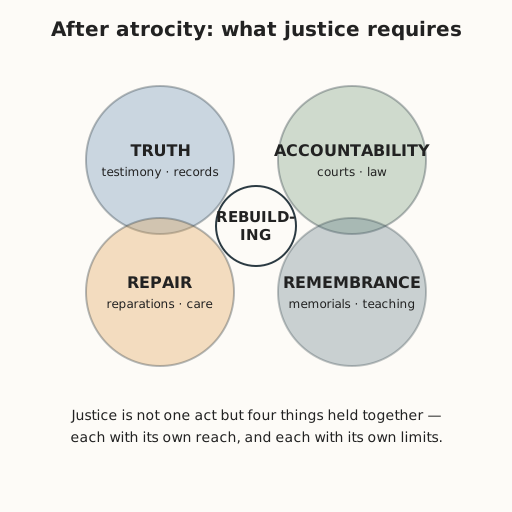
- After atrocity chart · 1 per learner One page listing the paths after atrocity — truth, accountability, repair, remembrance — with a short example of each
- History journal · 1 per learner
Low-tech / no-cost
- Hand-drawn chart Write the four paths on paper or a board; no printed sheet needed
- Voice and circle In a circle, each person names one thing a harmed community needs to rebuild, in turn or by passing
Enriched / lab & device
- Device or library · 1 per pair A short account of a truth commission or rebuilding effort, chosen for dignity and no graphic detail
Works in different contexts
- large-group Present the four paths whole-class, then small groups each take one and report what it can and cannot do, keeping dignity central
- multi-age Younger learners name what a community needs to heal; older learners weigh accountability, truth, repair, and remembrance and their limits
- self-directed A learner works the chart at their own pace and writes one paragraph on what they think justice requires
- level-grouped Group by readiness to engage, not age; a ready group compares a truth commission and a court of law as responses
- outdoor-only In a quiet circle, place stones for the things a community needs to rebuild — truth, safety, repair, memory — and discuss each in turn
Lesson 13 — Rebuilding and What Justice Requires
Summary
Learners analyze how communities rebuild after genocide and mass violence, and what justice requires — truth, accountability, repair, and remembrance. They weigh what each path can and cannot do, and close by turning toward the unit’s synthesis.
Objectives
- Analyze how ordinary people have resisted oppression, sheltered others, and rebuilt after atrocity, and what remembrance and justice require. (D08.S4.10.02)
Connection
After a fire, a family does not only mourn the house — it also clears the ash, tells the truth about what happened, holds anyone responsible accountable, and rebuilds so that life can continue. After atrocity, whole communities face the same four tasks at a vast scale: tell the truth, seek accountability, repair what can be repaired, and remember. Justice is not one act but these four things held together.
Materials
- “After atrocity” chart
- History journal
Preparation
- Copy or draw the four-path chart.
- Retrieval: from Lessons 10–12, recall the care rules, the study questions, and the ordinary people who resisted and sheltered. Today we ask: what comes after, and what does justice require?
Facilitator note
This lesson is written to the learner (“you”). The idea to land: after atrocity, communities rebuild through four interlocking paths — truth, accountability, repair, and remembrance — and justice is not a single verdict but the holding of these together, each with its own reach and its own limits. Model the four paths with a worked example before learners weigh them (S-011).
Emotional safety (non-negotiable): (1) Warning and opt-out: re-state that learners may step out, pass, or write privately at any time. (2) Referral: name the trusted adult or support line. (3) Grounding: open and close with a slow breath. (4) No graphic images or gratuitous detail: discuss the paths, not the violence. (5) Agency and hope: this lesson is the turn toward repair — end by centering what communities built, not only what they suffered (S-495).
The ethics lens is the spine: justice is a moral question — what is owed to the harmed and to the truth. The egalitarian lens: justice exists because every life counts equally, and repair seeks to restore dignity, not merely to punish. The global lens: truth commissions, courts, and reparations have been attempted in many places, and repair is often understood not as revenge but as restoring relationship — a principle shared by restorative-justice traditions (S-022) and echoed in Indigenous peacemaking and other world traditions. The critical-thinking lens: weigh what each path can and cannot do — truth without accountability can ring hollow, accountability without repair can feel empty, and remembrance without the others can fade into ceremony. Preview: Lesson 14 synthesizes the whole unit into one many-voiced story.
Procedure
- Ground (3 min). Breathe once, slowly. Recall you may pause or step away.
- Meet the chart (20 min). Look at the four paths.
- Truth: naming what happened honestly — testimony, records, truth commissions.
- Accountability: holding those responsible to answer — courts of law, legal process (S-491).
- Repair: restoring what can be restored — reparations, rebuilding, care for survivors and communities (S-022).
- Remembrance: keeping memory alive — memorials, days of remembrance, teaching (S-490). Watch one worked example: a community that told the truth, sought accountability, repaired what it could, and built a memorial — and notice how the four paths support one another.
- Guided practice (15 min). In pairs, ask: what can truth do that a court cannot? and what can repair do that remembrance cannot? Share one answer each.
- Independent work (10 min). In your journal, write one paragraph: what do you think justice requires after atrocity, and which of the four paths matters most to you, and why?
- Close and ground (5 min). Breathe once more. Next time: the whole unit, woven into one many-voiced story.
Differentiation
- Support: Focus on two paths (truth and remembrance) and one question each.
- Extension: Compare a truth commission and a court of law as responses to the same atrocity, and argue what each is best suited to do.
- Access (blind / low vision): Name the four paths aloud — truth, accountability, repair, remembrance — meeting in “rebuilding,” and offer four overlapping loops of yarn meeting at a center knot so the interlock can be felt.
Assessment
- Formative (peer + self): Can the learner name the four paths and say what one path can do that another cannot?
- Portfolio artifact (unit): The “what justice requires” paragraph.
Home connection
With a trusted adult, talk about what your family or community does to repair after a hurt — and what “making it right” means to you. (No one is required to discuss the events themselves outside class.)
Resources
- On accountability and the crime of genocide: United Nations, “Genocide” and the 1948 Convention (S-491).
- On repair and restoring relationship: International Institute for Restorative Practices (S-022).
- On remembrance: United States Holocaust Memorial Museum, “Introduction to the Holocaust” (S-490); on teaching with dignity, its “Guidelines” (S-495).