Lesson 14 — The Many-Voiced Story: A Unit Synthesis
Learners synthesize the unit into one many-voiced story, retrieving the big ideas of time, culture, migration, and the remembrance of atrocity, assembling their portfolio, and reflecting on their own place in the long, unfinished human story.
Objectives
Objectives
- D08.S1.10.02 Argue for a way to divide a global era into periods and defend where its turning points should fall.
- D08.S2.10.02 Analyze how global trade and technology have spread and transformed cultural traditions in the modern world.
- D08.S3.10.02 Analyze modern migration and displacement driven by conflict, economy, and climate, and weigh their causes and human consequences.
- D08.S4.10.02 Analyze how ordinary people have resisted oppression, sheltered others, and rebuilt after atrocity, and what remembrance and justice require.
Essential question
How do I gather everything this unit taught — time, culture, migration, and the remembrance of atrocity — into one many-voiced story I can carry forward?
Key vocabulary
Materials
Standard materials
- Synthesis organizer · 1 per learner One page with four boxes — time, culture, migration, remembrance — to gather the unit's big ideas and one artifact from each
- Portfolio folder · 1 per learner To assemble the unit's artifacts into a finished collection
Low-tech / no-cost
- Four drawn boxes Draw the four boxes on paper; no printed organizer needed
- Voice and recall Re-tell each big idea aloud from memory, then write one line for each
Enriched / lab & device
- Device or shared display · 1 per group To assemble a simple digital portfolio or slide with one artifact from each strand
Works in different contexts
- large-group Build the synthesis on a four-quadrant board, then let each learner share one artifact aloud or in writing, in a calm circle
- multi-age Younger learners place one artifact in each box and say its big idea; older learners write the connecting synthesis paragraph
- self-directed A learner completes the organizer alone and writes the synthesis paragraph, using the portfolio as their own record
- level-grouped Group by readiness to synthesize, not age; a ready group drafts a shared one-sentence "many-voiced" statement of the unit
- outdoor-only Use four stones or leaves to mark the four big ideas on the ground, and walk from one to the next, saying each idea aloud
Lesson 14 — The Many-Voiced Story: A Unit Synthesis
Summary
Learners synthesize the whole unit into one many-voiced story. They retrieve the big ideas of time, culture, migration, and the remembrance of atrocity, assemble their portfolio, and reflect on their own place in the long, unfinished human story.
Objectives
- Argue for a way to divide a global era into periods and defend its turning points. (D08.S1.10.02)
- Analyze how global trade and technology have transformed cultural traditions. (D08.S2.10.02)
- Analyze modern migration and displacement and weigh their causes and consequences. (D08.S3.10.02)
- Analyze how ordinary people resisted, sheltered, and rebuilt, and what remembrance and justice require. (D08.S4.10.02)
Connection
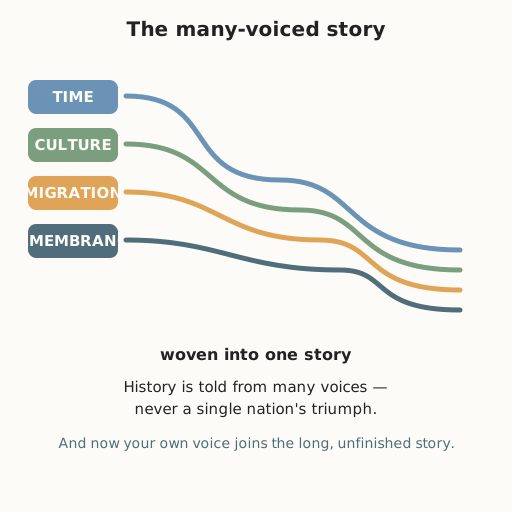
A braid is stronger than any single strand, and a many-voiced story is truer than any single telling. This unit has held four strands — time, culture, migration, and the remembrance of atrocity — and asked you to weave them. The point was never to arrive at one “correct” history, but to learn how to hold many voices together with care and accuracy, and to know that your own voice now joins the long, unfinished story.
Materials
- Synthesis organizer
- Portfolio folder
Preparation
- Copy or draw the four-box organizer.
- Retrieval (spaced): this capstone is a deliberate retrieval pass across the unit — recalling ideas spaced over time, which is among the highest-utility study techniques (S-039). Gather the learner’s portfolio artifacts from Lessons 1, 3, 4, 6, 7, 8, 9, 11, 12, and 13.
Facilitator note
This lesson is written to the learner (“you”). The idea to land: the unit’s four strands — time, culture, migration, and remembrance — weave into one many-voiced story, and the learner’s own voice now joins it; the capstone is retrieval, not new content. Keep the tone calm and affirming; this is a portfolio and reflection day, not an exam (philosophy §8: mastery, never ranking).
The global lens is the spine: history is told from many perspectives, never as a single nation’s triumph. The egalitarian lens: the voices centered all unit were those too often left out — Indigenous peoples, the displaced, the enslaved, the resisters and survivors. The ethics lens: how we remember is itself an ethical act. The critical-thinking lens: the learner’s synthesis should show evidence and values distinguished, questions held open, and more than one perspective kept in view. Feedback is the close: give each learner one specific thing they did well and one next step, in the spirit of mastery (S-007, S-011).
Procedure
- Recall (10 min). Without looking back, write one big idea for each strand: time, culture, migration, remembrance. Then check against the organizer.
- Gather artifacts (15 min). Open your portfolio. Place at least one artifact in each of the four boxes: your periodization argument (time), your knowledge- ethics or transformation analysis (culture), your migration or colonization analysis (migration), and your remembrance or justice reflection (remembrance).
- Synthesize (15 min). Write one connecting paragraph: how do the four strands fit into one story — and where do you stand in it? Use one piece of evidence from two different strands.
- Share and feedback (10 min). Read your paragraph to a partner (or keep it private). Tell them one thing they did well and one next step. Let them do the same for you.
- Close (5 min). Read your paragraph once more. Remember: the story is unfinished, and you are now one of its voices.
Differentiation
- Support: Complete the four boxes with a single idea each and a two-sentence synthesis.
- Extension: Write the synthesis as a short spoken or written “address” that a future learner could open the unit with, naming all four strands and one voice from each.
- Access (blind / low vision): Name the four strands aloud and braid four pieces of yarn or cord together while saying each one, so the synthesis is felt and heard, not only seen.
Assessment
- Summative (portfolio + self): The assembled portfolio shows at least one artifact per strand and a synthesis paragraph linking two strands with evidence.
- Self-check: Can the learner name the unit’s four strands and one voice they will remember from each?
Home connection
Share your synthesis paragraph (or just the four big ideas) with a trusted adult, and ask: whose voice would you add to this story? Then add it, in one line, to your portfolio.
Resources
- On retrieval and spacing as study techniques: Dunlosky et al. (2013), https://doi.org/10.1177/1529100612453266 (S-039).
- On feedback and mastery: Bloom (1984), the 2 sigma problem (S-007); and on worked examples and guided practice, Kirschner, Sweller & Clark (2006) (S-011).