Lesson 02 — Weighing a Technology: The Phone in My Hand
Learners weigh the benefits and harms of a technology they use daily — the phone — across its full lifecycle: minerals, manufacture, use, and disposal. A worked example models the weighing skill, then learners apply it stage by stage and write their own reasoned judgment.
Objectives
Objectives
- D09.S1.10.01 Apply ethical reasoning to a question about technology or the environment, weighing benefits and harms for people and the planet.
Essential question
How do I weigh the benefits and harms of a technology I use every day — for people near me and people far away?
Key vocabulary
Materials
Standard materials
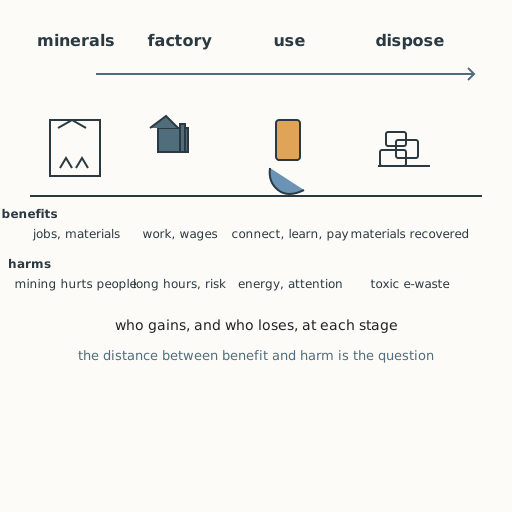
- Phone lifecycle sheet · 1 per learner A diagram of a phone's life — minerals, factory, use, discard — with space to list benefits and harms at each stage
- Worked-example card · 1 per learner A model of how to weigh one benefit against one harm, step by step
Low-tech / no-cost
- A shared board or large paper Draw the lifecycle together and list benefits and harms as a group
- Voice Name one benefit and one harm of a phone aloud, with no printed sheet needed
Enriched / lab & device
- Two short sourced case studies · 1 set per group One on the benefits of mobile connectivity, one on the harms in the supply chain, to compare
- A shared digital document · 1 Co-build a benefits/harms table each group can edit
Works in different contexts
- large-group Model the worked example whole-class, then groups weigh a different stage of the lifecycle and report back
- multi-age Younger learners list what a phone helps people do; older learners trace the harms and write the weighing
- self-directed A learner works through the lifecycle sheet, lists benefits and harms, and writes one paragraph of weighing
- level-grouped Learners ready to extend weigh two harms against each other (who bears each) and defend a judgment
- outdoor-only Use a familiar tool from the surroundings (a shared pump, a vehicle, a cooking fire) and weigh its benefits and harms the same way
Lesson 2 — Weighing a Technology: The Phone in My Hand
Summary
Learners weigh the benefits and harms of a technology they use daily — the phone — across its full lifecycle: minerals, manufacture, use, and disposal. A worked example models the weighing skill, then learners apply it stage by stage and write their own reasoned judgment.
Objectives
- Apply ethical reasoning to a technology — weighing benefits and harms for people and the planet — and defend a reasoned judgment. (D09.S1.10.01)
Connection
The phone in your pocket can call a friend across the sea, find a health clinic, move money, and read a schoolbook — in a single hour it can do work that once took a journey of days. But that same phone began as rock dug from the ground, was assembled in a factory far away, and will one day be thrown away. Some of the people who dug that rock or sorted that waste worked in conditions that hurt them. A phone is not simply “good” or “bad”: it is a trade-off, and weighing it honestly — benefit against harm, near against far — is exactly what ethical reasoning about technology means.
Materials
- Phone lifecycle sheet
- Worked-example card
Preparation
- Copy the lifecycle sheet and worked-example card.
- Retrieval: from Grade 8, recall that every tool has effects — who benefits, who is harmed (the phone’s life cycle; e-waste and cobalt). Today we weigh those effects with more care.
- Prepare one worked example of weighing a single benefit against a single harm.
Facilitator note
This lesson is written to the learner (“you”). The idea to land: a technology is never all benefit or all harm; weighing it means naming benefits and harms for the people near it and the people far away, across its whole life — then judging which trade-off you can defend. Teach the weighing skill with a worked example first, then guided practice, then independent work — novices learn a procedure this way (S-011). Keep the facts accurate and hedged: cobalt and other minerals in phones are sometimes mined in conditions that harm and exploit workers, including children (S-398); discarded phones become e-waste, which when improperly dumped or recycled can release hazardous substances, with children and pregnant women especially vulnerable (S-397). At the same time, mobile connectivity is real and widely valued — it is how hundreds of millions of people bank, learn, and stay connected (S-281, S-211). Hold both true at once; do not collapse into a verdict that a phone is simply evil or simply wonderful. The egalitarian lens: always ask who bears each harm and who keeps each benefit — the distance between them is the point. The global lens: the people harmed by a phone’s birth and death live on other continents; the question of fairness crosses borders. Distinguish evidence (the documented harms) from values (how much each harm should weigh). Preview: next lesson we weigh an environment, not a device.
Procedure
- Recall (5 min). From Grade 8: what is one benefit and one harm of a mobile phone you already know? Say each in a sentence.
- Meet the lifecycle (10 min). Look at the lifecycle sheet — four stages: minerals, factory, use, dispose. For each stage, read who is touched there.
- Worked example (10 min). Watch one weighing done step by step: (a) name the benefit — connectivity lets a family stay in touch and a shop take payments; (b) name the harm — some of the minerals inside are sometimes mined in conditions that exploit workers, including children; (c) say who gains and who loses; (d) judge: is the trade-off worth it, and what would make it fairer? This is the pattern you will use.
- Guided practice (15 min). In a pair, weigh one more stage (e.g., dispose — e-waste that harms soil and the people who sort it, against the phone’s long useful life). Use the four steps aloud, then agree on a judgment.
- Independent practice (10 min). In your journal, weigh the whole phone in four sentences: one benefit, one harm, who bears each, and your reasoned judgment. Mark yourself “not yet” if you skipped a step, and try again.
- Close (5 min). Read your judgment to a partner. Notice: two people can weigh the same facts and reach different judgments — that is reasoning, not failure.
Differentiation
- Support: Provide sentence starters (“The benefit is…; the harm is…; who gains is…; who loses is…; I judge…”).
- Extension: Add a second, less visible harm (energy used by data centers; the minerals in the battery) and fold it into the weighing.
- Expression: Learners who do not speak aloud can write or draw each weighing step, arrange benefit/harm slips on the lifecycle, or have a partner read their written judgment — no step requires the voice.
Assessment
- Formative (peer + self): Can the learner name a benefit and a harm, say who bears each, and give a reasoned judgment?
- Portfolio artifact (unit): The completed weighing (four sentences), as the first page of the unit’s “ethical-reasoning” portfolio.
Home connection
With a family member, choose one household object and trace one step of where it came from and where it will go. Name one benefit and one harm together.
Resources
- On worked examples and guided practice: Kirschner, Sweller & Clark (2006), https://doi.org/10.1207/s15326985ep4102_1 (S-011).
- On cobalt and child labour in the phone supply chain: Amnesty International (2016), “This Is What We Die For,” https://www.amnesty.org/en/latest/news/2016/01/child-labour-behind-smart-phone-and-electric-car-batteries/ (S-398).
- On e-waste and its harms: WHO, “Electronic waste (e-waste) fact sheet,” https://www.who.int/news-room/fact-sheets/detail/electronic-waste-%28e-waste%29 (S-397).
- On uneven digital benefits and the digital divide: World Bank, World Development Report 2016, https://www.worldbank.org/en/publication/wdr2016 (S-281).
- On mobile money spreading where bank branches were scarce: World Bank, “Financial Inclusion,” https://www.worldbank.org/en/topic/financialinclusion (S-211).