Lesson 03 — Weighing an Environment: Energy and Trade-Offs
Learners apply the weighing skill to an environment question — energy and land use — where every option carries a cost. They weigh a dam, a wind farm, and a standing forest, naming benefits and harms for people and the planet, then write a reasoned judgment about one choice.
Objectives
Objectives
- D09.S1.10.01 Apply ethical reasoning to a question about technology or the environment, weighing benefits and harms for people and the planet.
Essential question
How do I weigh the benefits and harms of an energy or land-use choice for people and the planet — when every option has a cost?
Key vocabulary
Materials
Standard materials
- Energy trade-off sheet · 1 per learner A sheet laying out one energy or land-use choice with its benefits and harms columns
- Three short case cards · 1 set per group A dam, a wind farm, and a forest kept standing — each with benefits and harms for people and the planet
Low-tech / no-cost
- A shared board or large paper Draw the three choices and list benefits and harms together
- Voice Discuss the three choices aloud, naming one benefit and one harm each
Enriched / lab & device
- Sourced data snapshot · 1 per group A short table of real, cited figures on one choice (e.g., emissions or habitat loss) to ground the weighing
- A shared digital table · 1 A benefits/harms table each group can fill and compare
Works in different contexts
- large-group Assign each group one case, then share out; the class compares the three trade-offs
- multi-age Younger learners name what each choice gives and takes; older learners write the weighing and judgment
- self-directed A learner reads the three cards, fills the sheet, and writes one paragraph weighing a chosen case
- level-grouped Learners ready to extend weigh two choices against each other and defend which trade-off is more justifiable
- outdoor-only Use a real nearby choice — a field, a water source, a stand of trees — and weigh what building, planting, or leaving it would give and take
Lesson 3 — Weighing an Environment: Energy and Trade-Offs
Summary
Learners apply the weighing skill to an environment question — energy and land use — where every option carries a cost. They weigh a dam, a wind farm, and a standing forest, naming benefits and harms for people and the planet, then write a reasoned judgment about one choice.
Objectives
- Apply ethical reasoning to an environment question — weighing benefits and harms for people and the planet — and defend a reasoned judgment. (D09.S1.10.01)
Connection
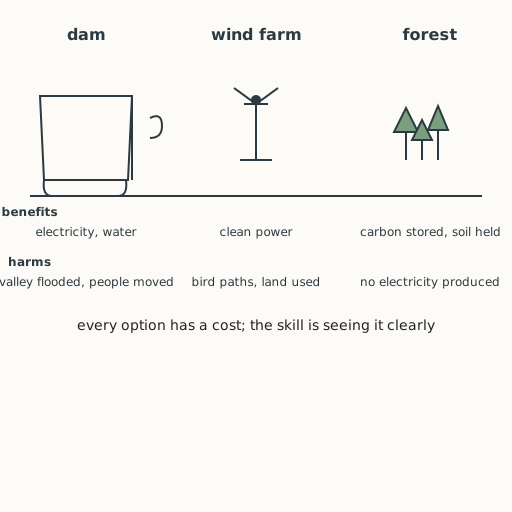
Every source of energy is also a use of land and water, and every use of land changes who and what can live there. A dam can bring electricity to a whole region but floods a valley where people farmed and fish spawned; a wind farm turns the wind into power but can cut through a bird’s migration path; a forest left standing stores carbon and holds soil but produces no electricity at all. There is no option with zero cost — only trade-offs to be seen clearly and weighed honestly. That is what it means to reason about the environment: not to find a perfect answer, but to see the real costs and decide which ones you can defend.
Materials
- Energy trade-off sheet
- Three short case cards (dam, wind farm, forest)
Preparation
- Copy the trade-off sheet and case cards.
- Retrieval: from Lesson 2, recall the four weighing steps — name the benefit, name the harm, say who gains and who loses, judge. Today we use the same steps on an environment choice.
- Prepare one worked example of weighing a single environment trade-off.
Facilitator note
This lesson is written to the learner (“you”). The idea to land: an environment or energy choice is never cost-free; weighing it means naming benefits and harms for people and for other living systems, then defending a judgment. Reuse the four steps from Lesson 2 (name the benefit; name the harm; say who gains and who loses; judge), so the skill is spaced and reinforced, not re-taught from scratch (S-039). Keep the science honest and hedged: burning fossil fuels releases greenhouse gases that warm the climate (S-005); dams provide power and water but can displace communities and change rivers; wind and solar avoid most operating emissions but use land and materials. Present these as documented effects, not verdicts — and note that people disagree about how to weigh them, which is a question of values, not of fact (philosophy §5). The egalitarian lens: the people who bear a project’s harms (a flooded valley, a felled forest, a polluting plant) are often not the same people who receive its benefits — name that gap. The global lens: energy choices are made in one place but their effects travel (a coal plant warms a climate everywhere). The environment lens is the spine: the “stakeholders” include rivers, forests, birds, and the climate itself. Preview: next we turn from weighing to critiquing — reading an argument for what it leaves unsaid.
Procedure
- Recall (5 min). From Lesson 2: what are the four steps of weighing? Say them in order.
- Meet the cases (10 min). Read the three case cards — a dam, a wind farm, a forest kept standing. For each, underline one benefit and one harm for people, and one benefit or harm for the planet.
- Worked example (10 min). Watch one weighing done step by step for the dam: (a) benefit — electricity for many homes and water for crops; (b) harm — a valley is flooded, and people who lived there are displaced; (c) who gains and who loses — distant electricity users gain, the valley’s people and its river lose; (d) judge — is the trade-off justifiable, and what would make it fairer?
- Guided practice (15 min). In a pair, weigh the wind farm using the same four steps aloud. Agree on a judgment, then switch and weigh the forest.
- Independent practice (10 min). In your journal, weigh one choice in four sentences: a benefit, a harm, who bears each, and your reasoned judgment. Mark yourself “not yet” if you skipped a step.
- Close (5 min). Share judgments in a small group. Notice: the same facts can support more than one defensible judgment — the skill is seeing the costs clearly, not agreeing on one answer.
Differentiation
- Support: Provide the four-step sentence starters from Lesson 2 and a pre-filled example to annotate.
- Extension: Weigh the same choice for a different stakeholder (a bird, a farmer, a child in another country) and say how the judgment shifts.
- Expression: Learners who do not speak aloud can write the four steps, sort printed benefit/harm slips onto the sheet, or have a partner read their written judgment — no step requires the voice.
Assessment
- Formative (peer + self): Can the learner name a benefit and a harm for people and for the planet, say who bears each, and defend a judgment?
- Portfolio artifact (unit): The four-sentence environment weighing, added to the ethical- reasoning portfolio.
Home connection
Ask a family member: what in our home uses energy, and where do they think it comes from? Name one benefit and one harm of that source together.
Resources
- On climate-warming greenhouse gases from fossil fuels: IPCC, https://www.ipcc.ch/ (S-005).
- On worked examples and guided practice: Kirschner, Sweller & Clark (2006), https://doi.org/10.1207/s15326985ep4102_1 (S-011).
- On spaced retrieval: Dunlosky et al. (2013), https://doi.org/10.1177/1529100612453266 (S-039).