Lesson 06 — Who Bears the Climate Burden?
Learners analyze a global justice question — who bears responsibility for climate harm — and weigh four competing answers: polluter pays, historical responsibility, capability, and common but differentiated responsibility. They hold each answer's strengths and limits, then write their own reasoned position.
Objectives
Objectives
- D09.S2.10.01 Analyze global justice questions, such as who bears responsibility for climate harm or poverty, and weigh competing answers.
Essential question
Who bears responsibility for climate harm — and how do I weigh the competing answers?
Key vocabulary
Materials
Standard materials
- Responsibility framework sheet · 1 per learner A sheet listing four candidate answers to "who is responsible for climate harm" with space to note strengths and limits
- Climate harm case study · 1 per learner A short, sourced case of climate harm in a specific place, with who contributed and who is harmed
Low-tech / no-cost
- A shared board or large paper List the four candidate answers and mark strengths and limits together
- Voice Discuss the case aloud, naming who contributed and who is harmed
Enriched / lab & device
- Sourced emissions and vulnerability data · 1 per group A short table of real, cited figures on who emits and who is most exposed, to ground the weighing
- A shared digital table · 1 A table comparing the four answers each group can annotate
Works in different contexts
- large-group Assign each group one candidate answer to defend, then hold a structured weighing across the four
- multi-age Younger learners name who is harmed in the case; older learners write the comparison of answers
- self-directed A learner reads the case and framework sheet, then writes one paragraph weighing two answers
- level-grouped Learners ready to extend combine two answers into a hybrid and argue for it
- outdoor-only Use a real local weather or land change and ask who caused it and who bears it, with the same four answers
Lesson 6 — Who Bears the Climate Burden?
Summary
Learners analyze a global justice question — who bears responsibility for climate harm — and weigh four competing answers: polluter pays, historical responsibility, capability, and common but differentiated responsibility. They hold each answer’s strengths and limits, then write their own reasoned position.
Objectives
- Analyze a global justice question about climate harm, and weigh competing answers about who bears responsibility. (D09.S2.10.01)
Connection
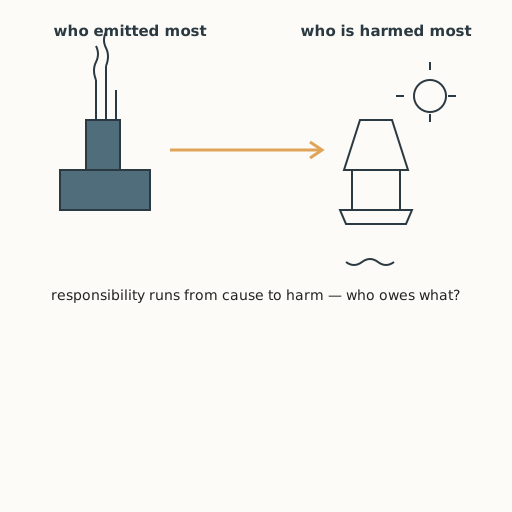
Climate change does not fall evenly. The places that emitted the most greenhouse gases over the past two centuries — powering industry, homes, and transport — are often not the places that feel the worst floods, droughts, and storms now; many of the most exposed places are ones that emitted little but depend on rain-fed farms and low-lying coasts (S-005, S-006). This is a justice question, not just a science question: when a harm is caused by many people over many generations and felt most by people who did not cause it, who is responsible, and what do they owe? There is more than one honest answer, and today we weigh them.
Materials
- Responsibility framework sheet
- Climate harm case study
Preparation
- Copy the framework sheet and the case study.
- Retrieval: from Grade 9, recall that justice has more than one theory (equal treatment, need, restitution) and that systemic injustice combines actions, rules, and structures. Today we apply that to climate harm.
- Prepare the four candidate answers and one worked example of weighing two of them.
Facilitator note
This lesson is written to the learner (“you”). The idea to land: responsibility for climate harm is a genuine, contested question, and weighing the answers — polluter pays, historical responsibility, capability, and common but differentiated responsibility — is the skill. Hold the science as evidence and the answers as values: it is documented that emissions are unequally distributed and that harms fall hardest on the most exposed (S-005, S-006); how much each actor owes is a values question on which reasonable people disagree. The egalitarian lens: always ask who caused it, who is harmed, and whether the same people are both. The global lens is the spine: this is a question that crosses borders and generations, and the answers are debated in every region, from the “polluter pays” principle to “common but differentiated responsibilities” in international climate agreements. The environment lens: the “victims” include rivers, reefs, glaciers, and future generations, not only people alive today. Do not settle the question as dogma (philosophy §11); distinguish evidence from values (philosophy §5). Preview: next lesson we weigh the same question for poverty.
Procedure
- Recall (5 min). From Grade 9: name two different ideas of justice you met (e.g., equal treatment, need, restitution). Say each in a sentence.
- Meet the case (10 min). Read the climate harm case study. Underline who contributed, who is harmed, and whether they are the same people.
- Meet the four answers (15 min). Read the framework sheet. Four candidate answers to “who is
responsible?”:
- Polluter pays — those who emitted the most should pay the most.
- Historical responsibility — those who emitted most in the past owe for the harm their past still causes.
- Capability — those most able to pay and act should bear the most, whatever they emitted.
- Common but differentiated — everyone shares the duty, but not equally: those who caused more and can do more, do more. For each, note one strength and one limit.
- Guided practice (15 min). In a pair, weigh two answers against each other for the case: which fits best, and what does each leave out? Agree on a tentative answer, then say what would change your mind.
- Independent practice (10 min). In your journal, write your reasoned position in four sentences: which answer you lean toward, one strength, one limit, and one thing a fair response must not ignore.
- Close (5 min). Share positions in a small group. Notice: different defensible answers can coexist — the question is whether you can defend yours, not whether everyone agrees.
Differentiation
- Support: Provide sentence frames for each answer (“The polluter-pays answer says…; its limit is…”).
- Extension: Combine two answers into a hybrid (e.g., historical responsibility + capability) and argue for it against the others.
- Expression: Learners who do not speak aloud can write their position, place a marker beside a framework, or have a partner read their written position — no step requires the voice.
Assessment
- Formative (peer + self): Can the learner state two competing answers, give a strength and a limit of each, and defend a position?
- Portfolio artifact (unit): The four-sentence position, as the first page of the “global justice” section of the portfolio.
Home connection
Ask someone at home: if a harm was caused by many people long ago but felt mostly by others today, who should pay to fix it? Compare answers.
Resources
- On climate science and unequal exposure: IPCC, https://www.ipcc.ch/ (S-005).
- On global emissions and exposure data: Our World in Data, https://ourworldindata.org/ (S-006).
- On competing theories of justice as ideas to compare, not a single answer: Rawls (1971), A Theory of Justice (S-459); Sen (1999), Development as Freedom (S-460).