Lesson 07 — Poverty and Responsibility: Competing Answers
Learners analyze a global justice question — who bears responsibility for poverty — through three traditions of justice: capabilities (Sen), fairness (Rawls), and ubuntu. They compare what each tradition counts as "responsibility," note where they agree and differ, and write their own reasoned position.
Objectives
Objectives
- D09.S2.10.01 Analyze global justice questions, such as who bears responsibility for climate harm or poverty, and weigh competing answers.
Essential question
Who bears responsibility for poverty — and how do competing traditions of justice answer the same question differently?
Key vocabulary
Materials
Standard materials
- Competing answers sheet · 1 per learner A sheet presenting three traditions of justice — capabilities (Sen), fairness (Rawls), and ubuntu — each answering "who is responsible for poverty"
- Poverty case study · 1 per learner A short, sourced case of poverty in a specific place, with its structural drivers
Low-tech / no-cost
- A shared board or large paper List the three traditions and their answers, and mark where they agree and differ
- Voice Discuss the case aloud, naming who is responsible under each tradition
Enriched / lab & device
- Sourced poverty data · 1 per group A short table of real, cited figures on where poverty is concentrated and why, to ground the weighing
- A shared digital document · 1 A shared comparison of the three traditions each group can annotate
Works in different contexts
- large-group Assign each group one tradition to explain, then hold a structured comparison across the three
- multi-age Younger learners name what people in the case need; older learners write the comparison of traditions
- self-directed A learner reads the case and sheet, then writes one paragraph comparing two traditions
- level-grouped Learners ready to extend add a fourth tradition from their own culture and compare it
- outdoor-only Use a real nearby inequality (who has water, land, or shade) and ask how each tradition would answer who is responsible
Lesson 7 — Poverty and Responsibility: Competing Answers
Summary
Learners analyze a global justice question — who bears responsibility for poverty — through three traditions of justice: capabilities (Sen), fairness (Rawls), and ubuntu. They compare what each tradition counts as “responsibility,” note where they agree and differ, and write their own reasoned position.
Objectives
- Analyze a global justice question about poverty, and weigh competing answers from more than one tradition of justice. (D09.S2.10.01)
Connection
Poverty is not one thing and has no single cause. Where someone is born, what work and pay are available, inherited wealth, health, and conflict all shape who has enough and who does not — and these are structural conditions, not measures of a person’s worth (S-234, S-283). Because the causes are structural, the question of responsibility is too: does the responsibility to end poverty rest on individuals, on governments, on the global order, or on all of us together? Different traditions of justice answer differently — and each answer shows something the others miss. Today we hold three of them side by side.
Materials
- Competing answers sheet
- Poverty case study
Preparation
- Copy the competing answers sheet and the case study.
- Retrieval: from Lesson 6, recall the four candidate answers about climate responsibility. Today we meet a different family of answers — whole traditions of justice, each with its own idea of responsibility.
- Prepare the three traditions and one worked example of comparing two of them.
Facilitator note
This lesson is written to the learner (“you”). The idea to land: different traditions of justice — not only Western ones — give different, defensible answers to “who is responsible for poverty,” and weighing them is the skill. Present each tradition fairly and briefly: capabilities (Sen) asks whether people are actually able to do and be the things that make a life worth living — so responsibility falls on whoever can expand those freedoms (S-460); fairness (Rawls) asks what rules we would choose behind a “veil of ignorance” of our own position, so responsibility falls on arrangements that would be chosen by someone who did not know if they would be rich or poor (S-459); ubuntu (a Southern African ethic, often glossed “I am because we are”) holds that a person’s humanity is bound up with others’, so poverty is everyone’s concern and no one is fully themselves while another is left out. The global lens is the spine: this is the lesson where the curriculum most deliberately de-centers any single tradition — ubuntu, Confucian role ethics, Buddhist consequentialism, and dharma-based duty all carry ideas of justice as old and as serious as the Western canon (S-465, S-468, S-467, S-469). The egalitarian lens: every tradition here is being used to ask who is left out. The community lens: ubuntu names belonging itself as a good. Keep all three as questions and frameworks, not as the one correct answer (philosophy §11); distinguish the documented structural drivers of poverty (S-234) from the values each tradition adds (philosophy §5). Preview: next we turn to technology, data, and the right to privacy.
Procedure
- Recall (5 min). From Lesson 6: name one candidate answer about climate responsibility. Today the question is poverty — what is different about it?
- Meet the case (10 min). Read the poverty case study. Underline the structural drivers — where the person was born, work and pay, health, conflict. Note: none of these is a measure of worth.
- Meet the three traditions (15 min). Read the competing answers sheet:
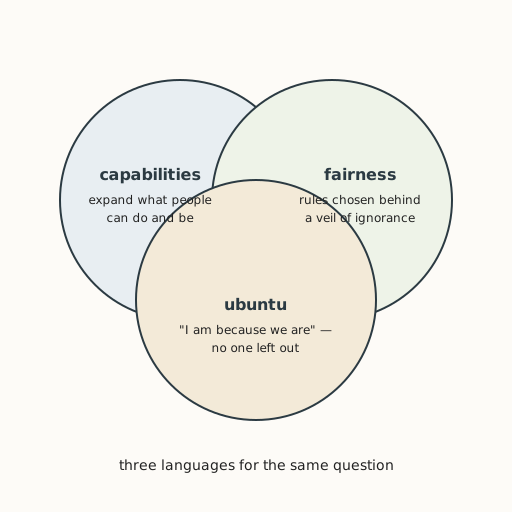
- Capabilities (Sen) — responsibility falls on whoever can expand what people are actually able to do and be.
- Fairness (Rawls) — responsibility falls on rules that would be chosen by someone who did not know if they would be rich or poor.
- Ubuntu — “I am because we are”; no one is fully themselves while another is left out, so poverty is everyone’s concern. For each, write one sentence: how would this tradition answer “who is responsible?”
- Guided practice (15 min). In a pair, compare two traditions on the case: where do they agree, where do they differ, and which answer do you find more convincing — and why?
- Independent practice (10 min). In your journal, write your reasoned position: which tradition (or blend) you lean toward, one strength, one limit, and one thing any fair answer must not ignore.
- Close (5 min). Share in a small group. Notice: the traditions are not a quiz with a right answer — they are languages for asking the same question.
Differentiation
- Support: Provide a one-line plain-English gloss of each tradition and sentence starters for the comparison.
- Extension: Add a fourth tradition from your own family or culture and compare it with the three.
- Expression: Learners who do not speak aloud can write or draw each tradition’s answer, sort slips under the three traditions, or have a partner read their written position — no step requires the voice.
Assessment
- Formative (peer + self): Can the learner state two traditions’ answers, give a strength and a limit of each, and defend a position?
- Portfolio artifact (unit): The four-sentence position, added to the “global justice” section.
Home connection
Ask someone at home: whose responsibility is it when a family has too little — the family, the community, the government, or all of us? Compare with the three traditions.
Resources
- On structural drivers of poverty: World Bank, “Poverty and Inequality,” https://www.worldbank.org/en/topic/poverty/overview (S-234); UNDP, Human Development Reports, https://hdr.undp.org/data-center (S-283).
- On the capabilities approach: Sen (1999), Development as Freedom (S-460).
- On fairness and the veil of ignorance: Rawls (1971), A Theory of Justice (S-459).
- On justice extended across traditions: African Charter on Human and Peoples’ Rights (S-465); Stanford Encyclopedia of Philosophy, “Confucius” (S-468).