Lesson 05 — Rebuilding More Fairly
Learners rebuild a moral argument more fairly, using the hidden assumptions and bias they found in Lesson 4. They name who was left out, qualify sweeping claims, and rewrite the argument so it speaks more honestly — then check their rebuild against a fairness list.
Objectives
Objectives
- D09.S1.10.02 Critique a moral argument for hidden assumptions or bias, and rebuild it more fairly.
Essential question
How do I rebuild a moral argument more fairly, once I have found its hidden assumptions and bias?
Key vocabulary
Materials
Standard materials
- Rebuild scaffold sheet · 1 per learner A before/after sheet with space to write the original argument, the hidden assumptions, and the rebuilt version
- Worked-example card · 1 per learner A model of rebuilding one argument fairly, step by step
Low-tech / no-cost
- A shared board or large paper Write the original and rebuilt versions side by side together
- Voice Say the rebuilt argument aloud and check it together
Enriched / lab & device
- A set of contrasting arguments to rebuild · 1 per group Arguments from different regions or traditions, to rebuild each more fairly
- A shared digital document · 1 A shared before/after table groups can fill and compare
Works in different contexts
- large-group Model one rebuild whole-class, then groups rebuild different arguments and present before/after
- multi-age Younger learners add one missing group to the argument; older learners write the full rebuild
- self-directed A learner rebuilds one argument, checks it against a fairness list, and revises
- level-grouped Learners ready to extend steelman the strongest version of an argument they disagree with
- outdoor-only Take a claim about a shared outdoor space and rebuild it so it names who is left out and how to include them
Lesson 5 — Rebuilding More Fairly
Summary
Learners rebuild a moral argument more fairly, using the hidden assumptions and bias they found in Lesson 4. They name who was left out, qualify sweeping claims, and rewrite the argument so it speaks more honestly — then check their rebuild against a fairness list.
Objectives
- Rebuild a moral argument more fairly, after surfacing its hidden assumptions and bias. (D09.S1.10.02)
Connection
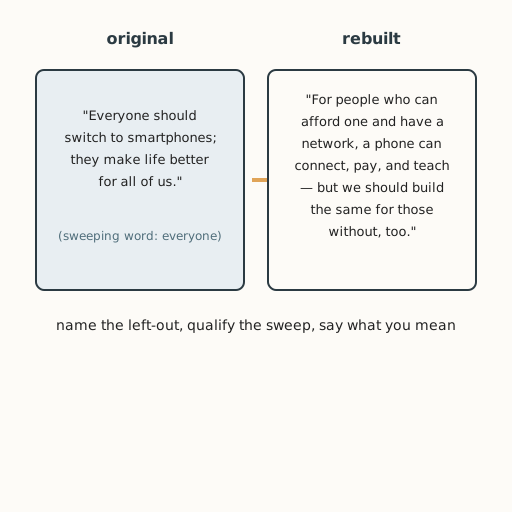
Finding an argument’s hidden assumptions is only half the work. The other half is building it again better — the way you would repair a tool rather than throw it away. If someone says “everyone should switch to smartphones; they make life better for all of us,” a fairer rebuild says something like: “for people who can afford one and have a network, a smartphone can connect, pay, and teach — but we should also build those same services for people who cannot, so the benefit is not just for some.” The rebuilt version is not weaker; it is more true, because it finally says what it means and names who it left out. Rebuilding is how critique becomes repair.
Materials
- Rebuild scaffold sheet
- Worked-example card
Preparation
- Copy the rebuild scaffold sheet and worked-example card.
- Retrieval: from Lesson 4, recall the iceberg — a stated claim above the water, hidden assumptions below. Today we use what we found to build again.
- Prepare one worked example of rebuilding an argument fairly.
Facilitator note
This lesson is written to the learner (“you”). The idea to land: a critique is not finished until the argument is rebuilt — with the left-out people named, the sweeping claims qualified, and the hidden assumptions made visible. Teach with a worked example, then guided practice (S-011). The egalitarian lens is the spine: rebuilding “more fairly” means asking who was left out and writing them back in. The ethics lens: a fairer argument is one a person unlike the speaker could also accept. The global lens: when we rebuild, we borrow the voice of someone from another place or tradition — and notice how the argument changes. Emphasize the steelman discipline: rebuild the strongest honest version of the argument, not a straw one — disagree with arguments at their best, not their worst. Keep questions open (philosophy §11); whether a rebuilt argument is “fair enough” is a values judgment, not a fact, and learners may disagree (philosophy §5). Preview: we leave the micro of single arguments and turn to global questions — who bears responsibility for climate harm and poverty.
Procedure
- Recall (5 min). From Lesson 4: what is a hidden assumption? Name the iceberg’s two halves.
- Meet the scaffold (10 min). Look at the rebuild sheet — three columns: original, what was left out, rebuilt. Read the worked-example card and see how one argument was rebuilt.
- Worked example (10 min). Watch the rebuild done step by step for “Everyone should switch to smartphones.” (a) Name who was left out — people who cannot afford one, who have no network, who cannot use the interface. (b) Qualify the sweeping word — “everyone” becomes “many people.” (c) Add what was missing — the same services should be built for those without. (d) Read the rebuilt version aloud and check: would a person unlike the speaker accept it?
- Guided practice (15 min). In a pair, rebuild the argument from Lesson 4 you critiqued. Write the original, the left-out people, and the rebuilt version, then swap and improve each other’s.
- Independent practice (10 min). In your journal, rebuild one argument on your own and check it against the fairness list: (a) no sweeping word left unqualified; (b) the left-out are named; (c) the claim now says what it means.
- Close (5 min). Read your before and after to a partner. Which sentence changed the most, and why?
Differentiation
- Support: Provide a half-built rebuild (one left-out group already added) to complete.
- Extension: Steelman an argument you disagree with — rebuild its strongest honest version — then say what it still leaves out.
- Expression: Learners who do not speak aloud can write the before/after, underline what changed, or have a partner read their written rebuild — no step requires the voice.
Assessment
- Formative (peer + self): Can the learner name who was left out, qualify a sweeping claim, and produce a rebuilt version that a person unlike the speaker could accept?
- Portfolio artifact (unit): The before/after rebuild, added to the “critique” section of the portfolio.
Home connection
Take a claim you heard at home this week (“everyone does X now”). Rebuild it fairly with someone there, naming who it leaves out.
Resources
- On worked examples and guided practice: Kirschner, Sweller & Clark (2006), https://doi.org/10.1207/s15326985ep4102_1 (S-011).
- On arguing with others at their strongest, not weakest: the “steelman” norm is a common critical- thinking practice; see also NAMLE, “Key Questions,” https://namle.org/resources/key-questions/ (S-151).