Lesson 03 — Automation and Work: Who Gains, Who Loses
Learners analyze automation — a machine doing work a person once did — through the lens of who gains and who loses. They read cases from farming, retail, translation, and factory work, weigh productivity against displacement and deskilling, and ask who holds the power to decide when and how automation happens.
Objectives
Objectives
- D10.S1.10.01 Analyze how data, surveillance, and automation affect privacy, freedom, and who has power in a society.
Essential question
When a machine does work a person once did, who gains, who loses, and who decides?
Key vocabulary
Materials
Standard materials
- Automation case cards · 1 set per group Short, sourced cases of a task being automated in different places and sectors — farming, retail, translation, factory work
- Gains/losses chart · 1 per learner A two-column chart for listing who gains and who loses in each case
Low-tech / no-cost
- A shared board or large paper Draw the gains/losses chart together for each case
- Voice and discussion Discuss the cases aloud; no printed cards needed
Enriched / lab & device
- Sourced automation cases with data · 1 per group Two contrasting cases with links to verify — one where automation freed people from drudgery, one where it displaced them
- A shared digital document · 1 A shared gains/losses table each group can annotate
Works in different contexts
- large-group Analyze one case whole-class, then groups analyze a second and share the gains/losses chart
- multi-age Younger learners name a machine that helps at home; older learners write the gains/losses and decision-power analysis
- self-directed A learner reads the cases, fills the gains/losses chart, and writes one paragraph on who decides
- level-grouped A group ready to extend compares automation in two sectors and argues where the gains outweigh the losses, and for whom
- outdoor-only Name a task outdoors — carrying water, sowing, sorting a harvest — and discuss how a machine doing it changes who works and who profits
Lesson 3 — Automation and Work: Who Gains, Who Loses
Summary
Learners analyze automation — a machine doing work a person once did — through the lens of who gains and who loses. They read cases from farming, retail, translation, and factory work, weigh productivity against displacement and deskilling, and ask who holds the power to decide when and how automation happens.
Objectives
- Analyze how automation affects work, freedom, and who has power in a society. (D10.S1.10.01)
Connection
A machine that threshes grain frees a farmer’s back from weeks of bending. The same machine can put the people who once did that threshing out of work. Automation is never just a gadget — it is a rearrangement of who does what and who gets paid for it. When the cashier is replaced by a self-checkout, when the translator is aided by software, when a tractor does the work of twenty hands, the gains are real and so are the losses — and they rarely land on the same people. The question is not whether machines change work (they always have); it is who benefits, who is left holding the cost, and who gets to decide.
Materials
- Automation case cards
- Gains/losses chart
Preparation
- Copy the case cards and the gains/losses chart.
- Retrieval: from Lesson 2, recall that the few who hold the data hold power. Today we ask what happens when machines act on that data, and on whose behalf.
- Prepare one worked example of filling the gains/losses chart for a single case.
Facilitator note
This lesson is written to the learner (“you”). The idea to land: automation rearranges work — it raises productivity and can free people from drudgery, but it can also displace and deskill workers, and the gains and losses fall on different people; the decisive question is who holds the power to decide. Keep the facts hedged: automation’s net effect on employment is debated and varies by sector and place, not a single verdict. The technology lens is the spine — this is what technology does to work. The egalitarian lens: the gains (profit, cheaper goods) often accrue to owners, while the losses (jobs, skills, wages) fall on workers, and the digital divide shapes who can adapt (S-281). The global lens: automation lands differently in a rice field, a garment factory, and an office — there is no single story. The ethics lens: deciding how work changes is a moral choice, not just an efficiency calculation. The environment lens: automation can use more energy and materials, or less — weigh both. Distinguish evidence (what changed) from values (whether the change is fair) (philosophy §5). Preview: next lesson we build a method for weighing an emerging technology’s promises and risks.
Procedure
- Recall (5 min). From Lesson 2: who watches, and who is watched, in your school or street? What does that asymmetry do to power?
- Meet automation (10 min). Automation is delegating a task to a machine or software. Productivity is output per worker or per hour; displacement is a worker losing a task or job; deskilling is a task being simplified so it needs less judgment. These three travel together, and not evenly.
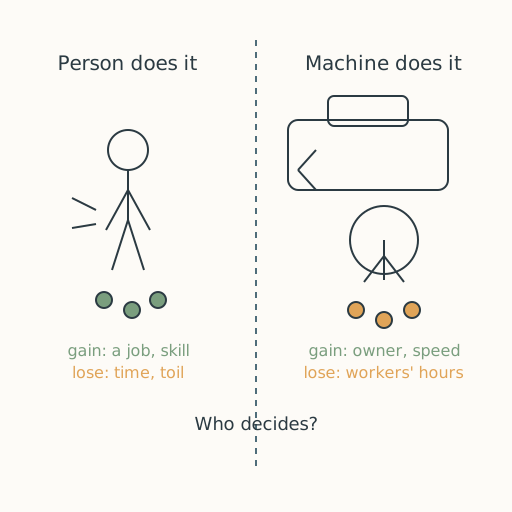
- Worked example (10 min). Watch one case done step by step — a self-checkout at a store: (a) who gains (the owner saves wages; some customers are quicker); (b) who loses (cashiers lose hours; some customers do unpaid work); (c) who decides (the owner, not the cashier); (d) the environment angle (machines use power and are made of materials).
- Guided practice (15 min). In a group, read two case cards — one where automation freed people from dangerous or exhausting work, one where it displaced them. Fill the gains/losses chart for each: who gains, who loses, who decides.
- Independent practice (10 min). In your journal, write: who should have a say when a machine takes over a job, and why? If you only described what changed without saying who should decide, mark “not yet.”
- Close (5 min). Share one gains/losses contrast. Notice the recurring pattern: the decision power sits with the few, while the consequences spread to the many.
Differentiation
- Support: Provide one pre-filled gains/losses chart and sentence starters (“The owner gains __; the worker loses __”).
- Extension: Compare automation in two sectors and argue whether the gains outweigh the losses — and for whom.
- Expression: Learners may record their reasoning by voice, by diagram, or have a partner read it — no step requires writing.
Assessment
- Formative (peer + self): Can the learner name who gains and who loses in a case, and say who holds the decision power?
- Portfolio artifact (unit): The gains/losses chart with one case, added to the “technology and power” section.
Home connection
With a family member, find one task at home or work that has been automated (a machine, an app, a self-service step). Ask who it helps and who it costs — and whether the people affected had a say.
Resources
- On automation, work, and uneven digital dividends across the world: World Bank, World Development Report 2016: Digital Dividends, https://www.worldbank.org/en/publication/wdr2016 (S-281).
- On a concrete automation technology — machine translation’s capabilities and limits for human work: Encyclopaedia Britannica, “Machine translation,” https://www.britannica.com/technology/machine-translation (S-350).